
Install
Inside DeepSeek Harness, with dsh-market
dsh plugin --profile web add dshmarket
Or from the command line
dsh plugin --profile web add dsh-trace-compare
Installing runs third-party code with your own permissions — it can read your files, use your credentials and reach the network. Review the source first, and pin a commit (github:owner/repo#sha) when you can.
README
中文 | English
Trace visualization for DeepSeek Harness: see how the agent actually explored — the main path it committed to, the detours that failed or dead-ended, and where it backtracked — on one shared timeline.
Two surfaces, one visual language:
- Trace Compare (sidebar entry): upload 1 session log for a single-run maze, or 2 logs for a same-axis comparison (e.g. flash vs pro on the same task) — answer nodes auto-align per turn, comparison anchors can be pinned by hand, and a per-turn inventory tallies the detour gap between the two runs.
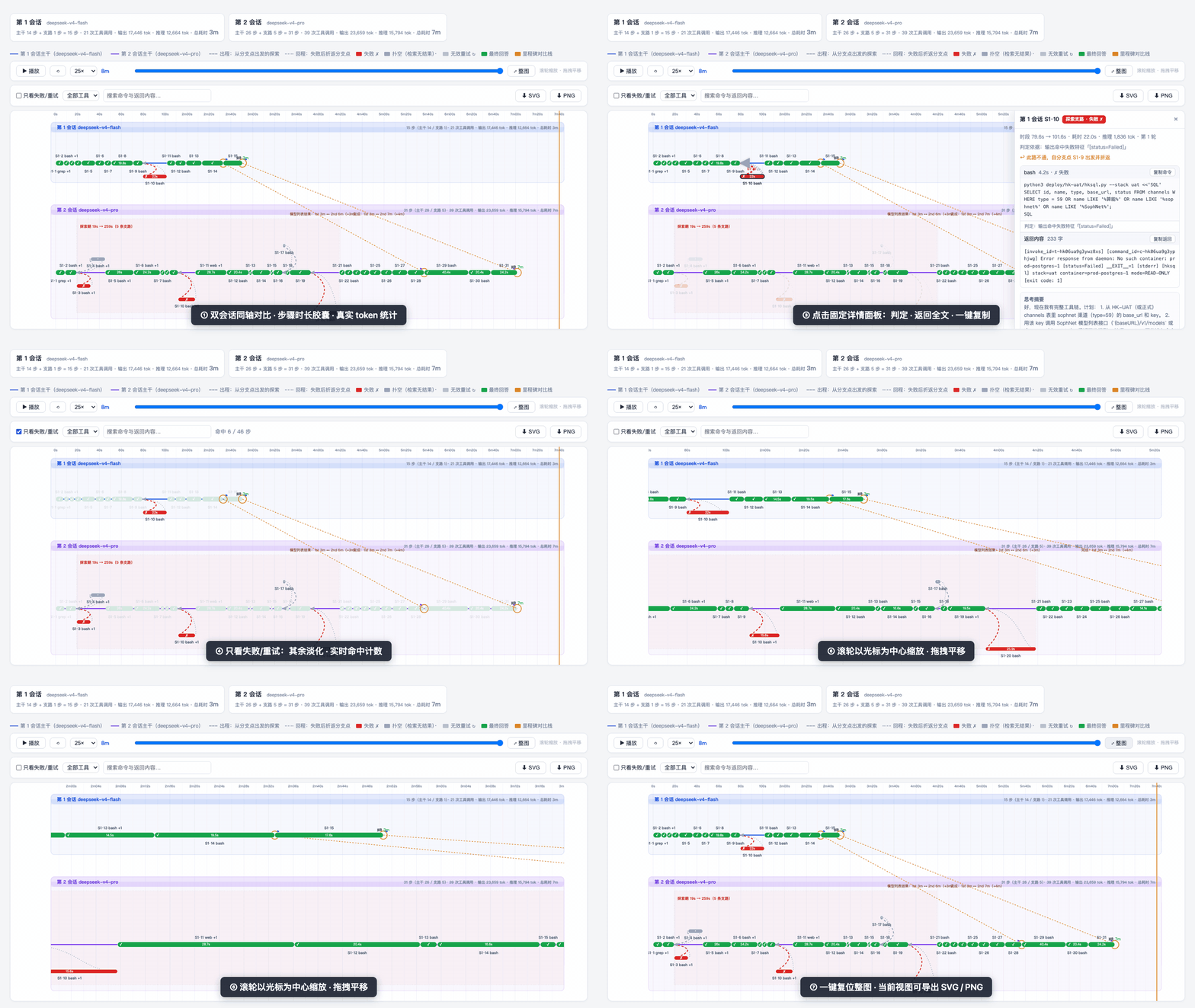
- Live Maze (per-session conversation tab): the same maze grows in real time while the session executes; detours appear as soon as a tool result settles a step's verdict.
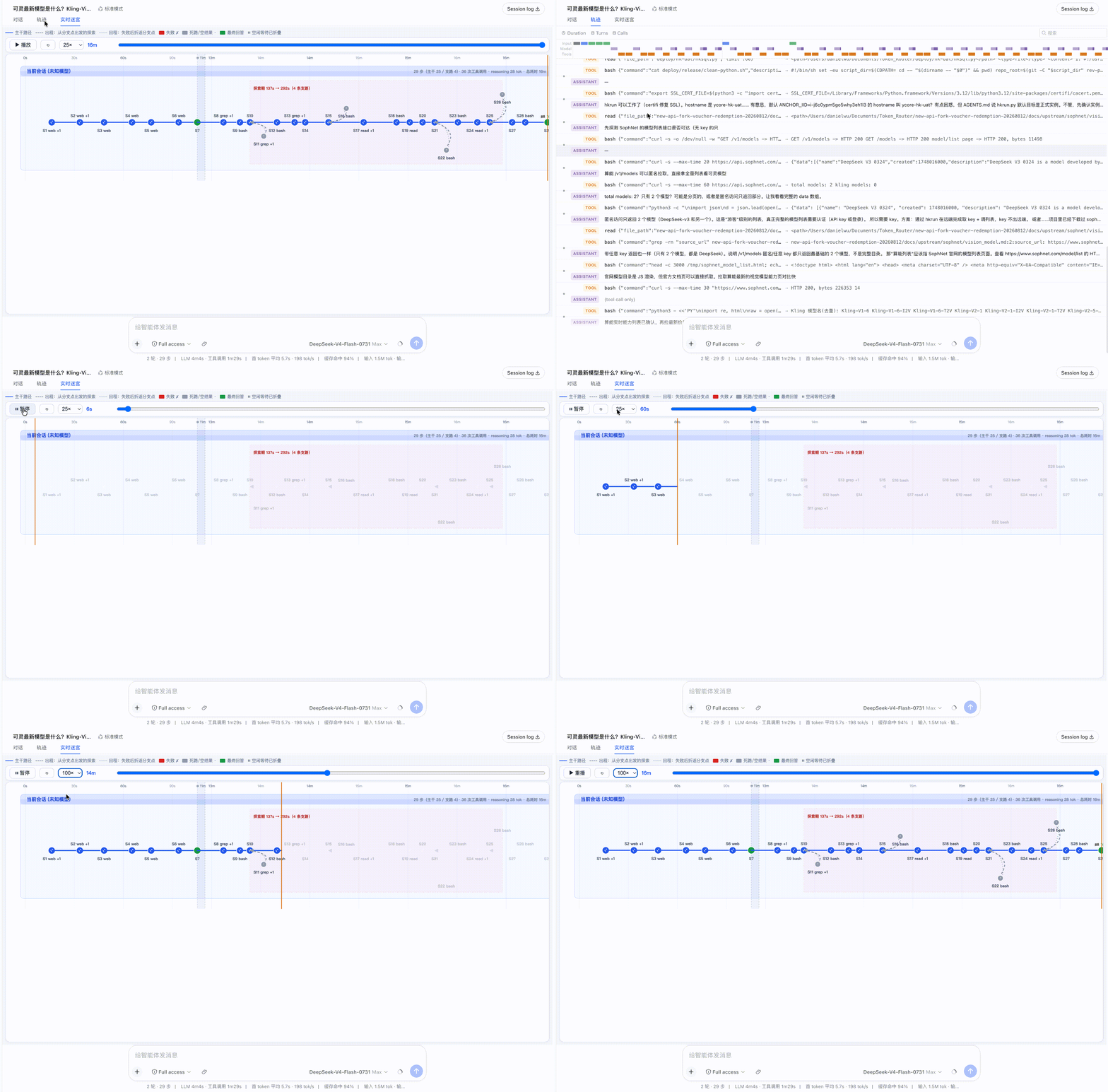
What the maze shows
- Solid line: the main path — steps whose tool calls succeeded, plus answer nodes.
- Duration capsules: every step renders as a rounded bar spanning its start→end, verdict-colored — a 3-minute bash and a 0.2 s read are no longer the same dot; wide bars carry the duration inline.
- Parallel tool-call rows (since v0.3.2): when a step fires ≥2 tool calls, each call renders as a thin waterfall bar under the capsule at its real start→end, colored by its own verdict — see at a glance which of the parallel calls dragged or failed; hover a bar for that call's command/result/rationale. Lane height adapts to the maximum concurrency; detour nodes keep their "+N" label (fixed lane slots; the panel lists everything).
- Dashed arcs: exploration detours — steps whose tools failed (red ✗), searched and found nothing (gray ·), or blind-retried (gray ↻), with the return arc back to the branch point.
- Subagent branches (since v0.4.0, live tab): dsh subagent child sessions spawned by the model render as aggregated detour nodes branching off the main path — anchored at the spawning step on the parent's clock, with the child's judged tool calls as sub-bars; running children grow live and read "still running". Hover cards and the detail panel carry the subagent identity and spawn/rejoin copy; clicking jumps back to the spawning row. Only real task subagents qualify (
origin: 'subagent') — manual branch-offs and side chats stay out. Requires the host's background history-open capability; absent on the official rc line the feature hides silently. - Hover any node or arc for a quick preview; click to pin a detail panel on the right — full command and result text (copy buttons; results keep their first 5000 chars), timings, verdict, reasoning summary. Close with Esc or ×.
- Zoom navigation: wheel zooms horizontally around the cursor, drag pans, double-click (or the fit button) resets; axis ticks re-densify with the zoom window down to 1 s.
- Jump to conversation (live tab only): the panel's locate button switches the host back to the Chat view and scroll-highlights the step's tool row. Rows older than the chat's loaded window degrade to the view switch alone.
- Search & filter: a toolbar with a failures/retries-only toggle, per-tool filtering, and full-text search over commands and results (including the 5000-char panel text); non-matching nodes and arcs fade to 15% opacity with a live hit count. Filter state survives live-mode rebuilds.
- Turn alignment lines (two-session compare, since v0.3.0): each turn's answer nodes are auto-connected with a comparison line labeled with both wall-clock arrival times, the delta, and that turn's detour counts (e.g. "Turn 3 answer: 1st 4m ↔ 2nd 6m (Δ2m) · detours 4↔0"). Only turns present in both runs get a line — the old corpus-specific "model list result" regex milestone is retired.
- Manual anchors (two-session compare): after "🔗 add anchor", click one node in each lane to pin a comparison line with its time delta; click the line to delete, Esc cancels picking. Useful for pinning semantically equivalent moments that sit in different turns.
- Detour inventory (two-session compare): "📋 detour inventory" opens a per-turn table — each side's detour step count, wall-clock time, verdict breakdown (✗ failure / ↻ blind retry / · dead end) and the verdict-time gap (e.g. "session 2 wasted 48.4s more"); clicking a row zooms to that turn and keeps only its detours visible. A turn present on one side only shows "—" — the absence itself is signal.
- Export: one click saves the current view (zoom window and filter dimming included) as SVG or 2x PNG with styles inlined; exports are always light-background regardless of the page's current theme (built for sharing).
- Bilingual UI (since v0.5.0): the whole page (upload area, legend, lane stats, alignment lines, detour inventory, hover cards, detail panel, errors) ships in Chinese and English, live-follows the dsh host's language setting when embedded, and falls back to the browser language when opened standalone; verdict rationales are structured keys rendered in the current language, so switching languages needs no re-upload.
- Theme following (since v0.3.1): the page tracks the host dsh light/dark theme (the host components watch
body[data-ds-dark-theme]and postMessage into the iframe); standalone opens follow the system preference. - Compact header (since v0.3.1): once data renders, the intro text hides, the upload zone collapses to a slim strip, the per-lane stat cards hide (the same info lives in the lane bands), and the legend fits one row — the maze gets nearly the whole viewport.
- Playback replays the whole run at up to 300×.
Timeline honesty rules:
- Idle folding: stretches with no step or tool activity for over 60 s (you thinking between turns) collapse into a thin
⏸seam labeled with the skipped duration. Axis ticks keep wall-clock labels inside activity segments. - Step identity is turn-qualified (
S15·47), so multi-turn sessions attach detours to the right nodes. - Durations, tool timings, and totals stay wall-clock; only the axis is compressed.
- The live tab renders only the conversation's loaded event window (honestly labeled since v0.2.3): stale steps from earlier turns leaking into the window edge are dropped and noted as "⏮ N earlier steps not loaded" instead of piling at 0 s and inflating stats; for the whole session, download the log and use the upload view.
- Tokens are real (since v0.2.2): reasoning/output tokens come from the session log's
assistant/messageusage(the old "reasoning N tok" counted streaming chunks, not tokens). Logs without usage fall back to an honest "N reasoning segments" label.
Verdict honesty rules (since v0.2.1):
- No output-length verdicts. Per-tool verdicts layer: error flag (isError) → failure signatures → per-tool-class rules (write tools succeed unless errored; search tools only dead-end on empty results; bash and unknown tools succeed with any output).
- Failure signatures scan only the head and tail windows (since v0.2.3): real errors either lead the output or sit in the appended stderr section, while error-looking text QUOTED mid-output (git log, file reads, log dumps) is deliberately ignored — a command that prints "upstream returns HTTP 400" inside a commit message did not itself fail. Both render paths judge the same untruncated text.
- Blind retries are behavioral: only consecutive same-tool, similar-args call clusters containing at least one failure are marked — following AgentLens-style deterministic waste detection for SWE-agent trajectories.
- Every verdict carries a rationale string, visible in the hover tooltip and the detail panel.
- All thresholds and tool classes live in
VERDICT_RULESinsrc/client/verdict.js, tunable per corpus; the upload page and the live tab share this single implementation (spliced in at build time).
Session log support
Upload accepts DSH session logs in any of these forms, detected by content (the file name does not matter — macOS duplicates like session.jsonl 2 work):
- plain
.jsonl(session format v0 event streams) .jsonl.zstdexactly as stored under~/.dsh/sessions/— decompressed in the browser (nativeDecompressionStream('zstd')when available, bundled fzstd otherwise)
Install
Compatibility: verified against official 0.1.0-rc.6 (build + full test suite) and rc.8 (slot/type audit + live acceptance); the peer range covers rc.6 through the current rc line, and every new rc release gets a follow-up check.
npm install --global @deepseek-ai/dsh@0.1.0-rc.8
dsh plugin --profile web add dsh-trace-compare
dsh web
Prefer a pinned artifact? Every release also ships a tgz: dsh plugin --profile web add https://github.com/lamost423/dsh-trace-compare/releases/download/v0.4.0/dsh-trace-compare-0.4.0.tgz
To install from a checkout instead:
git clone https://github.com/lamost423/dsh-trace-compare.git
cd dsh-trace-compare
corepack enable
pnpm install
pnpm build
dsh plugin --profile web add .
dsh web
After a restart of dsh web, the sidebar footer gains a Trace Compare entry and every session view gains a Live Maze tab.
Recent iterations
Current branch-verdict logic (introduced v0.2.1, refined v0.2.3)
Whether a step stays on the main path or becomes a branch is decided by its worst tool verdict: ok/answer stay on the trunk; failure (red x), empty-handed search (gray dot), and blind retry (gray loop) move the whole step to a branch. Each tool call is judged in four layers:
- Error flag: the result carries isError → failure;
- Strong failure signatures: wrapper hard markers like
[status=Failed], non-zero__EXIT__=,[stderr]followed by Error/Traceback → failure. Scanned only in the first 300 and last 1000 chars — real failures either lead the output or sit in the appended stderr section; errors QUOTED mid-output (git log messages, source strings) don't count; - Weak failure signatures: Traceback, command not found, Permission denied, No such file, HTTP 4xx/5xx, leading Error: → failure, first 300 chars only;
- Per-tool-class rules: write tools (write / edit / todo_write) succeed unless errored, regardless of output length; search tools (grep / read / web_search) only dead-end when the head matches a no-result signature; bash and unknown tools only dead-end on empty output.
On top sits a behavioral layer: consecutive same-tool calls with args similarity >= 0.6 forming a cluster that contains at least one failure mark their non-failing members as blind retries (AgentLens-style deterministic waste detection; without the failure constraint, ordinary consecutive edits to one file would be misflagged). Deliberately no output-length rules and no LLM calls; every verdict carries a rationale string visible in tooltips and the detail panel. All thresholds live in VERDICT_RULES in src/client/verdict.js, tunable per corpus; the upload page and the live tab share this single implementation. Calibrated on four real sessions (871 steps total) — evidence and false-positive cases in the version notes below.
v0.5.0 - Bilingual UI following the host language (2026-08-20)
Page copy used to be hardcoded Chinese. The whole UI now runs on zh/en dictionaries: when embedded, the host component posts dsh's language setting into the iframe and the page follows it live (same channel pattern as theme following); opened standalone, it falls back to the browser language. Verdict rationales changed from baked strings to language-neutral structured keys {k, p} (verdict.js emits keys only; the page renders them centrally), so a language switch takes effect instantly without re-parsing loaded sessions. The repo README also swapped to Chinese-default with English in README.en.md. Release
v0.4.0 - Subagent execution folds into the live maze (2026-08-20)
Tasks the model spawns through the subagent tool used to be one opaque bar; now every dsh subagent child session folds into the parent's live maze as an aggregated detour node — anchored at the spawning main-path step on the shared clock, with the child's judged tool calls (args/results/verdicts) as sub-bars, live growth while running, and a click-through back to the spawning row. Admission is disciplined: only origin: 'subagent', non-ephemeral children (manual "branch in new conversation" and side chats stay out), and settled children whose whole activity predates the visible window are dropped under the parent's pre-window rule. Subagent identity runs through node labels, hover cards, and the detail panel ("⤴ spawned from main step SN; results rejoin the main path"), replacing the dead-end copy that belongs to failed exploration; internal step ids are no longer user-visible. Requires the host's SessionFace.open background history capability — absent through official rc.6–rc.8 the feature degrades silently, everything else unaffected. Release

v0.3.3 - Fix: live maze went blank at the start of every new step (2026-08-19)
Whenever a new step began in the live tab (model reasoning, no tool call issued yet), the whole maze turned transparent until the first tool call appeared. Root cause was a tier-1-era bug: the node label code read tools[0].name unguarded, and an in-flight step has an empty tools array during its reasoning phase — the TypeError aborted build() mid-way, leaving every element at its initial opacity 0. Zero-tool nodes now skip the tool label; verified with a synthetic push sequence (reasoning phase → tool appears → settled) staying visible throughout. Release
v0.3.2 - Parallel tool-call rows (2026-08-19)
Multiple tool calls in one step used to collapse into a "bash +1" label, hiding each call's timing and verdict. Now every call renders as a thin waterfall bar under the step capsule at its real start→end, verdict-colored, with a per-call hover (command / result / rationale); lane height adapts to the lane's maximum concurrency (parH zone in computeLayout) and detour arcs shift below it. Real-corpus scale: the 16-turn session has 36 parallel steps, max concurrency 5. Release

v0.3.1 - Theme following + compact header (2026-08-19)
The palette collapses into CSS variables as the single source (SVG attribute colors read via readPalette), tracking the host dsh theme: host components watch body[data-ds-dark-theme] (rc.6's ThemePresenter mechanism) and postMessage into the sandboxed iframe; standalone opens fall back to the system preference. Exports stay light-background — under dark the page briefly rebuilds in light, serializes, and switches back. The same release compacts the header once data renders (intro hidden, upload zone down to a 31px strip, stat cards hidden, one-row legend), freeing ~250px for the maze, and bumps the blind-retry gray from #b6c0d2 to #8892a6 for legibility. Release

v0.3.0 - Compare semantics: turn alignment + manual anchors + detour inventory (2026-08-19)
Two-session comparison graduates from a single regex milestone to per-turn semantics: answer nodes auto-connect per turn (labeled with the time delta and detour counts); manual anchors pin any two nodes; the detour inventory tallies per-turn detour steps, wall-clock time, and verdict breakdown for both sides, with row-click zoom and highlighting. The corpus-specific "model list result" regex milestone (MODEL_LIKE/mlist) is retired — the last hardcoded heuristic left after verdict v2 removed the length thresholds. The "exploration phase" red band is retired too: it spanned min-to-max across all detours, covering 99% of a 16-turn session's axis while actual detour time was 1% — a false signal. Release

v0.2.3 - Honest live window + quote-proof verdicts (2026-08-19)
The live tab renders only the conversation's loaded event window — stale steps from earlier turns leaking past the window edge used to clamp to 0 s and pile up on the left, rendering an 18-hour, 533-step session as "3 turns / 39 steps / 71.4 s". They are now dropped and labeled "N earlier steps not loaded". Also fixed quoted-error false positives: "upstream returns HTTP 400" inside a git commit message no longer flags the command itself — failure signatures scan only the head and tail windows, and both render paths judge the same untruncated text. Release

v0.2.2 - Real tokens, search & filter, export (2026-08-19)
"reasoning N tok" used to count streaming chunks — now real usage is read from the session log's assistant/message events, per step and per lane (honest "N segments" fallback without usage). Added the filter toolbar (failures/retries-only, per-tool, full-text search with 15% dimming of misses) and current-view SVG / 2x PNG export. Release

v0.2.1 - Explainable verdicts: no more length thresholds (2026-08-19)
"Result < 60 chars = dead end" retired in favor of the layered verdicts + behavioral retry detection described above. Motivation: calibration showed the length threshold misjudged 56 of 338 tool calls (every 57-char todo_write confirmation included) while missing real failures buried in long outputs. Verdict logic also converged into the single source src/client/verdict.js (spliced into the upload page at build time, imported by the live path), ending mirror drift for good. Release
Development
pnpm install
pnpm check   # typecheck + vitest + build
The upload/visualization page is a self-contained HTML document (src/client/maze-upload.html) rendered inside a sandboxed <iframe srcDoc>; parsing and rendering run entirely in the browser, and nothing from an uploaded log reaches the host.
License
MIT. See NOTICE — this project contains code derived from DeepSeek Harness.