 Browse 4377 plugins
GitHub
npm
中文
Browse 4377 plugins
GitHub
npm
中文
The plugin market
inside DeepSeek Harness
Browse and search 4377 community plugins, install with one click — most go live without even a restart. Updates, uninstall, live install progress. No telemetry, ever.
dsh plugin --profile web add dshmarketdsh web → Settings → Plugin Market. That's the whole setup.Most installed
Ranked by npm downloads over the last week.
- omdsh-dev/DSH-better-sidebar
Full sidebar workbench with file rendering and editing, terminal, Git, and subagents; third-party plugins can register new tabs.
- ranxianglei/billion-context
The official billion-context plugin: a context-compression plugin for small context windows (a 100K context is enough), token savings (5x fewer tokens), and month-long single sessions (billions of tokens).
- MichengAI/dsh-codex-ui
Rebuilds the DeepSeek Harness web sidebar, workspace tree, search, and turn navigation in a Codex-style layout.
- zhu1090093659/dsh-web#packages/dsh-skill-explorer
Skill center for the dsh web GUI: browse all loaded skills grouped by source, enable or disable model invocation, create new skills, and delete into a recoverable trash.
- zhu1090093659/dsh-web#packages/dsh-remote-web-ui
Remote control of a dsh web workspace from phone or PC: QR-code pairing through a token-gated channel, SSE real-time sync, and separate mobile and full desktop GUI modes.
- MichengAI/dsh-archive-manager
Adds an archived-sessions page in Settings to search, restore, and delete archived DeepSeek Harness sessions by workspace.
- zhu1090093659/dsh-web#packages/dsh-task-board
Task board for the dsh web GUI: a sidebar multi-column kanban whose cards run in real DSH agent sessions and can also be scheduled with cron expressions, executed host-side even with the browser closed.
- zhu1090093659/dsh-web#packages/dsh-git-graph
Git branch selector and Git graph for the dsh web GUI: switch branches and explore branch-lane and commit history from the conversation header.
- zhu1090093659/dsh-pet
A whale-girl companion for the dsh web GUI: animations follow the agent state, with pat interactions and a feeding mechanic that raises intimacy from a calf to deep-sea bonds.
- MichengAI/dsh-agency-agents
Adds a summonable domain-expert roster that runs as subagents while the parent session keeps the task and final answer.
- MichengAI/dsh-skills-manager
Manages local DeepSeek Harness skills in Settings and shows shared Agent skills as read-only.
- zhu1090093659/dsh-web#packages/dsh-ssh
SSH ops panel for DSH: web terminal, SFTP transfer with progress, local port forwarding, and one-command cluster execution across hosts; agents share the same host config.
- MichengAI/dsh-im-connect
Connects WeChat, WeCom, DingTalk, Feishu, Lark, QQ, and Telegram to a local DeepSeek Harness agent, with each IM chat as a separate workspace channel.
- zhu1090093659/dsh-web#packages/dsh-web-all
Plugin and skin collection for the DSH Web UI: task board, Git graph, right-side panel, remote mobile UI, pet, live token stats, and a skin center.
- MichengAI/dsh-automation
Runs scheduled coding tasks in isolated DeepSeek Harness sessions, managed from Settings or the agent.
- bowenliang123/dsh-context
DSH context insight panel: Context dashboard + /context command + Context browser — one-stop context lifecycle management with categorized composition, content details, evolution trends, compaction/injection events, and stats.
- liustack/modlens
Vision bridge for text-only models: paste an image, get structured JSON evidence (OCR, layout, semantics).
- MichengAI/dsh-btw
Adds /btw for one-off, context-aware side questions without tool execution, with independent answer bubbles that can be copied, collapsed, or closed without adding answers to the main conversation.
- Han-1413141/dsh-cost-meter
Per-session and daily API cost, budget with usage %, official balance, history dashboard, and one-click official price sync with peak/off-peak pricing.
- MichengAI/dsh-simplify
Adds a /simplify command that asks the agent to simplify code within a selected Git change scope, including staged changes, commits, and untracked files.
- MichengAI/dsh-codex-pet
An in-page pet for DSH Web with multi-session task notifications and controls to open tasks, stop turns, and respond to supported approval and question requests.
- dream-num/dsh-univer-office
Give DeepSeek Harness a real office environment. Univer Office Plugin brings spreadsheets, docs, slides, canvases, relational tables, and more into one runtime — with connected data, validation, versioned changes, and isolated worktrees for multi-agent collaboration.
- MeteorNOX/DeepSeek-Balance-Whale-Widget
A fixed-corner whale widget for the DSH web GUI — balance, today's usage and per-turn cost with peak/off-peak pricing, editable balance-alert and daily-budget bubbles, a module-based custom bubble queue with A/B weighted choices and random lines or images, 30+ vendor templates (OpenAI, OpenRouter, Kimi, SiliconFlow, Ark, Zhipu, MiniMax and more) with per-model balance and subscription quota, plus task-end sound, imported audio, custom roles and a resource manager. Local-only, no telemetry.
- MichengAI/dsh-code-review
Adds /review, /review-status, and /review-cancel to spawn an independent native subagent that inspects a chosen Git scope (base branch, uncommitted changes, a commit, or custom instructions) and returns a findings report in the current conversation, with English or Chinese output from the host locale.
- NanmiCoder/dsh-agent-teams
AgentTeams multi-agent teams.
- xmanrui/dsh-im
Connect IM bots to DeepSeek Harness via QR codes or bot credentials (9 channels: Feishu, WeChat, DingTalk, WeCom, QQ, Slack, Telegram, Discord, and WhatsApp).
- vectorize-io/hindsight#coding-agents
Hindsight, agent memory that learns: long-term project memory with auto recall and retain, knowledge pages, deep reflection, and per-repo memory banks.
- liustack/modsearch
Web search bridge for text-only agents: ask the web or X, get structured JSON evidence (search, fetch, citations).
- omdsh-dev/dsh-mnemon
Cross-agent, local-first persistent memory plugin for DeepSeek Harness (DSH), powered by Mnemon. It shares long-term memory across Mnemon-enabled agents and adds runtime memory, searchable project documents, semantic recall, knowledge graph, and a Sidebar UI.
- ysr666/dsh-vision-router
Free vision for text-only agents: built-in keyless vision chain plus pixel tools (Q&A, grounding, crop, pixel diff, colors, OCR, SVG trace, cutout, screenshots); paste an image to use it.
- ccch1mneyyy/dsh-TUI
Claude Code-style full-screen terminal UI: pixel-whale header, live status line, and streaming thought expansion.
- jkStars/dsh-token-usage-stats
DeepSeek-styled cross-session token usage, request count, and tiered cost analytics dashboard.
- baosfeng/my-dsh-plugins#dsh-my-guardian
Plugin governance: new/updated plugins stage in a candidate area first, then hot-mount after startup — success promotes, failure auto-disables, repeated failures freeze, one-click safe mode, sidebar diagnostics panel (npm: `dsh-my-guardian`).
- volcengine/OpenViking#examples/dsh-memory-plugin
OpenViking memory and context bundle for DeepSeek Harness: pre-step auto-recall and profile injection, session capture, `viking://` URI guarding, and recall/write memory tools backed by an OpenViking server.
- Roarpeng/GraphFlow
Local-first code knowledge graph for coding agents: 10 MCP tools for layered context compression, DAG planning, incremental AST indexing, a cross-session skill flywheel, diagnostics, and graph artifact import/export.
- omdsh-dev/dsh-genui
Interactive UI components rendered inline in replies: layout, charts, forms, quizzes, mermaid, 3D scenes, and an action event loop back to the model.
- RevolutionLA/dsh-dream-skin
One-command skin plugin: 8 original themes, translucent wallpaper with opacity/blur, per-user accent, and shareable theme-pack import/export, favorites and surprise-me — purely native on DSH's token system.
- awesome-dsh-plugin/dsh-find-plugin
Find plugins without leaving the agent: search this curated registry by keyword or category, with ready-to-run install commands.
- DDDMUC/dsh-free-search
Free, keyless web search for DSH: 7 engines (DuckDuckGo/Bing/SearXNG free + Exa/Perplexity/DeepSeek paid), auto-failover, settings-page UI with API key inputs and official links, web_fetch, and an engine test tool.
- PC2005-cloud/dsh-pet#dsh-pet
Desktop pet for the DSH Web UI with 25 transparent animations, screen wandering, click reactions and drag, plus a reproducible asset-generation pipeline.
- meyaomiao/dsh-server-deck
Server card dashboard for DSH: per-host status, CPU, memory, disk and latency, with one-click xterm.js SSH terminals; imports ~/.ssh/config and mounts as a better-sidebar tab or a standalone right drawer.
- shaobeichen/dsh-pocket
Remote phone access to the DSH Web UI: scan a QR code for LAN or public (cloudflared tunnel) access with real-time sync, a mobile-adaptive layout, and a settings tab.
- elysia395/dsh-wallpaper-engine
Requires DeepSeek Harness 0.1.5-rc.1+ (DSH Desktop >= 2.0.7) and dsh-better-sidebar >= 0.19.0 - update both before installing or updating this plugin. Plays local Wallpaper Engine Video/Web wallpapers behind the chat, renders Scene wallpapers as extracted static frames, and adds content-rating/type filters, custom uploads and an iOS-style liquid-glass settings window.
- kenz1117/dsh-ui-usage-billing
Sidebar billing dashboard: real usage aggregated from session logs (per-model and per-day calls/tokens/cache), cost estimated in CNY from a current multi-provider pricing catalog, subscription-plan (coding/token/agent) routes exempt, and per-provider health dots.
- SiriLee/dsh-rewind
In-place conversation rewind in the same session window without forking (Claude Code /rewind semantics): a per-message ↶ button cuts the model context back to any user message, with an optional Claude-Code-style file restore from disk-persisted before-backups.
- FuRongJun-1999/dsh-memory
White-box AGI architecture exploration: metacognition (self-cognition loop), continual learning (knowledge flywheel), world model (condition space, spatiotemporal memory graph), self-improvement (bootstrap discipline), zero-LLM white-box pipeline, and auditable trust guardrails.
- Nwflower/dsh-chat-import
Import full-fidelity chat histories from 13 coding agents (Claude Code, Codex, ChatGPT, Cursor, Gemini, opencode, and more) as resumable DeepSeek Harness sessions, with reverse export back to Claude Code.
- duhu2000/dsh-mcp-connector
MCP Connector for DeepSeek Harness: an MCP manager with one panel to connect servers, configure authorization, search tools across connections, and troubleshoot failures. Browse a continuously updated catalog of over one hundred connectors; filter by connection/server/status, inspect readable parameters and the last successful cache time, and rediscover tools. Supports OAuth 2.0 PKCE, API keys, stdio/HTTP, and mcpServers JSON import. Maintained by Qichacha/QCC.
See them running
Plugins that ship screenshots, most installed first.
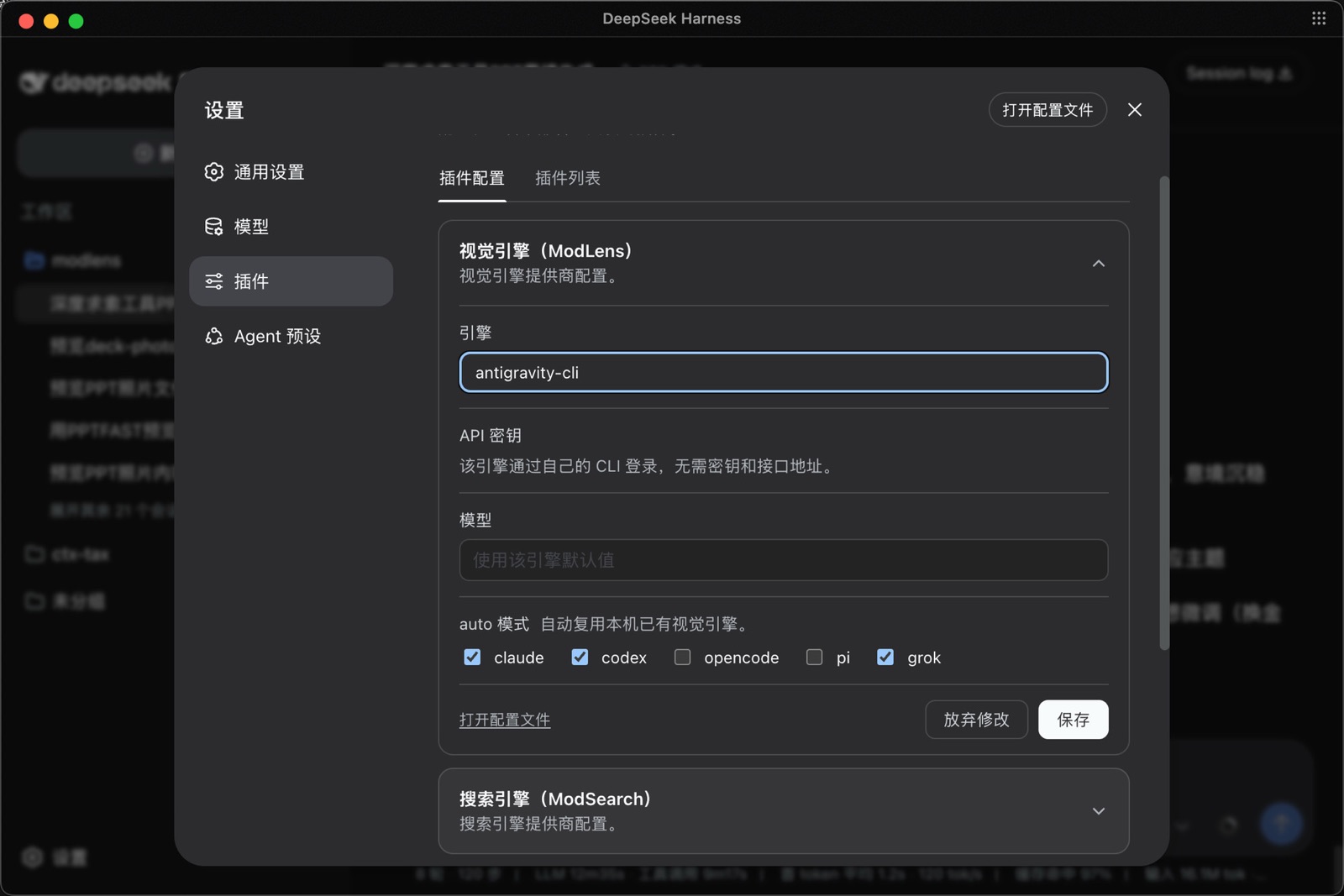 liustack/modlens
Vision bridge for text-only models: paste an image, get structured JSON evidence (OCR, layout, semantics).
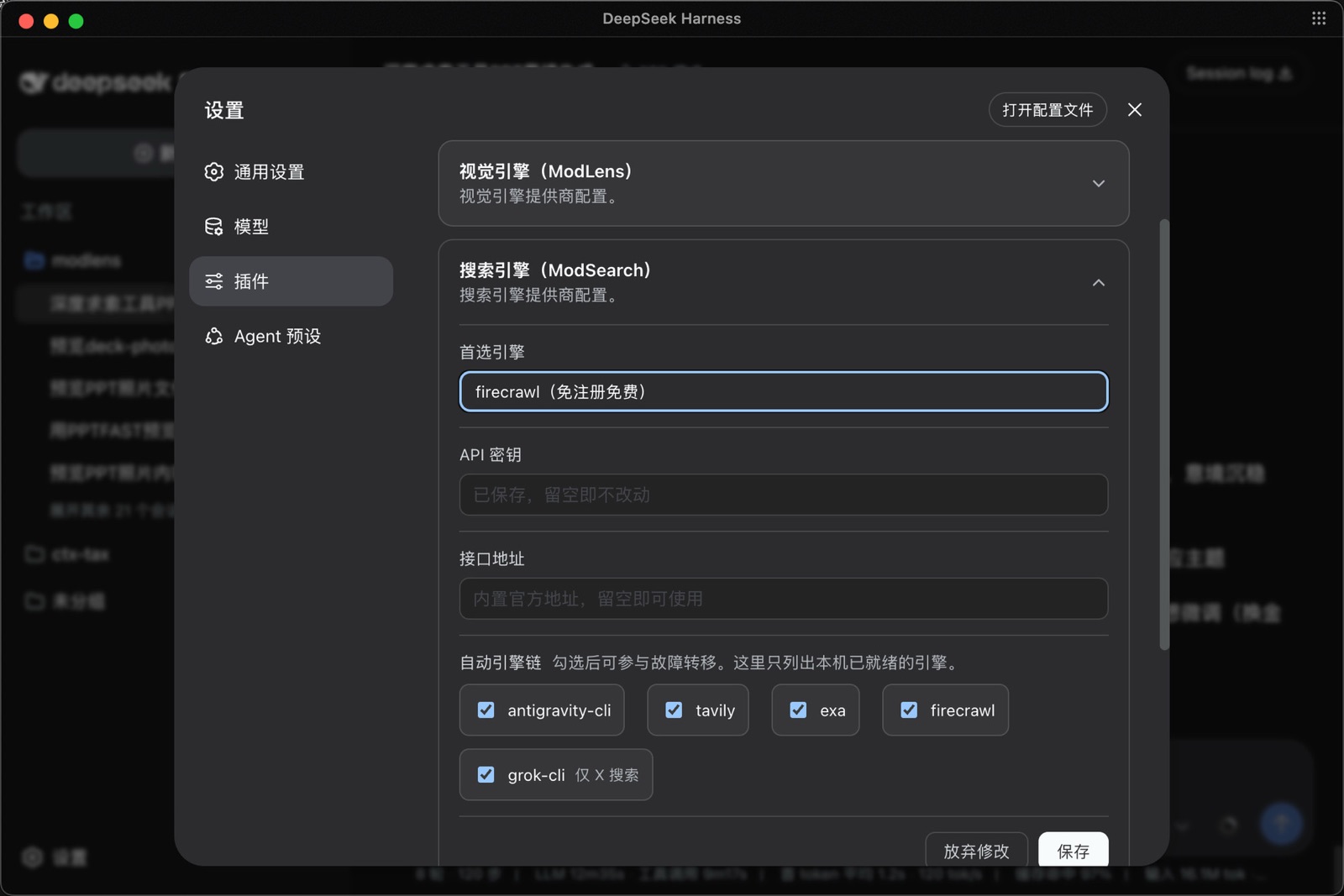 liustack/modsearch
Web search bridge for text-only agents: ask the web or X, get structured JSON evidence (search, fetch, citations).
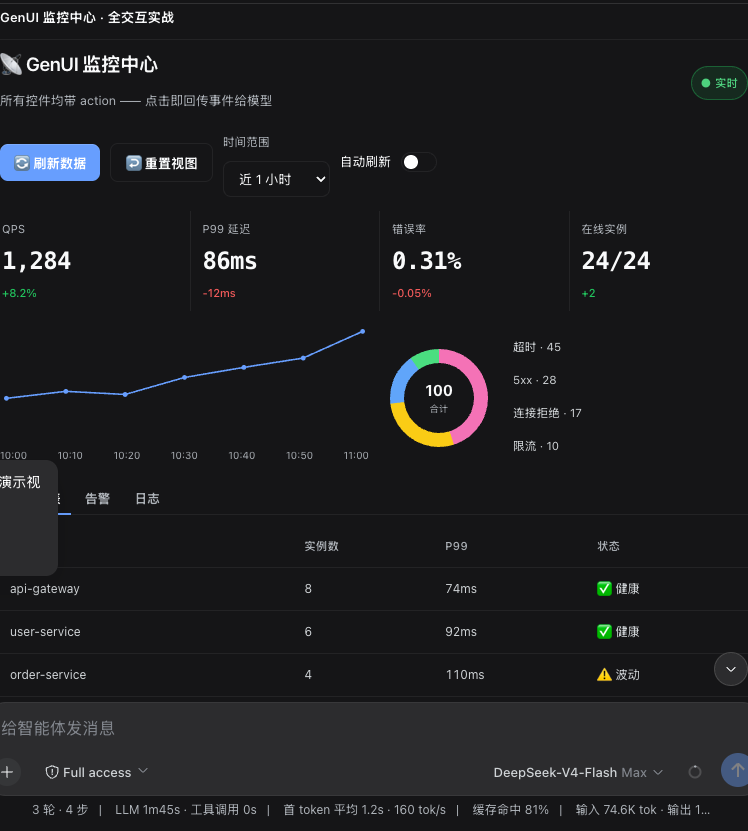 omdsh-dev/dsh-genui
Interactive UI components rendered inline in replies: layout, charts, forms, quizzes, mermaid, 3D scenes, and an action event loop back to the model.
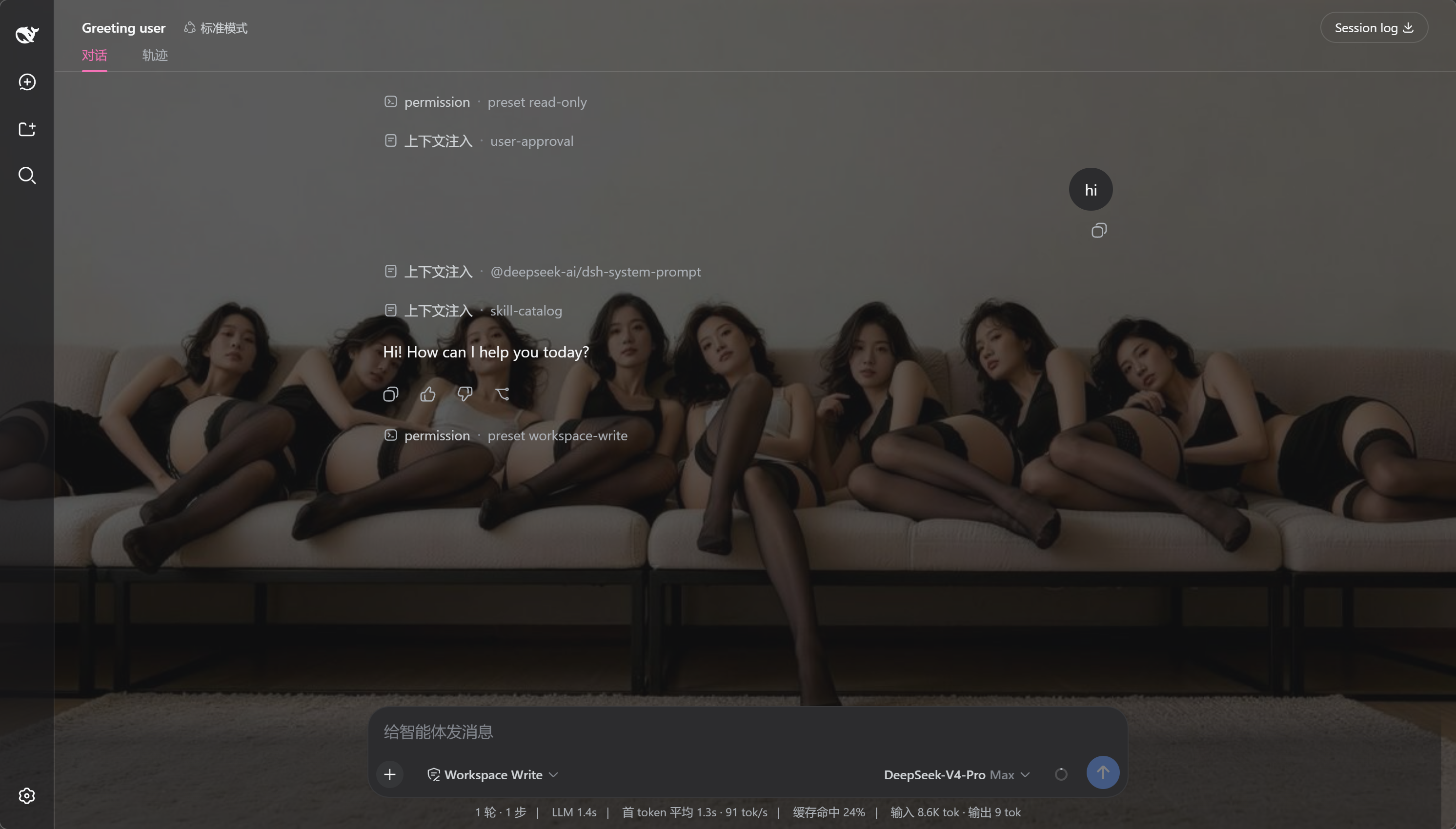 RevolutionLA/dsh-dream-skin
One-command skin plugin: 8 original themes, translucent wallpaper with opacity/blur, per-user accent, and shareable theme-pack import/export, favorites and surprise-me — purely native on DSH's token system.
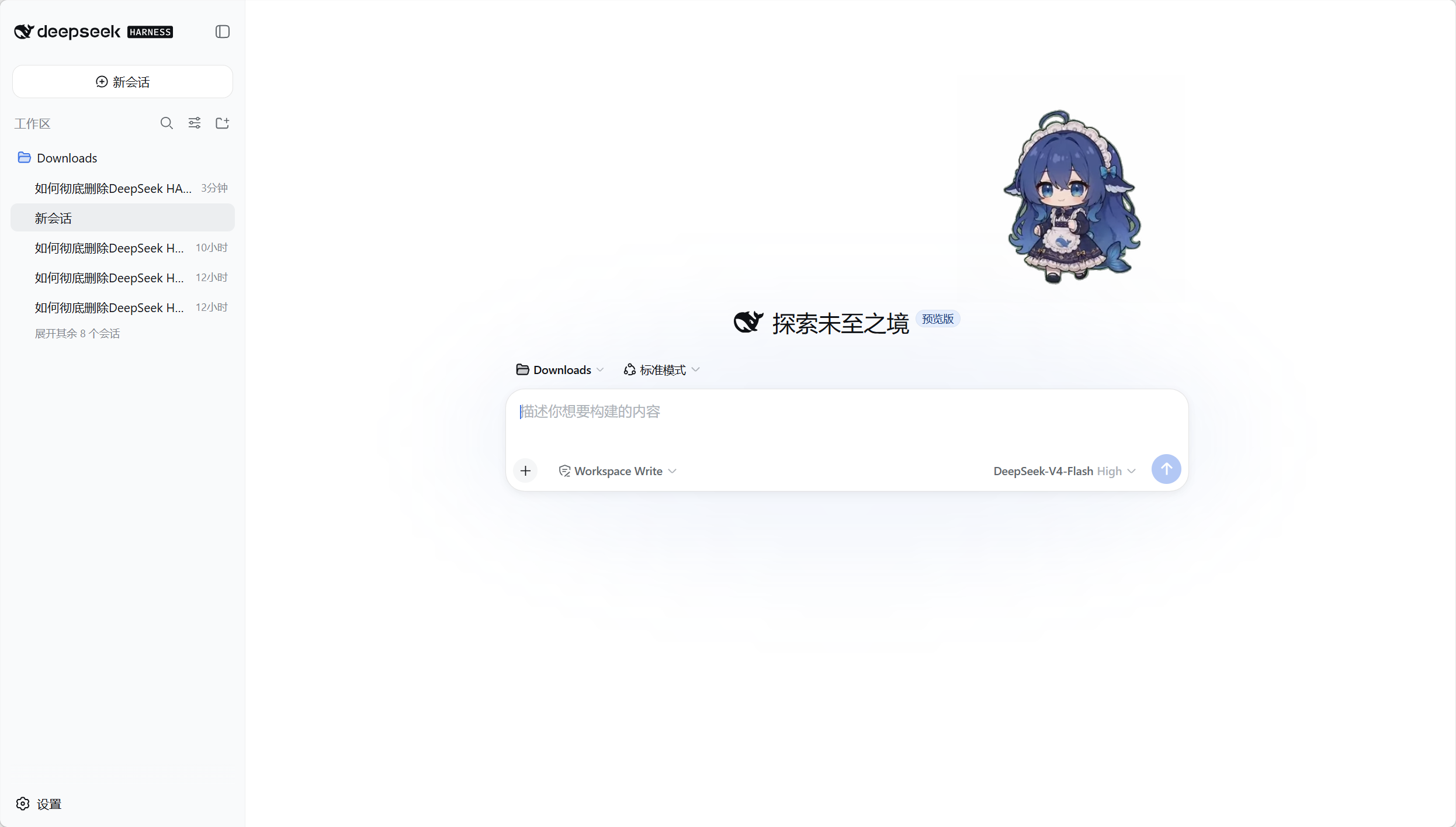 PC2005-cloud/dsh-pet#dsh-pet
Desktop pet for the DSH Web UI with 25 transparent animations, screen wandering, click reactions and drag, plus a reproducible asset-generation pipeline.
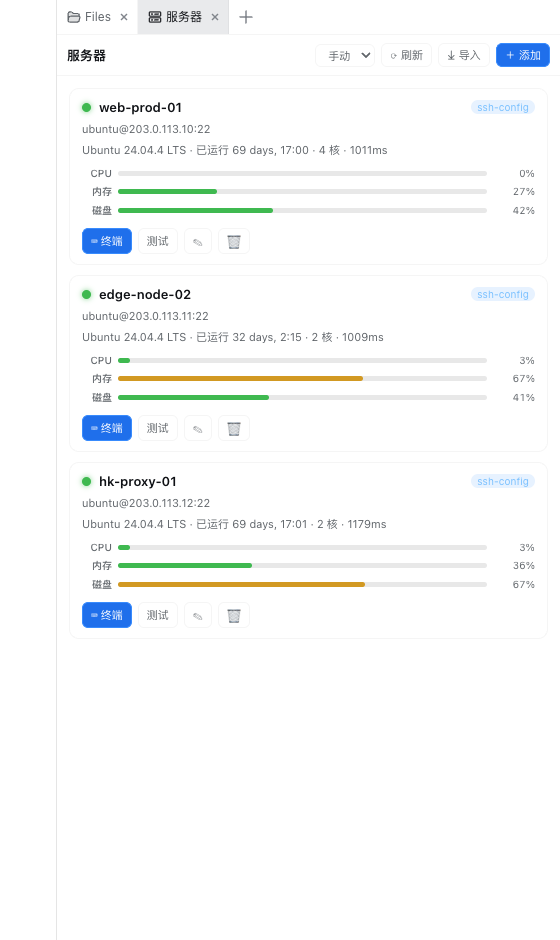 meyaomiao/dsh-server-deck
Server card dashboard for DSH: per-host status, CPU, memory, disk and latency, with one-click xterm.js SSH terminals; imports ~/.ssh/config and mounts as a better-sidebar tab or a standalone right drawer.
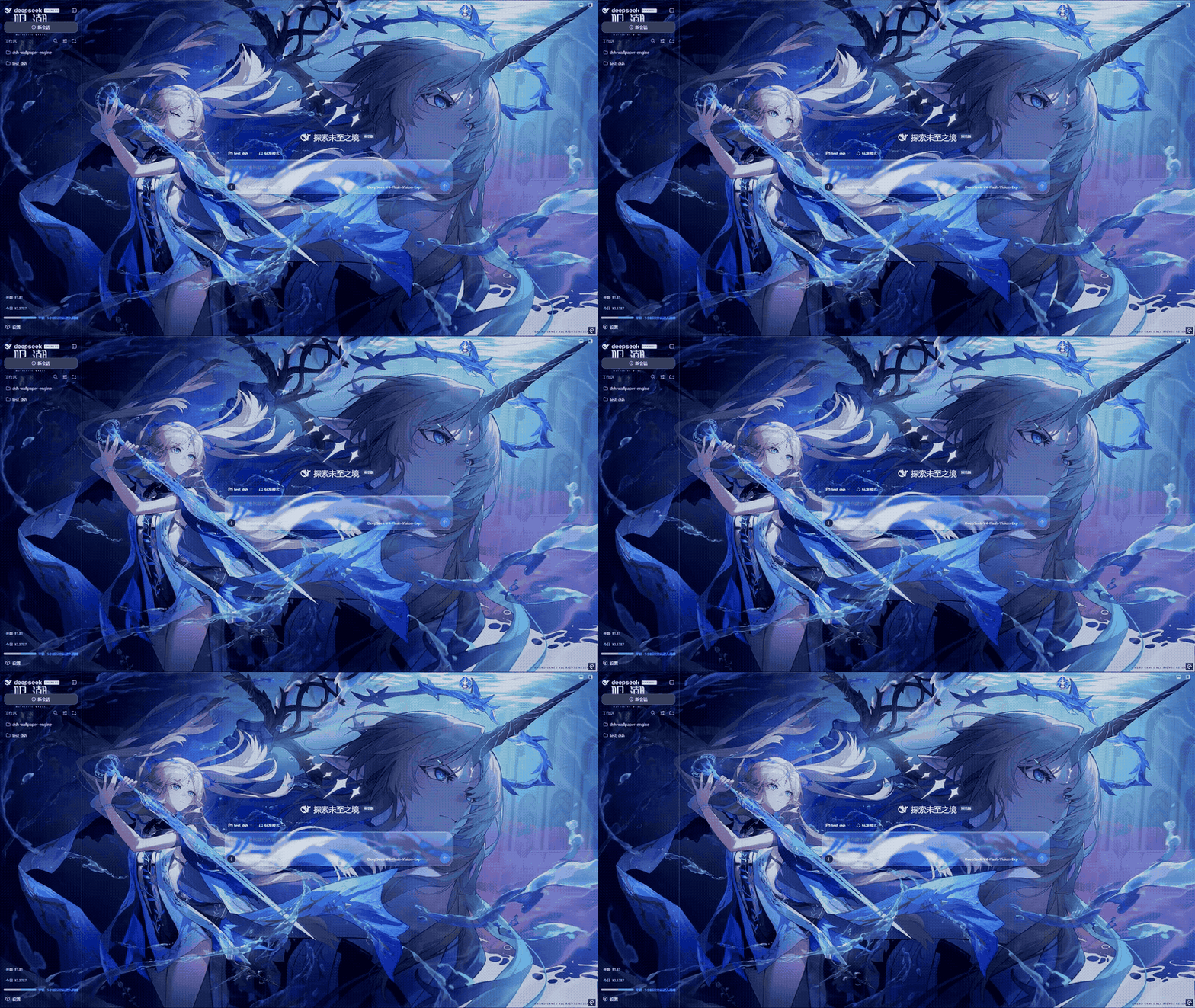 elysia395/dsh-wallpaper-engine
Requires DeepSeek Harness 0.1.5-rc.1+ (DSH Desktop >= 2.0.7) and dsh-better-sidebar >= 0.19.0 - update both before installing or updating this plugin. Plays local Wallpaper Engine Video/Web wallpapers behind the chat, renders Scene wallpapers as extracted static frames, and adds content-rating/type filters, custom uploads and an iOS-style liquid-glass settings window.
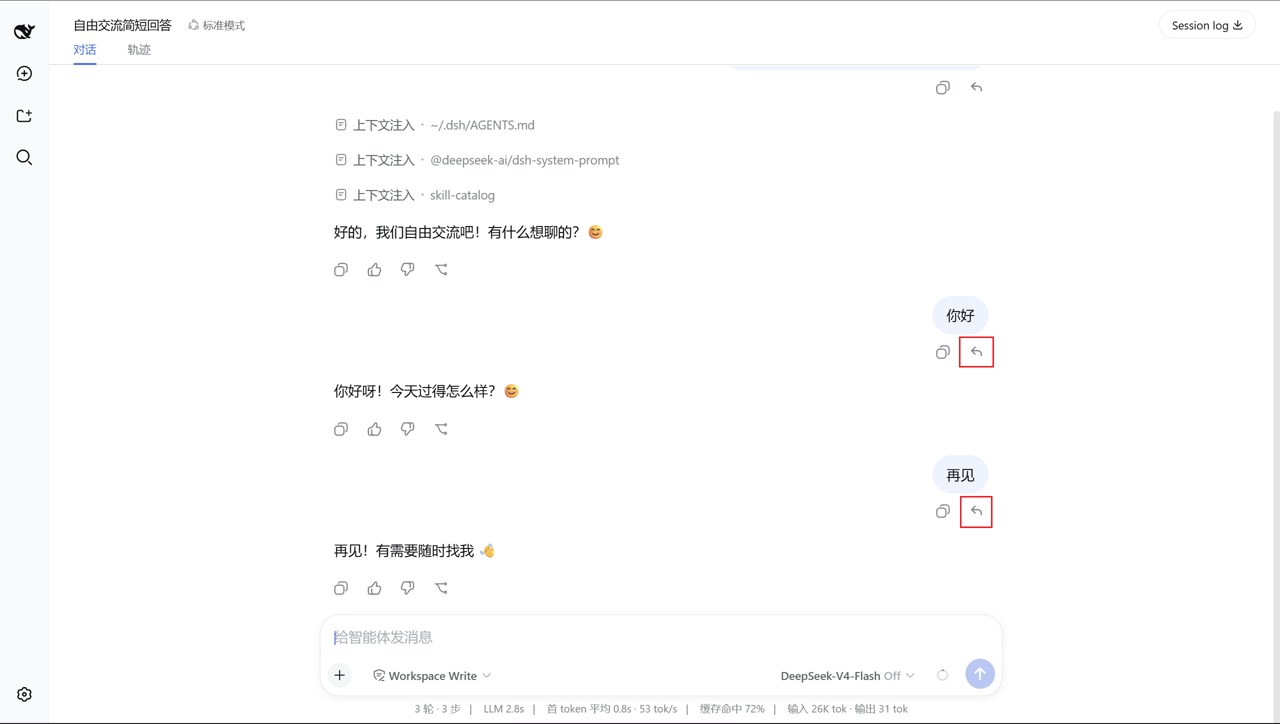 SiriLee/dsh-rewind
In-place conversation rewind in the same session window without forking (Claude Code /rewind semantics): a per-message ↶ button cuts the model context back to any user message, with an optional Claude-Code-style file restore from disk-persisted before-backups.
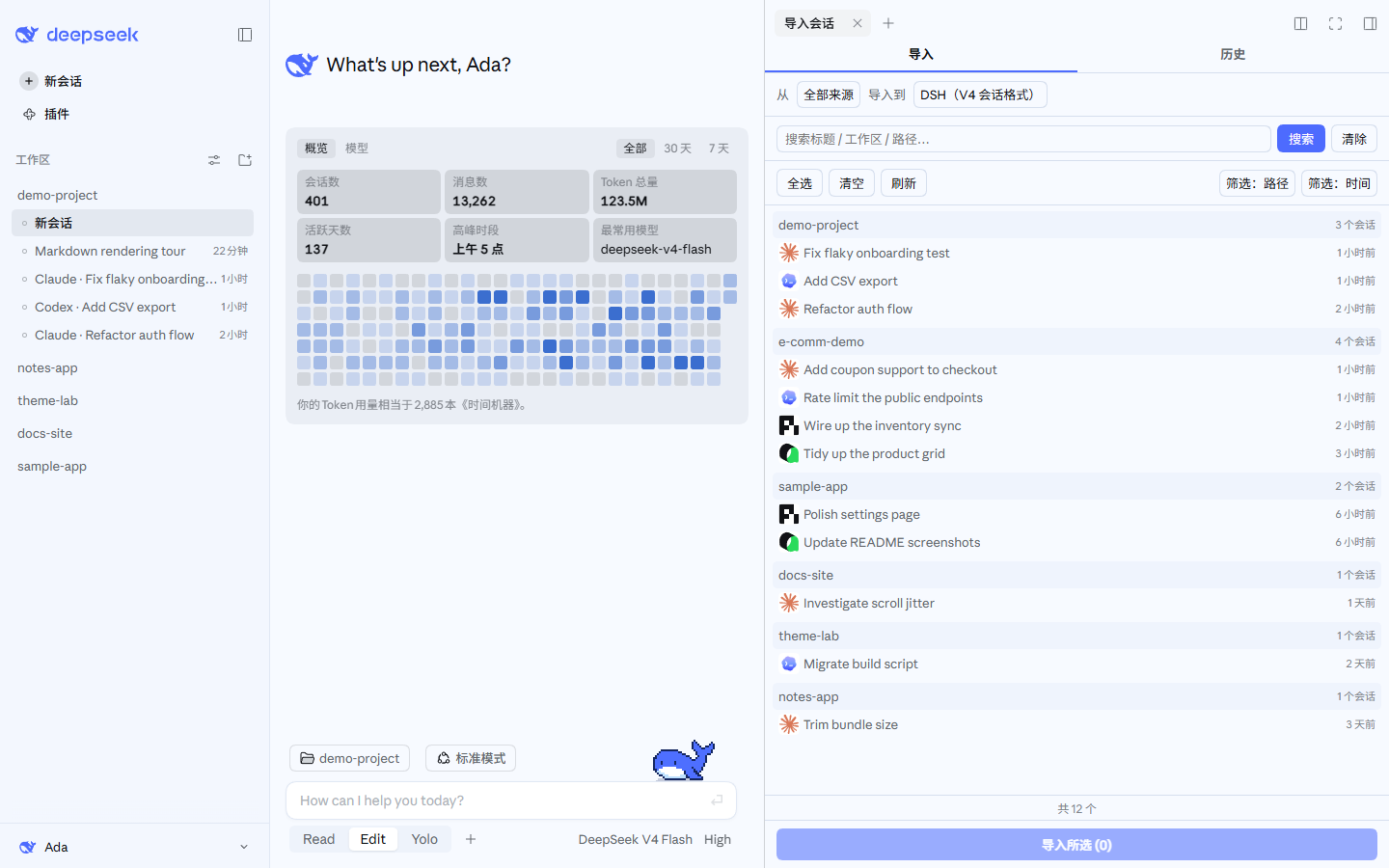 Nwflower/dsh-chat-import
Import full-fidelity chat histories from 13 coding agents (Claude Code, Codex, ChatGPT, Cursor, Gemini, opencode, and more) as resumable DeepSeek Harness sessions, with reverse export back to Claude Code.
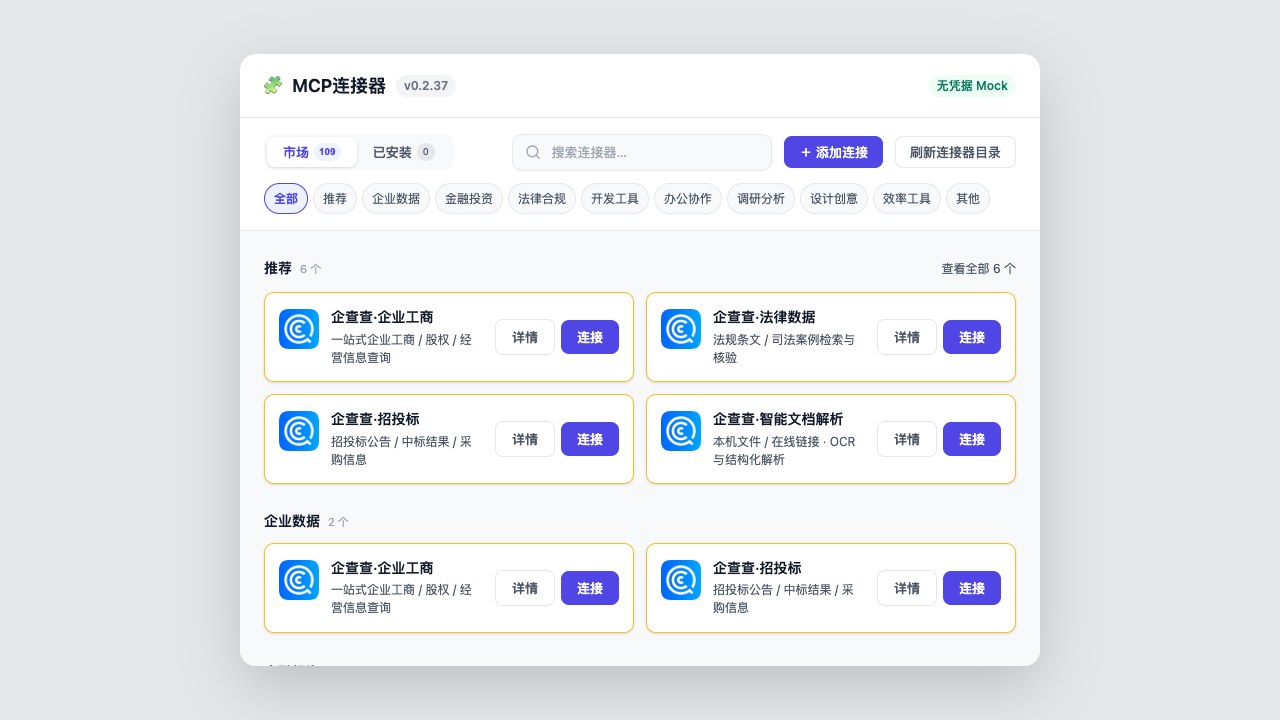 duhu2000/dsh-mcp-connector
MCP Connector for DeepSeek Harness: an MCP manager with one panel to connect servers, configure authorization, search tools across connections, and troubleshoot failures. Browse a continuously updated catalog of over one hundred connectors; filter by connection/server/status, inspect readable parameters and the last successful cache time, and rediscover tools. Supports OAuth 2.0 PKCE, API keys, stdio/HTTP, and mcpServers JSON import. Maintained by Qichacha/QCC.
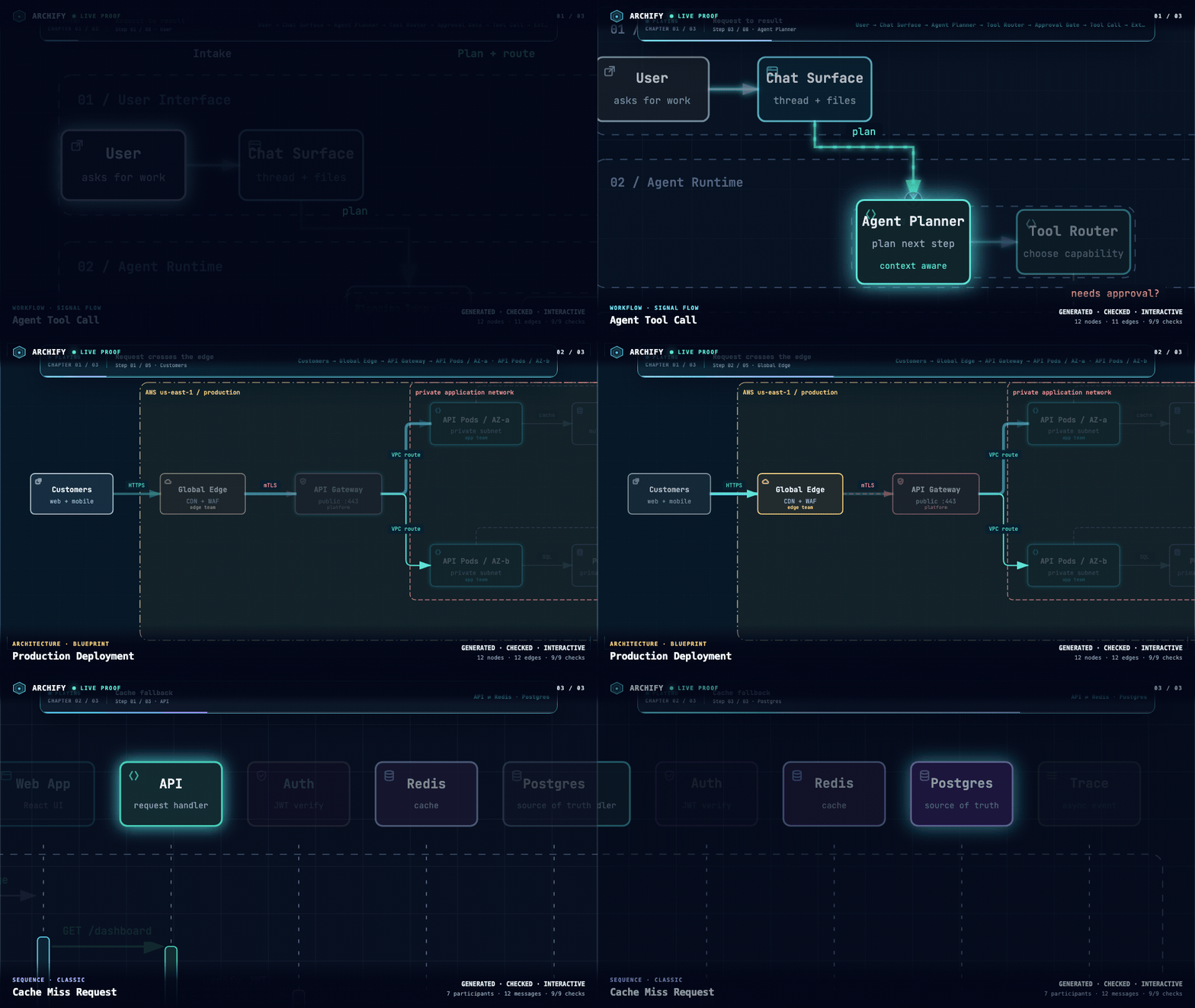 tt-a1i/archify#integrations/deepseek-harness
Generate validated, self-contained interactive architecture, workflow, sequence, data-flow, and lifecycle diagrams from repositories or system descriptions.
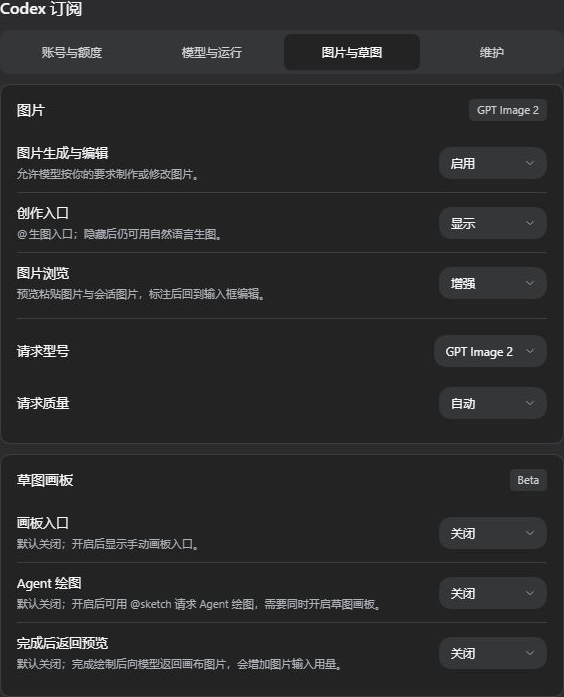 WSL043/dsh-codex-subscription
ChatGPT OAuth provider for Codex models with subscription web search, quota and safe reset, image tools, Fast mode, and model-aware context; no API key or Codex CLI.
Newly listed
The latest additions to the catalog.
- damlys99/dsh-morning-paper
A newspaper-style front page for a session you left running, as a Conversation View tab beside Chat and Trajectory: a per-turn timeline (duration, steps, tools, tokens, outcome), file churn counted per file, where the wall clock went and how much of it was the model rather than tools, which single turn ate the spend, failures nobody retried quoted with their failing command, and a context-pressure gauge measured against the routed model's own declared capacity. The briefing is folded from the durable session log and never generated by a model, so it costs no tokens, cannot hallucinate, and is byte-identical for the same log and clock; it appends nothing to the session and reaches no model, and it reports a pending approval without ever answering it. Pages are offered only when they have content, and the tab refreshes itself on turn settle and on a two-speed poll backed by a metadata-only tail probe.
- Iambatman1928/dsh-lawkb-ui
Legal knowledge-base workbench: hybrid keyword/statistical/vector retrieval over local statute .doc/.docx corpora, faceted filtering, charge-name and civil-cause trees, a document editor, and four AI tools (citation check, contract review, AI analysis, AI drafting).
- NativeDog1/dsh-boot-animation
Plays an intro full-frame on a new conversation, or every time you open the one you pinned. Four clips ship inside the plugin itself — embedded in code, with no separate video files — and an in-app library switches between them, previews the choice, and accepts your own clip. The pin button sits beside Settings.
- 1420079678-ctrl/agent-body#dsh-zero-residence
A zero-residence context engine: large tool payloads are evicted from the live context into a queryable store, only pointers stay behind, and any payload can be reconstructed verbatim on demand — so per-turn prompt tokens stop growing with the transcript. It ships four capabilities: zr_recall rebuilds masked originals by tool-call id or session sequence from the persisted session log (the content is not resident, never lost), zr_ledger reports the attention integral and a three-part cost breakdown, zr_compact arms one forced compaction, and zr_fast runs long commands asynchronously and hands back a handle immediately.
- etony668/dsh-balance
DeepSeek API balance badge in the sidebar footer beside Settings — reads the key DSH already stores, shows granted/topped-up breakdown on hover, flags a balance under ¥2, and refreshes every 60 seconds or on click.
- sequoiayunus-hue/dsh-subagent-model-config
Settings-UI editor that assigns per-teammate model and reasoning-effort rules for DSH native agent teams, resolved at spawn time by wrapping SubagentRuntime.startContinuable. No official files are modified.
- weibaohui/dsh-file-share
Session workspace file manager: adds a "Files" tab to the conversation area to browse the current session workspace directory tree and manage it in place (upload, download, mkdir, rename, delete, search), with files mentionable into the composer for the agent to process.
- weibaohui/dsh-flow
Execution flow chart: renders the current session's execution as a vertical node flow (turns, user, assistant, tools, approvals, retries, compaction), appended in real time over SSE with auto-follow scrolling — the chart draws wherever the session executes.
- weibaohui/dsh-fireworks
Fireworks celebration engine: floats fireworks above the chat window while the agent codes — welcome show, per-turn salutes, tool sparks, milestone celebrations, a finish finale and a dud on failure; each event type has its own fireworks card group with random variants, and token usage decides firework size, height and splendour.
- weibaohui/dsh-gaokao
Gaokao countdown blackboard: counts down the days to the gaokao on a desktop blackboard widget that collapses into a slim bar on double-click, and quizzes random knowledge cards while the agent works; open Markdown knowledge-card framework — drop .md files under subject/category folders and they load automatically, with cross-links, favorites, priority subjects and importing your own knowledge base.
- azazo1/dsh-deep-diving-back
Restores the blue shimmering Deep diving turn status row that DSH 0.1.6 and earlier showed at the end of the transcript.
- Azhe0306/dsh-connectors#balance-widget
Session-header balance readout for DeepSeek Harness: shows the spendable account total (recharge and bonus wallets combined) in the conversation header, refreshed every two minutes, and renders nothing when the account is signed out or the query fails.
- guooo1380/dsh-team-panel
Counts token usage for one selected project per machine, syncs the totals to a self-hosted team server, and shows each member's project, spend and last active time in a sidebar panel.
- zeng6125-rgb/dsh-usage-heatmap
Token usage dashboard in the DSH settings page: nine metric cards (total, today, yesterday, peak day, longest session, active-day streak, active days, sessions, subagent tokens), a GitHub-style daily/weekly/cumulative heatmap, and an activity insight list, aggregated locally from session logs and projection caches, keeping token history after a session is deleted.
- huzhengbang2007/dsh-orca-glass
DSH Web plugin that injects an SVG (feTurbulence + feDisplacementMap) refraction filter and applies it through backdrop-filter to panels, bubbles and the input card, and bundles the orca-scene skin with theme tokens plus light and dark backgrounds.
- LeemanCheung/dsh-skin-studio
Local semantic-token theme editor with palette extraction, WCAG auditing, preview, and export.
- Henta111/dsh-more-models-thinking-level
Per-model reasoning effort (off/minimal/low/medium/high/xhigh) for GPT, Codex, Gemini and OpenAI-compatible models. Installs a helper, not a runtime adapter: run enable-capabilities.ps1 once per profile (Windows) and restart — it declares the levels in ~/.dsh/settings.yaml, with a disable script and a backup to revert.
- qikairo7/dsh-gemini-pool
Multi-account Google Gemini provider: picks the account with the most remaining quota, fails over on 429 with exponential cooldown, probes disabled accounts in the background, and ships a Chinese/English settings page.
- taikaikaikai-pixel/dsh-codebuddy-plugin
Unofficial upstream bundle for DeepSeek Harness. CodeBuddy gateway with a runtime-synced model catalogue, per-model reasoning efforts, web search/fetch, image generation and a streaming credential bridge, plus TraeWork CN and Qoder CN subscription channels via local translation gateways and a key-type OpenAI-compatible provider registry, all managed from an accordion settings card.
- Azhe0306/dsh-connectors#desktop-connector
Windows desktop control connector: through 10 agent tools it captures the screen (including occluded and partially off-screen windows), lists and focuses windows, moves, clicks, drags and scrolls the mouse, and sends key chords or arbitrary Unicode text. Built on koffi FFI: no compiler, no per-call subprocess, and its own GDI screenshot plus PNG encoder.
- Hercules-debug/huixuan-assistant
Search, compare and pick Pinduoduo products from the DSH conversation, with price, sales, service tags, product images and promotion links from the official Pinduoduo open-platform API.
- Azhe0306/dsh-connectors#browser-connector
Browser automation connector: drives the local Edge or Chrome over the DevTools Protocol with zero runtime dependencies — launch a headless throwaway-profile browser or attach to one started with --remote-debugging-port, then navigate, read page text and interactive elements, click, type, and screenshot through 11 agent tools.
- vitas/dsh-web-search-openrouter
Runs the built-in web_search tool server-side on an OpenRouter-compatible gateway, so search uses the same endpoint and key as the chat models: three request protocols, every citation shape parsed (including snippets recovered from the cited span), and a settings card with a live connection test.
- Bingtang1019/dsh-ppt-fusion
Build PowerPoint decks from a brief: plan and storyboard gates, per-page authoring through pptwise and ppt-master, a design-profile pass, page-image snapshots with a render audit, and a tool that hands those pages to an image-capable model for review.
What dsh-market is
Everything, in one place
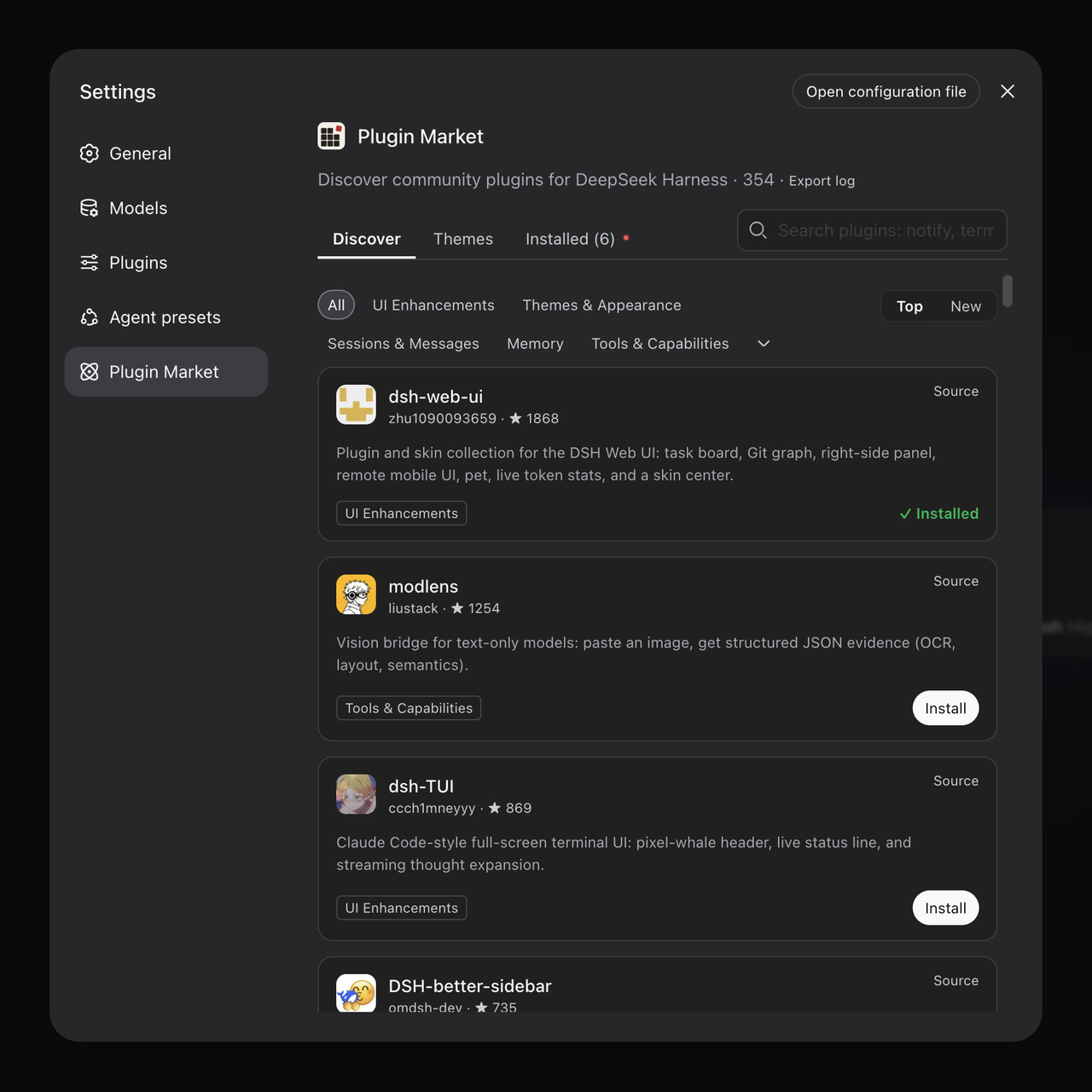
The full curated catalog from awesome-dsh-plugin — categories, star counts, top/new sorting, bilingual descriptions.
Fast installs
npm tarballs are preferred over full-repo GitHub downloads whenever a plugin publishes to npm — typically seconds.
No restart, mostly
Most plugins are live right after a page refresh. Updates and uninstalls take one click too — the market even updates itself.
Zero jargon
Missing a component? The market detects it and fixes it with one button. You never see a terminal.
Guard rails
Installs are restricted to the curated registry, build scripts stay blocked by default, and terminal-surface plugins are flagged before you install them.
Private by default
The market never phones home. Even the bug-report log export is sanitized and stays on your machine until you share it.