
Install
Inside DeepSeek Harness, with dsh-market
dsh plugin --profile web add dshmarket
Or from the command line
dsh plugin --profile web add dsh-token-plan-quota
Installing runs third-party code with your own permissions — it can read your files, use your credentials and reach the network. Review the source first, and pin a commit (github:owner/repo#sha) when you can.
Screenshots
README
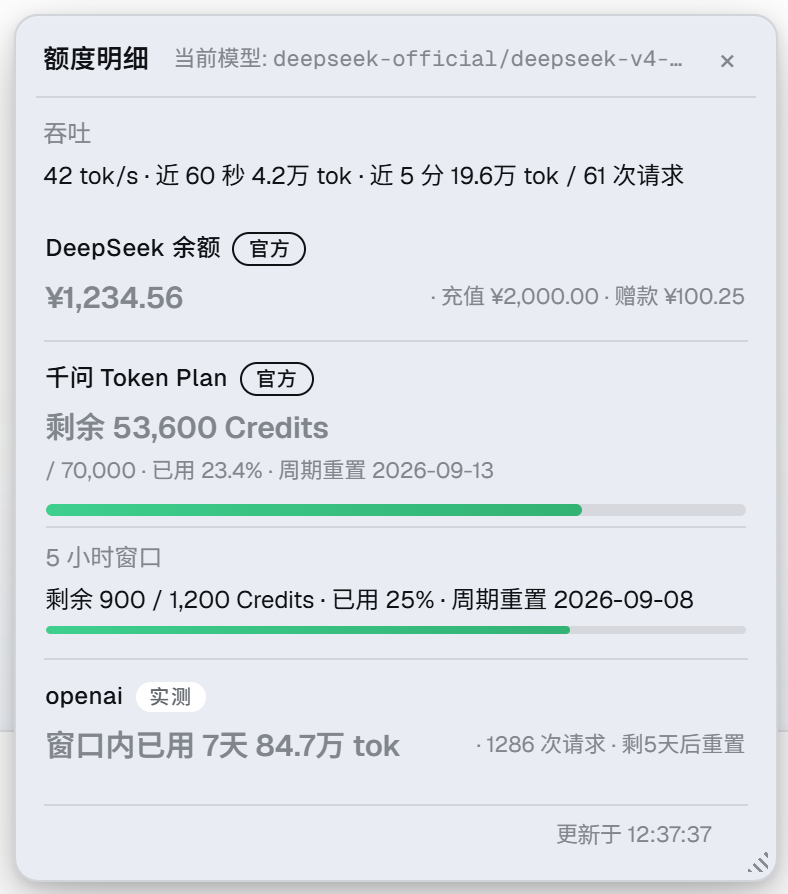
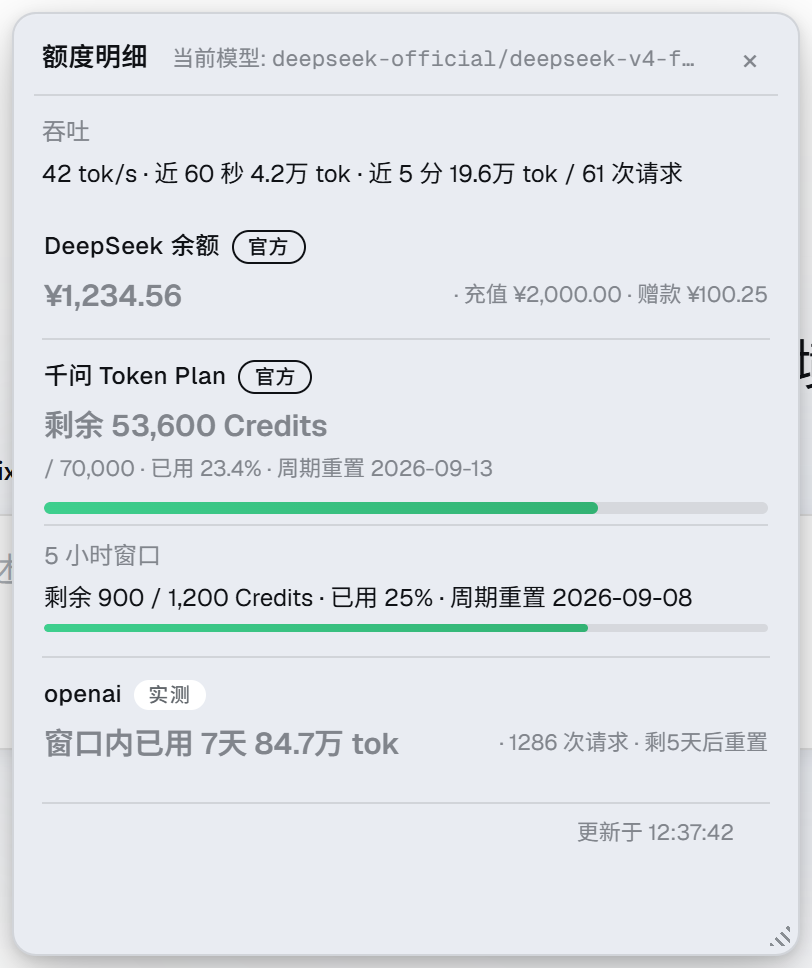
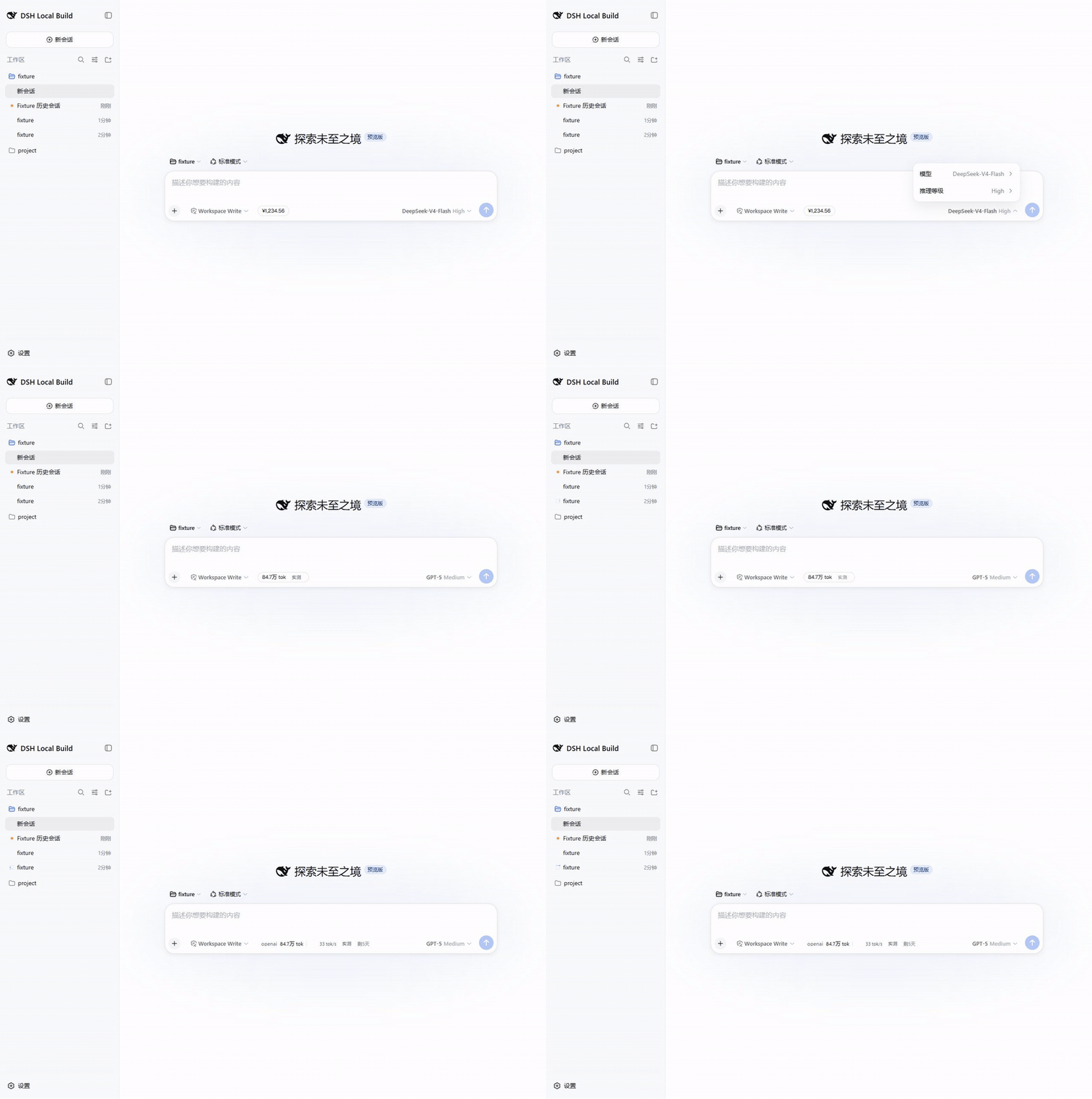
A quota chip in the composer tool row of DeepSeek Harness: "how much is left on the vendor I am actually using".
It exists for a specific reason: Aliyun / Qwen Token Plan does have a quota, but no public quota API - it is only reachable through the console data gateway (a Cookie session), so comparable plugins generally stay away from it. This plugin embeds that contract, and also wires up the vendors that do have official endpoints (DeepSeek, Moonshot, OpenRouter, Aliyun BSS) as true values.
Three rules, at a glance:
| Rule | Behaviour |
|---|---|
| Official endpoint → true value | With a denominator: remaining bar + percentage. Without one: numbers only - a DeepSeek balance has no "total", so no bar. |
| No official endpoint → labelled "measured" | Only what passed through this instance (tokens / calls). No Credits conversion, no extrapolation, never a bar, never a percentage. |
| Zero configuration | The sources to open are decided from the provider routes you actually have; no sources, no providers. |
The chip in the composer tool row is a small capsule that follows the active model’s provider
(name / speed / days live in the tooltip):

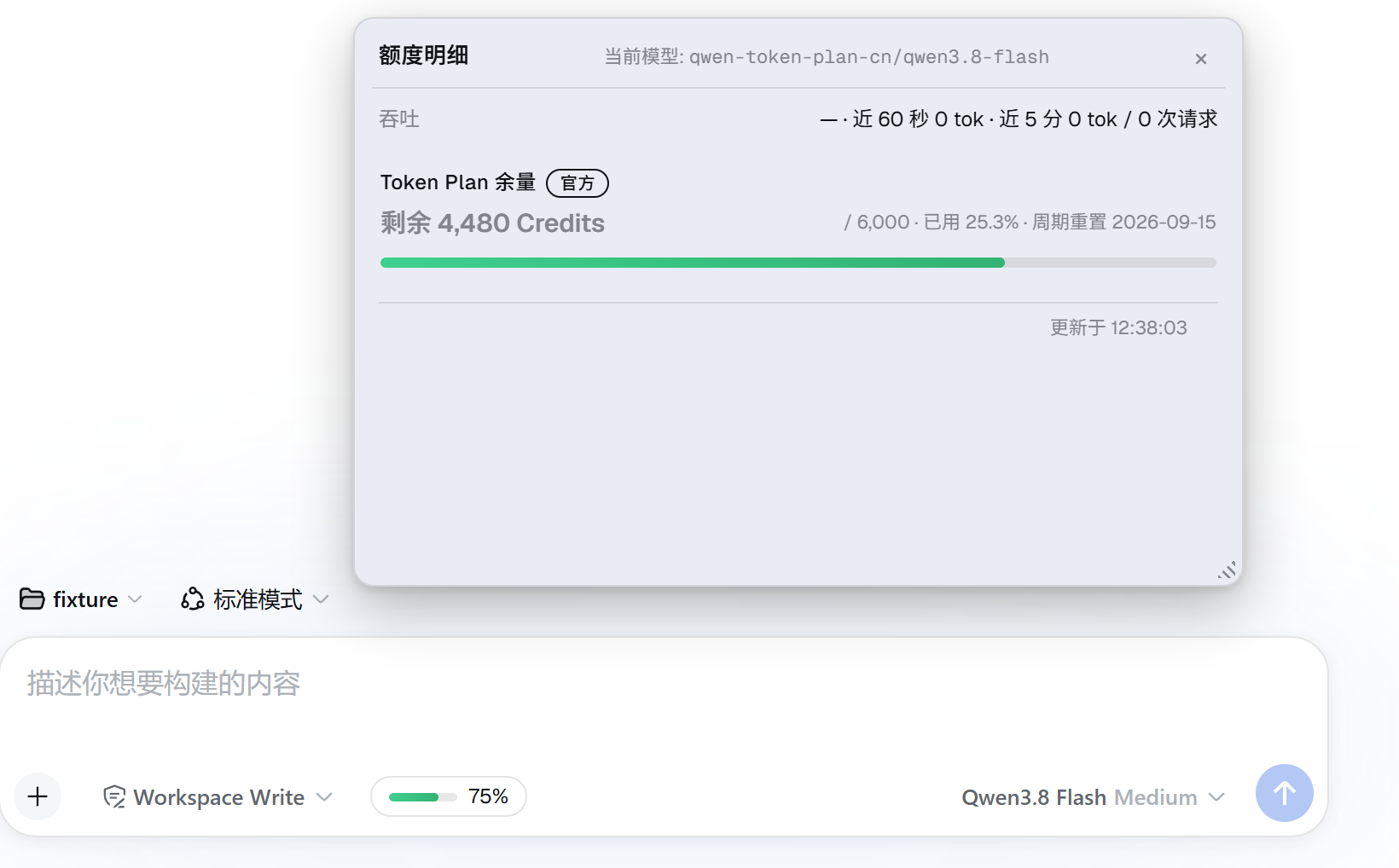
  ▓▓ 75%                  the vendor publishes a denominator → bar + percentage
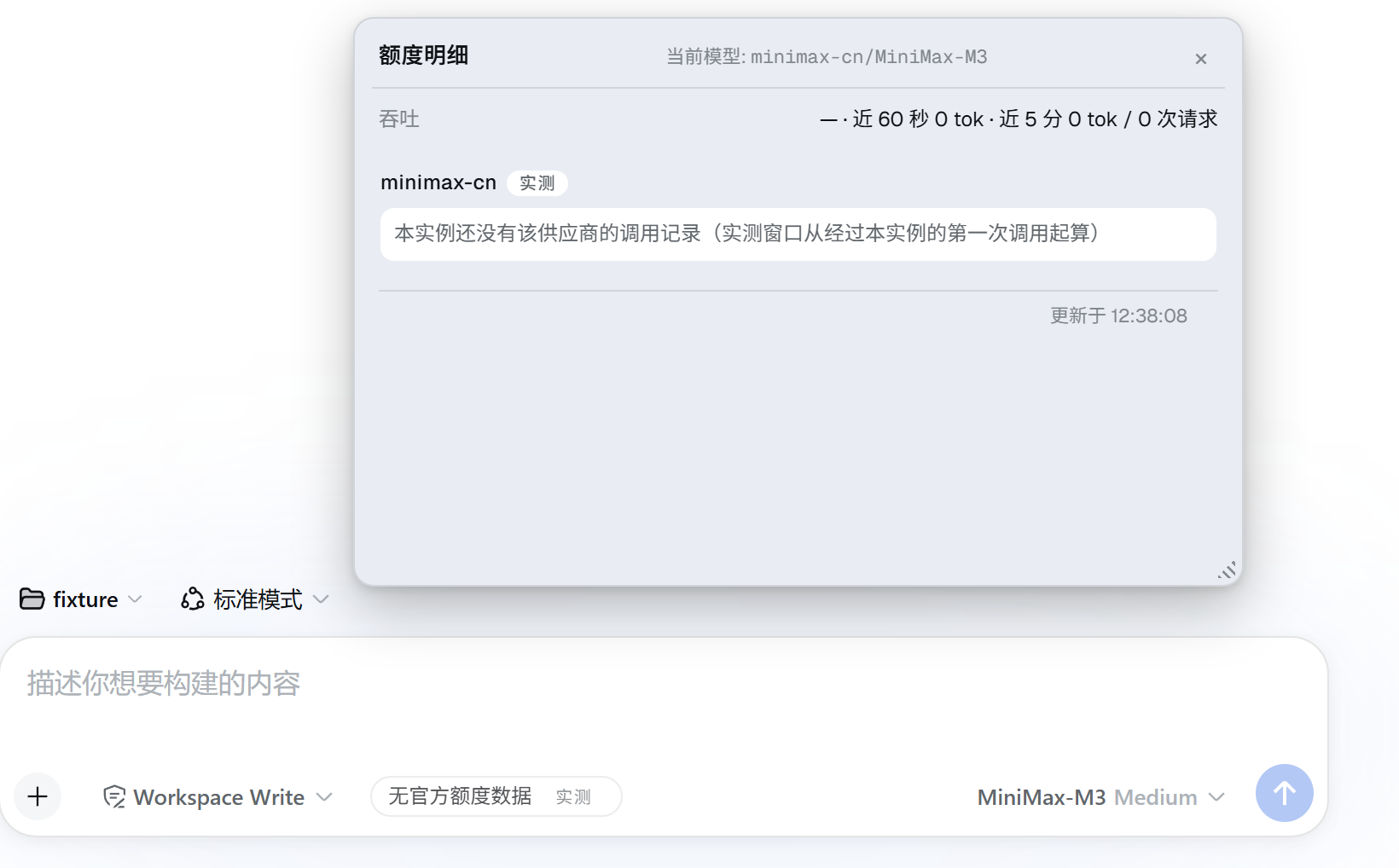
  123K tok  measured      no official denominator → what was used, never a bar or a percentage
① The chip follows the active model's provider — one route reports an official true value, and switching to a route with no official quota API falls back to an explicitly labelled measured card:
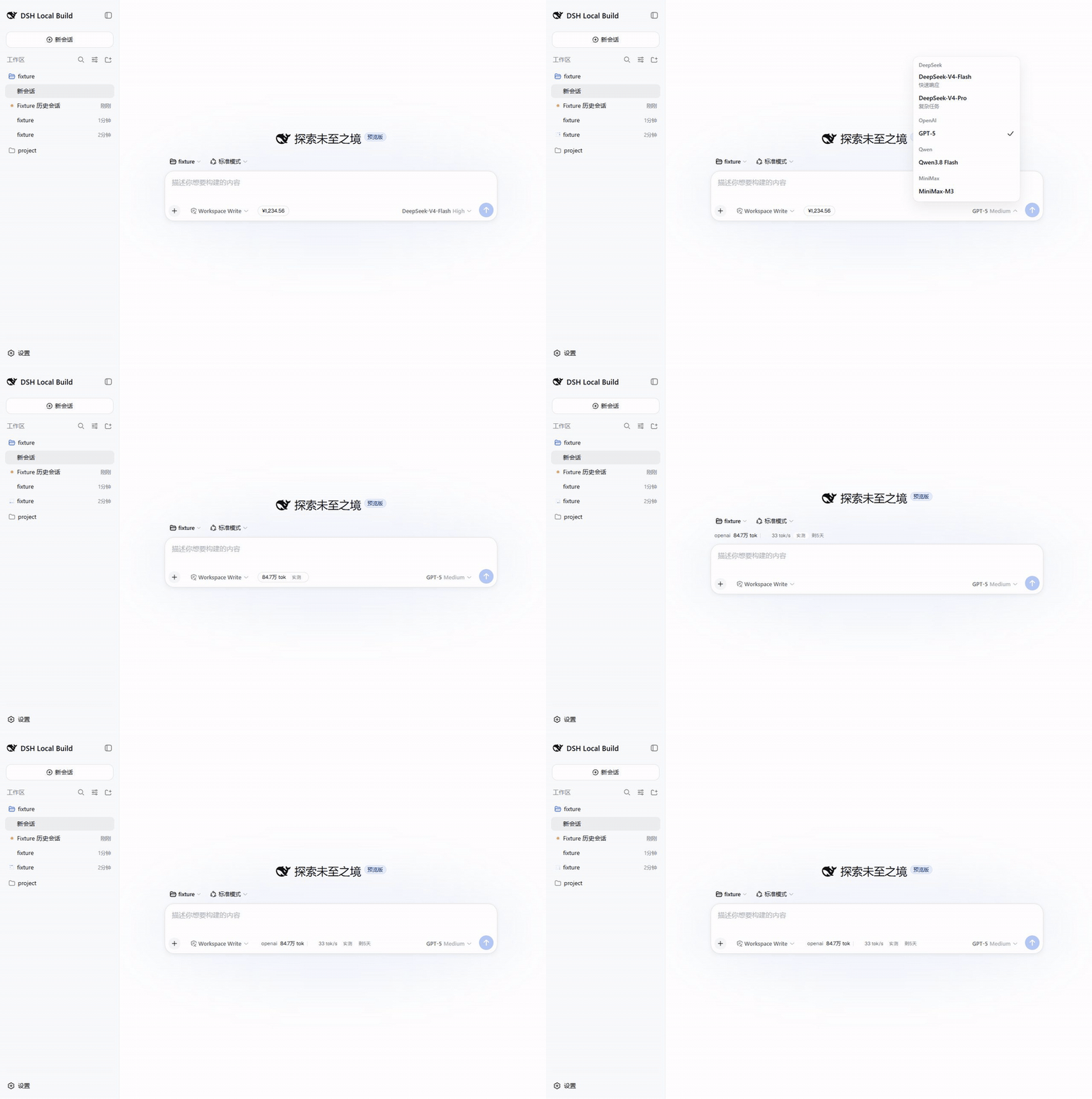
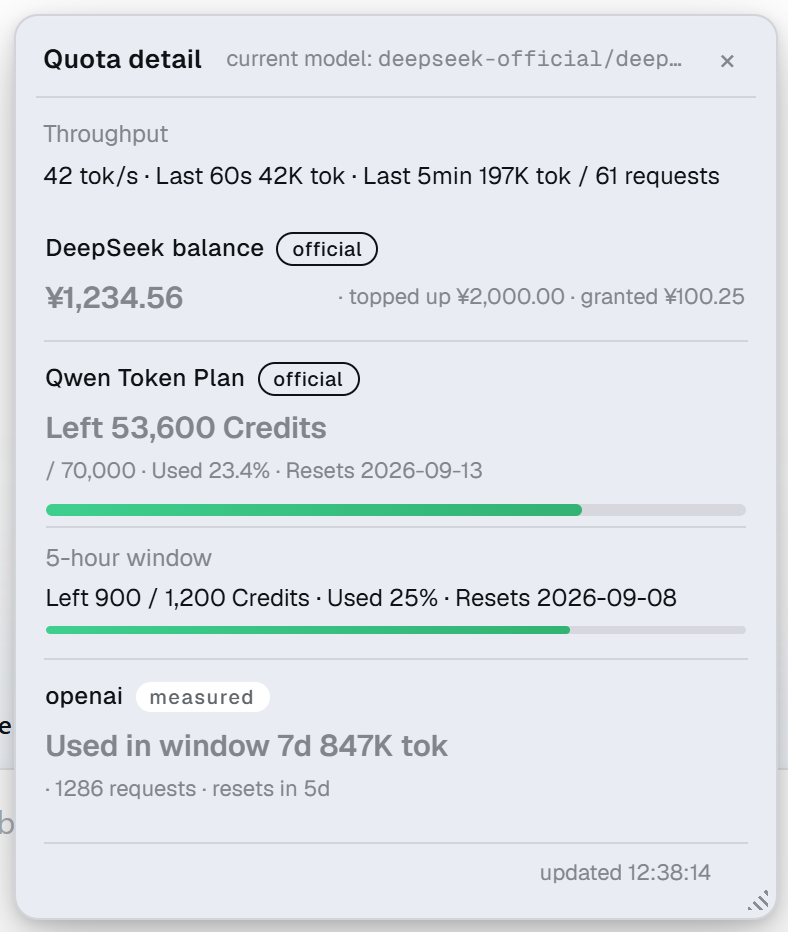
② The detail panel: an official quota card (a bar and a percentage only exist when the vendor publishes a denominator) plus the multi-window meters of a single card:
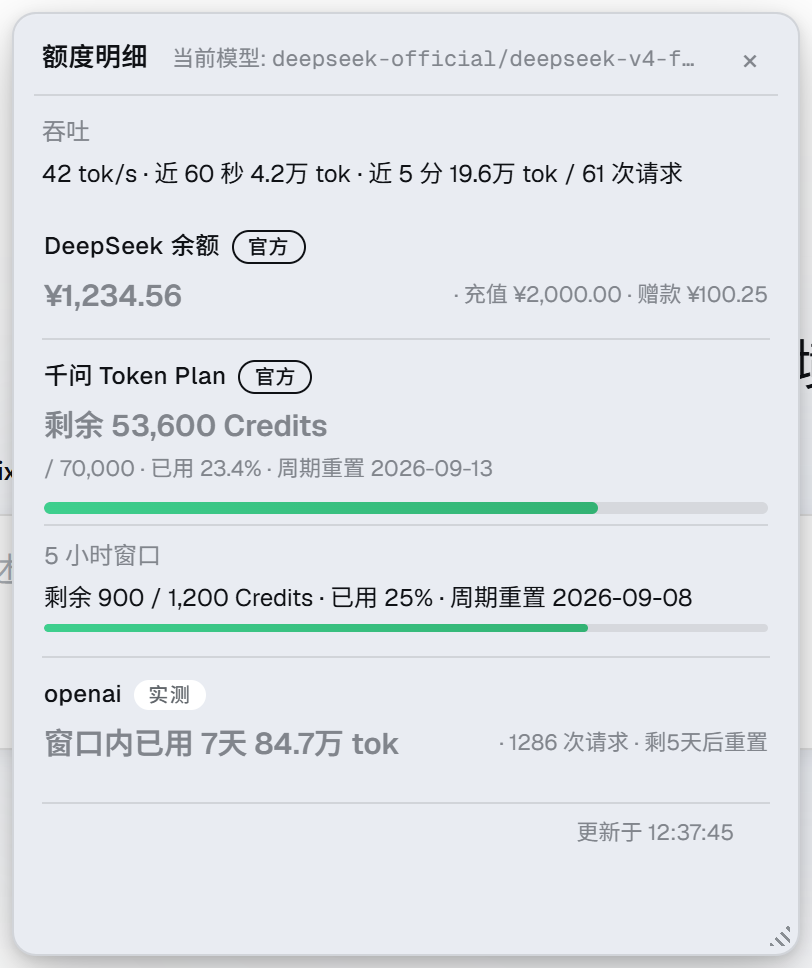
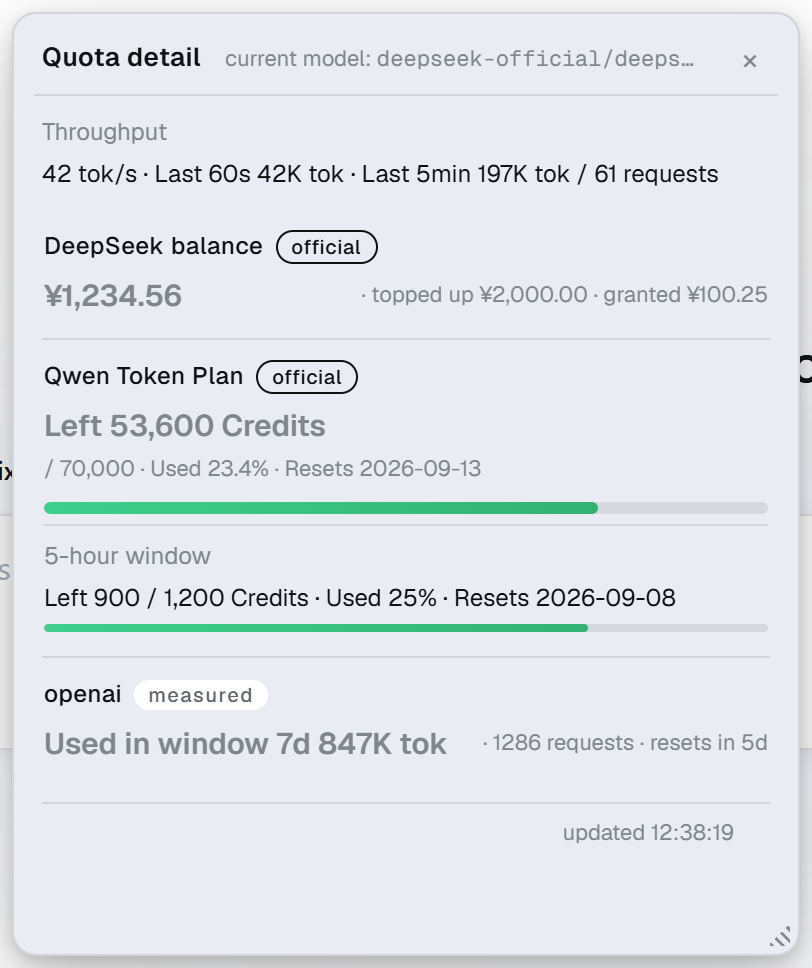
③ The panel detached into a floating window (drag the title bar, double-click to re-anchor):
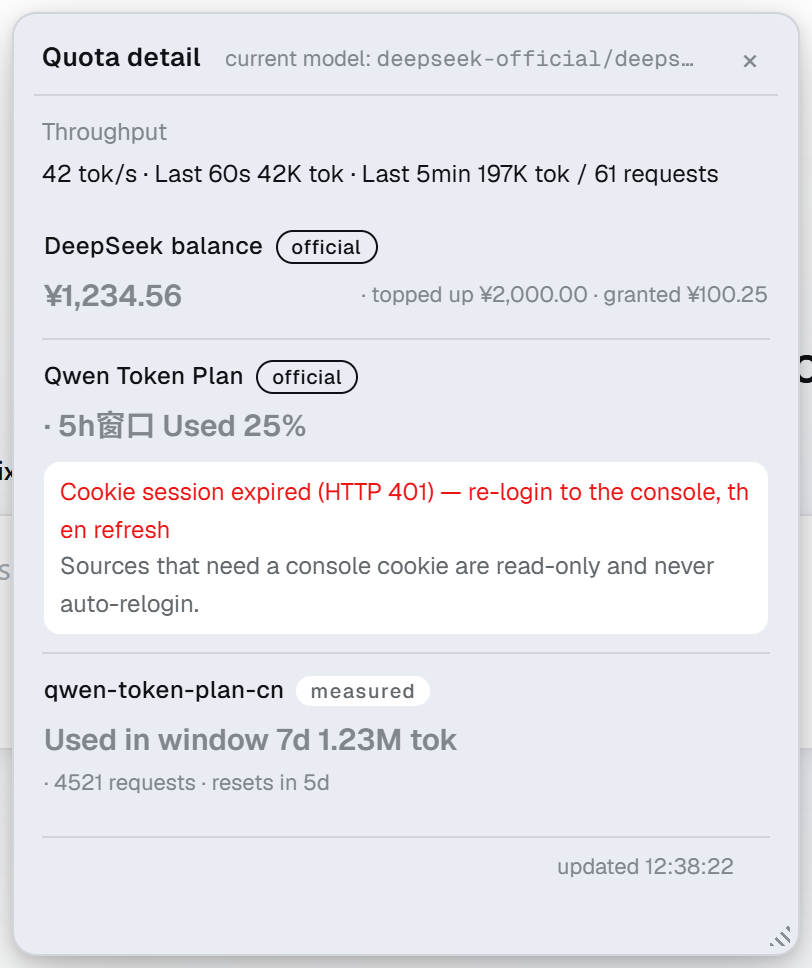
④ The measured card taking over after the console cookie expires: the official card becomes an error card that states the reason and carries no numbers at all, while the fallback measured card stays on the chip — no official denominator means no bar and no percentage:
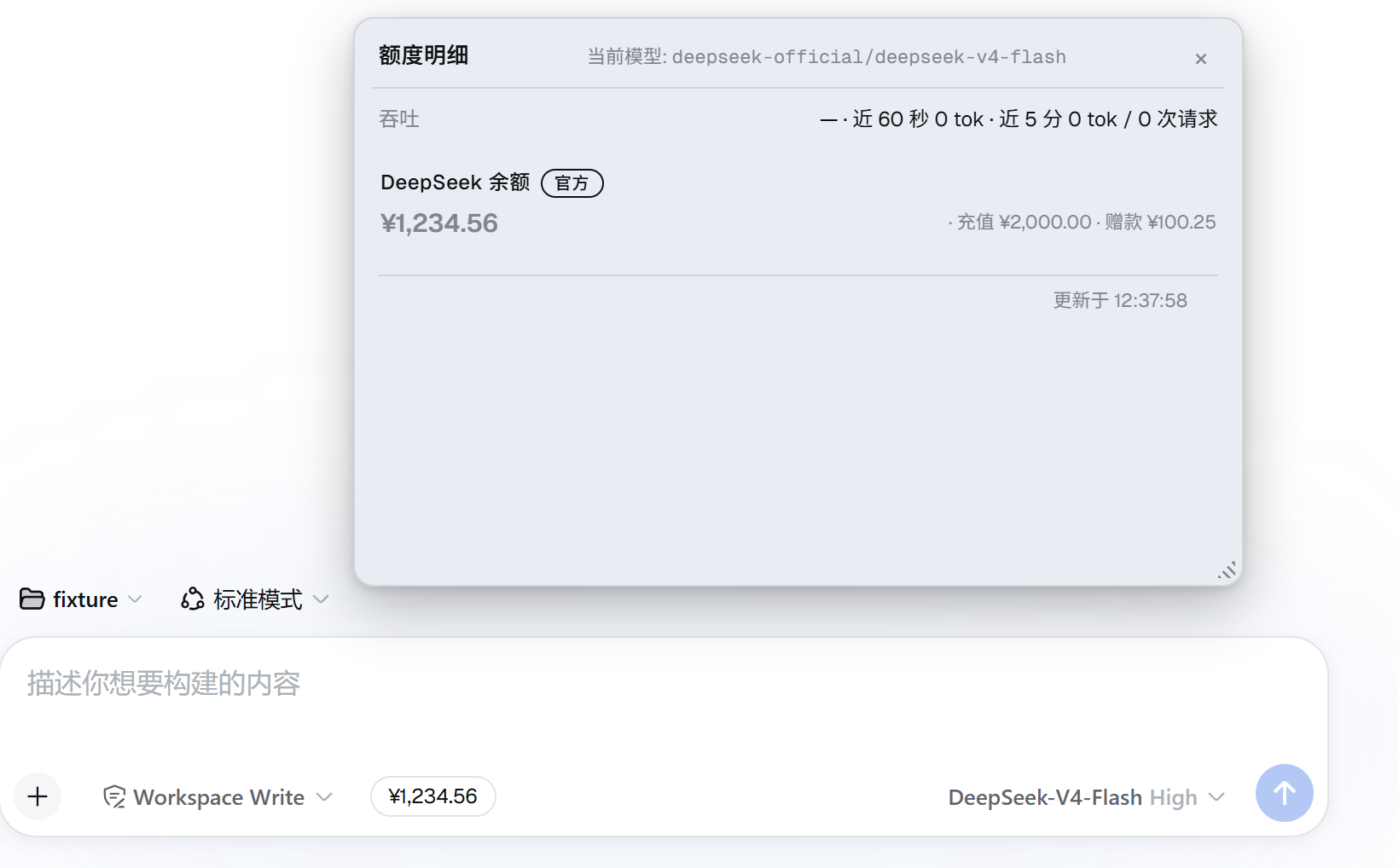
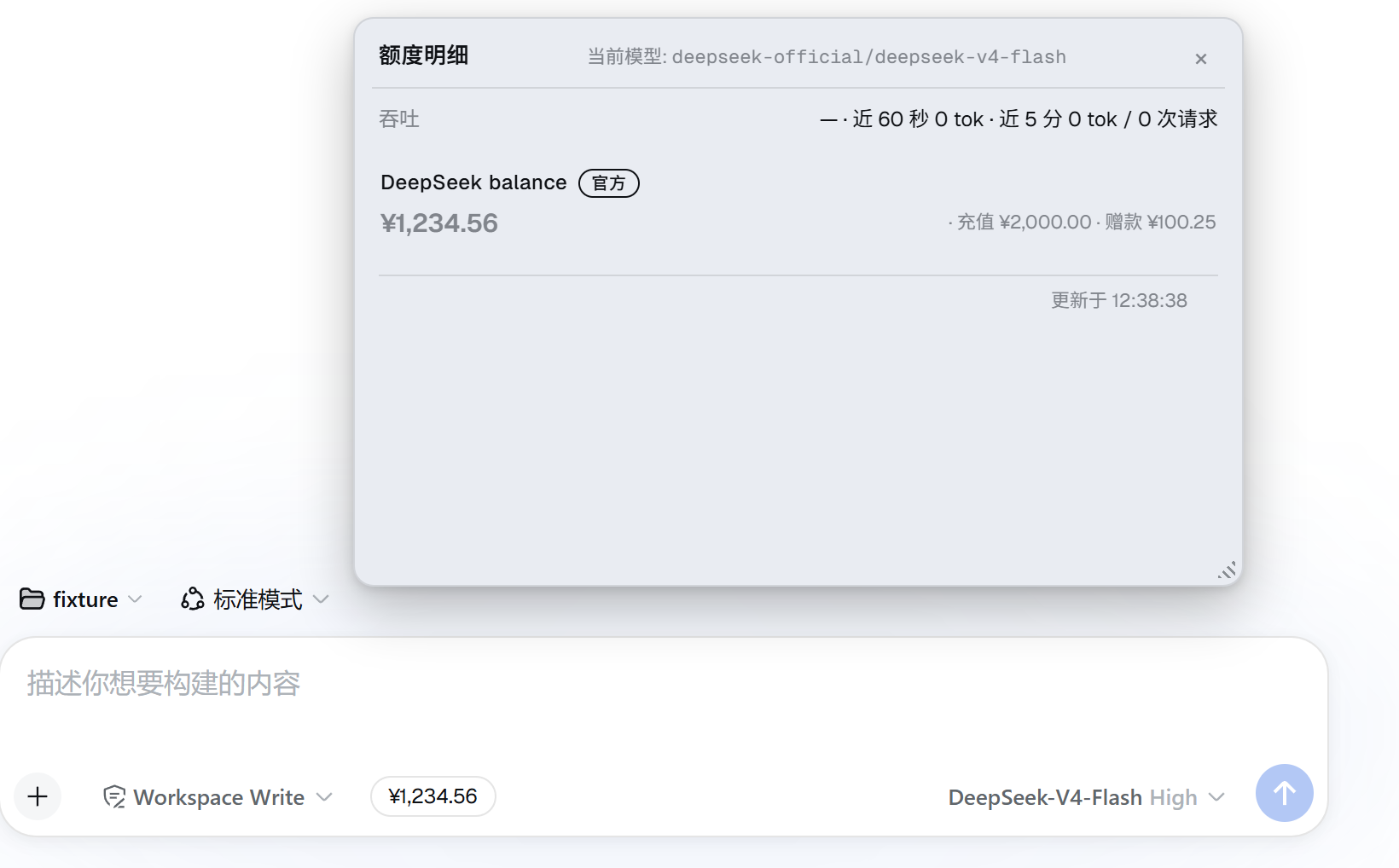
⑤ Metered-by-balance routes are recognised too: the DeepSeek balance is an official true value, but there is no "total" denominator to divide by ⇒ no bar and no percentage, just the amount left, topped up and granted:
⑥ A provider you have actually used shows its quota: only when the official API really publishes a denominator does the card draw a bar and state a percentage and a reset date:
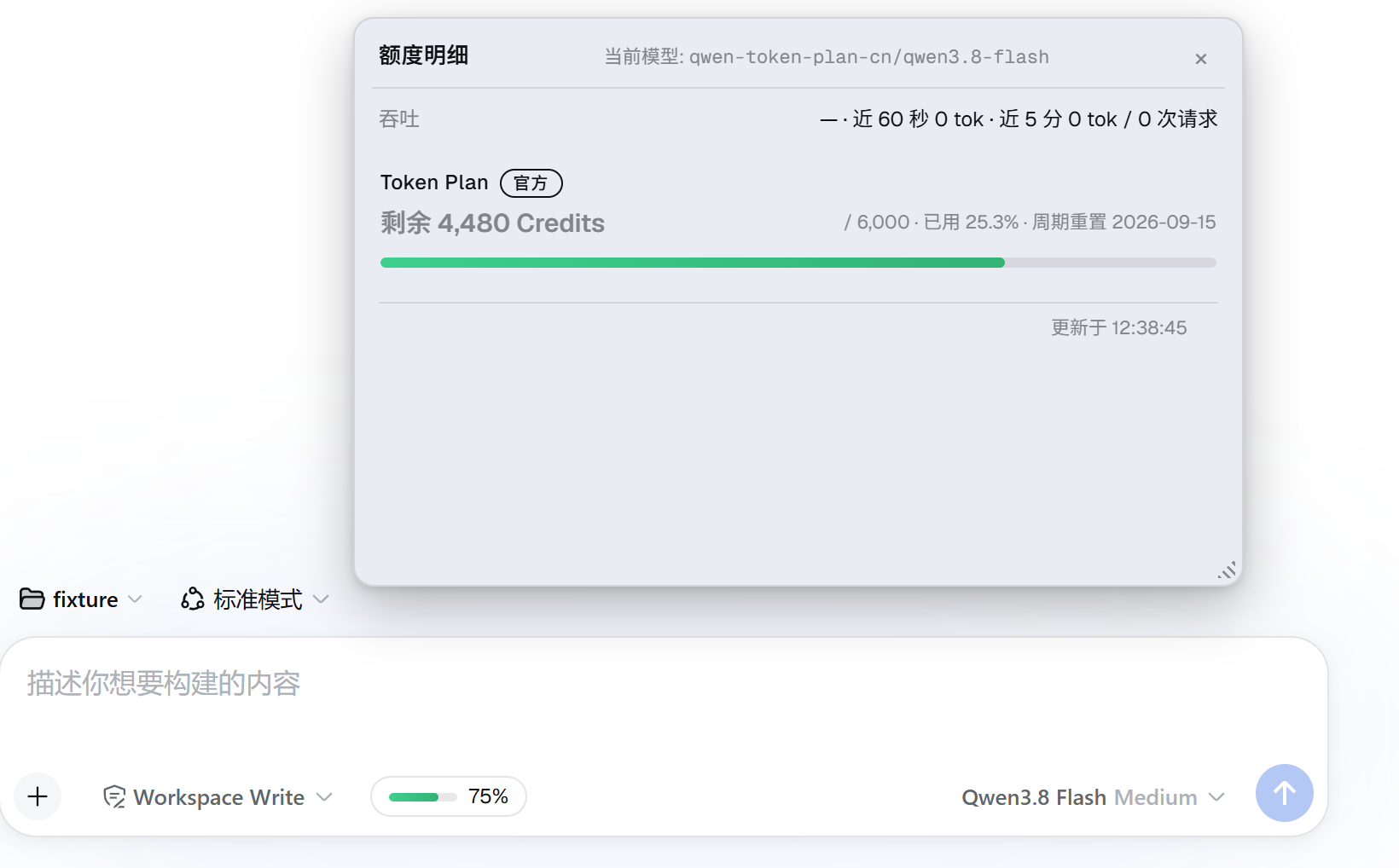
Every balance, token count and date in those six images is synthetic sample data, not any real account (this plugin never puts real numbers into the public repo). The English set has one image fewer than the Chinese one on purpose: the "this instance has no calls for that provider yet" note is currently only emitted in Chinese by the plugin itself, and inventing an English sentence for a screenshot would put words in the product's mouth that it never says. Tracked in ROADMAP.md. To reproduce or replace them: scripts/shots/README.md.
What this plugin does not do
This stance matters more than the feature list:
- No Credits conversion, no discount rates, no "remaining balance inferred from history";
- There is no "I type in my own quota limit" window: a denominator may only come from an official endpoint,
so there is no key here that expresses "period + limit".
token-plan-windowis not a custom-window preset - it is the local measured ledger for Qwen Token Plan (no network, only calls that passed through this instance); - No denominator, no derived percentage: nothing computed out of
used/totalor100 - used%is ever shown - a measured card never draws a bar and never shows a percentage, reporting only how many tokens / requests were used in its window. A percentage the API returns itself is official truth, though: when the plan-limit call times out (it does, intermittently), the chip still shows "used 3.3%", because that number came straight fromusage.per1MonthPercentage- with the bar (it draws that same official ratio) but without an absolute remaining amount (what cannot be computed is not displayed), and with anextra.denominatorFaileddiagnostic instead of going silent; - Plan configuration is not your quota: a window exists only when that plan actually reports a reading
(a
five_hourcap sitting inquota-configdoes not mean your account has a 5-hour window); - Never guess: detection would rather show one card fewer than pin another vendor's balance to the model you are using;
- No probing that costs money - read-only endpoints only;
- No reading other CLIs' local login state (see Three credential shapes we will not implement).
Install
dsh plugin --profile web add dsh-token-plan-quota          # npm package name
dsh plugin --profile web add github:xinghe-1018/dsh-token-plan-quota
dsh plugin --profile web add ./dsh-token-plan-quota        # local directory
dsh plugin passes through to pnpm inside the profile directory. This plugin has zero third-party
dependencies and no build step, so it never trips pnpm ≥10's build-script allowlist.
Restart dsh web once after installing (bundles and client entries are assembled at startup).
The only external resource at runtime is three CDN font links; if they fail, the UI falls back to system fonts.
Supported vendors
| Vendor | Quota source | What the chip shows | Verification status |
|---|---|---|---|
| DeepSeek | ✅ official /user/balance (Bearer) |
balance + topped-up + granted (truth) | verified with a real key |
| Qwen Token Plan | ⚠️ console data gateway (cookie session, not a published API) | used % + progress bar (same source as the subscription page); falls back to the measured card when the cookie is missing/expired | verified with a real account |
| Moonshot / Kimi open platform | ✅ official /v1/users/me/balance (Bearer; .cn CNY / .ai USD) |
balance + cash + voucher (truth) | endpoint existence probed; field names not yet checked against a real key |
| OpenRouter | ✅ official /api/v1/credits (Bearer) |
balance (USD) = total credits − total usage | endpoint existence probed; field names not yet checked against a real key |
| Aliyun BSS | ✅ BssOpenApi (AK/SK signature) | account balance / resource packs (truth) | every field checked against official OpenAPI metadata |
| MiniMax, OpenAI/Gemini with a plain API key, … | ❌ no key-authenticated quota endpoint | measured card (tokens / requests only) | common paths probed; no endpoint exists |
Per-vendor endpoints, envelope fields, unit traps and percentage direction are documented in
docs/upstream-contracts.md.
API hosts only, never console domains: web console domains such as platform.kimi.com,
platform.moonshot.cn and bailian.console.aliyun.com take no part in detection - the plugin queries balance
APIs, which live on the API host the route's baseURL points at (api.moonshot.cn / api.moonshot.ai).
A Kimi open-platform key belongs to the same account and balance as a Moonshot one, so point the route at
api.moonshot.*; if your baseURL says something else, detection will not recognise it and you get the
measured card instead. To force the official card, do not just name the source - bind it to your real route
id, or under the default panelScope: "current" it is queried but never displayed (the preset carries generic
names like moonshot, which do not include your route):
{ "sources": [{ "id": "moonshot-balance", "providers": ["kimi-open-cn"] }] }
Mind the last column of the table above: this vendor's field names are not yet checked against a real key, so if
the forced card looks wrong, compare field names with probe. When a providers list binds to nothing at all,
the host logs a warning - you are not left guessing in front of an empty panel.
How this differs from neighbouring plugins
The ecosystem already has related plugins, mostly in the cost-tracking / spend-estimation direction
(dsh-cost-meter, dsh-token-monitor). This plugin does not compete there: its stance is only official truth
or explicitly-labelled measurement, never conversions or estimates, the chip follows the current model's
provider, and it ships the Aliyun / Qwen Token Plan console-quota contract - a vendor that has a quota but
no public API, which is precisely why this plugin exists. Want a cost dashboard? Take the former. Want "how much
is left on the provider I am using right now"? Take this one.
Zero-configuration detection
The provider routes live in your harness are the single source of truth for which sources to open, so you
never write sources and never hand-fill providers - historically those two lists drifting apart is exactly
what produced "the card is queried but never displayed". Matching runs in confidence order, first hit wins:
| Signal | Notes |
|---|---|
baseURL host |
Most trustworthy - where the route actually points. api.moonshot.cn → Moonshot mainland region, openrouter.ai → OpenRouter, the Token Plan gateway → Qwen |
| route id / display name | Used only when no host is available (the shipped deepseek-official route relies on this) |
| key prefix | Last resort (sk-or- → OpenRouter) |
| nothing matched | Attach a window:<provider> measured source per unmatched route (three unrecognised routes, three cards): the chip stays visible, reporting local tokens/requests only |
In this document provider, "route id" and the strings inside providers are the same thing: the id
returned by the host's llm.listProviders() (compared case-insensitively, with . _ / all treated as -).
So the window:minimax-cn card only appears for the model on route minimax-cn, and the fallback detection
attaches is called exactly the same (window:minimax-cn) - one card, two spellings.
Two invariants:
- Your configuration always wins - as a layer, not as a replacement. With
autoDetect: true(the default) what you write lands first and detection then fills in the parts you said nothing about; adding one entry never wipes the cards it did not mention. "Already covered" has exactly three meanings: (1) one of your sources lists this route id inproviders→ detection adds nothing to that route; (2) you have a source with the sameid→ detection will not open a second one (skippedrecordsid-taken-by-configured); (3) you wrote{"id":"<source>","enabled":false}→ that name is never opened automatically again (skippedrecordsdisabled-by-config). A fourth case is not a coverage rule at all: a source whose credential cannot be resolved is simply not opened (skippedrecordsno-credentialand lists the reference names it tried; no error card taking up space). OnlyautoDetect: falsemakes your list the single source of truth. - Explainable. Every auto-opened card carries
detected: {by, rule, host, fallback}; its tooltip says "identified from api.moonshot.ai · region international", and the snapshot'sdetectionblock lists live routes, what was opened, what was skipped and why, and which routes were not recognised - one place to answer "why is this provider missing" (it is only in theGET /token-plan-quota/summarypayload; the panel does not render it). On an older host without anllmservice, detection degrades silently to the configured sources.
Interface
- The chip follows the model: it subscribes to the host's existing
sessions.list→modelDirectoriesruntime stores, so switching models updates the card immediately - no polling, no extra network. Priority: an official card with numbers > a measured card with numbers > an errored official card (which tells you to configure the cookie). - One quota card per provider: when the official card has numbers, the auto-attached measured fallback card is hidden; when the official card turns into an error card, the fallback must come back. This decision lives in the display layer where the data is visible - deciding it at planning time left a blank badge the moment a cookie expired.
- A card can carry several windows: the host orders them into
card.meters(this is the card shape in the snapshot, not a key you can write in a source entry);meters[0]is the same source as the top-level value (shown by the headline and the main bar), and each further window gets its own row - "label · remaining/total · used% · resets" - with its own thin gradient bar. - The detail panel is a persistent window: drag it by the title bar, resize with the bottom-right handle,
position and size persist in
localStorage, double-click the title to re-anchor. Clicking anywhere else never closes it - only the✕in the title bar, clicking the chip again, orEsc. Dismiss-on-outside-click is dropdown semantics that conflicts with this, and identifying the host's input area via selectors is guaranteed to leak (the shipped web bundle does not even containdata-composer-card). - Visuals: a ghost control with no border, no status dot and no emoji - the gradient balance bar is the
status (≥70% green, 40-70% blue, <40% orange→red); "official / measured" pills mark the tier; its own font
stack (Geist Variable + Noto Sans SC, system fallback offline) with monospace reserved for identifiers;
every animation respects
prefers-reduced-motion. panelScope: current(default) lists only the current provider's cards; set"all"to see every source.- "Measured" has exactly one meaning in this document: a number computed from the local ledger, never an
official balance. It appears in three places - the "this instance, measured" block in the panel (that is what
showInstanceWindowtoggles), thewindow:<provider>card for any vendor, and the built-intoken-plan-window(which simply is the Qwen ledger). All three default to a 7-day window, changeable withwindowDays; the window is anchored at this instance's first call, and "reset this cycle" re-anchors it.
Configuration
Main config lives in ~/.dsh/token-plan-quota.json - the host re-reads it before every query, so changes
apply without a restart (it can also go in the bundle row's config; the JSON wins):
{
  "autoDetect": true,
  "refreshMinutes": 10,
  "pollSeconds": 10,
  "panelScope": "current",
  "debug": false
}
The table below has 18 rows: 17 are keys of DEFAULTS in the code, and moonshotRegion is the exception - it is
not in DEFAULTS but is read by the Moonshot source through regionConfigKey. One key per row, and the unit is
part of every name (Minutes / Seconds / Ms).
| Key | Default | Meaning |
|---|---|---|
autoDetect |
true |
Fill in sources from the host's live provider routes. Writing sources does not switch it off: your entries are one extra layer and detection still covers the routes you said nothing about, so "sources": [] merely means "I have no additional request" (identical to omitting it). Set false to make your list the single source of truth: with nothing written you get the two built-ins deepseek-balance + token-plan-window, and with "sources": [] you get no cards at all |
sources |
none (detection decides) | Ordered source list. Built-in names (8): deepseek-balance (DeepSeek balance), token-plan-console (Qwen console quota, cookie), token-plan-window (Qwen local ledger - not a custom window), moonshot-balance (Moonshot/Kimi balance), openrouter-credits (OpenRouter balance), account-balance (Aliyun account balance), fr-instances (Aliyun resource-pack instances), resource-package (Aliyun resource-package allowances); or the window:<provider> shorthand (a measured window for any vendor); or a custom object (see Custom sources) |
moonshotRegion |
china-mainland |
china-mainland (api.moonshot.cn, CNY) or international (api.moonshot.ai, USD). Keys do not work across regions; a wrong region returns 401 and the card tells you to switch. Host and currency switch as a pair - there is no auto-probing |
refreshMinutes |
10 |
Cache TTL for official sources in minutes: TTL = minutes × 60 s, floor 15 s, so "refreshMinutes": 3 means one upstream call per 3 minutes (sub-minute polling is not what this key is for - see pollSeconds). The panel's "updated" line or ?fresh=1 forces a refetch |
pollSeconds |
10 |
Front-end poll interval - how often the UI re-reads the snapshot. Measured values and throughput are recomputed live anyway; lowering this never adds upstream calls |
panelScope |
current |
current lists only cards whose providers include the active route id, plus this instance's usage; all lists every source. That means the three Aliyun sources are invisible under current - an account balance and its resource packs have no provider binding, so they never enter a route-filtered view; set "all" to see them |
showInstanceWindow |
true |
Include the "this instance, measured + retry observations" block in the panel. It is not a data-source switch and does not affect window:<provider> cards |
exposeTool |
true |
Register the token_plan_quota model tool |
debug |
false |
Permanently echo the upstream response's field skeleton (values masked, credential-like keys skipped) in the panel. Same output as GET /token-plan-quota/probe?source=<id>; the difference is that debug is always on while probe is one-off and needs no config change |
endpoint |
business.aliyuncs.com |
Aliyun BSS sources only: OpenAPI endpoint (change it for the international site). A leading https:// and trailing slashes are stripped |
regionId |
none | Aliyun only: the OpenAPI RegionId |
accessKeyIdRef |
ALIBABA_CLOUD_ACCESS_KEY_ID |
Aliyun only: credential reference name for the AccessKeyId |
accessKeySecretRef |
ALIBABA_CLOUD_ACCESS_KEY_SECRET |
Aliyun only: credential reference name for the AccessKeySecret |
securityTokenRef |
none | Aliyun only: credential reference name for an STS token (leave empty with long-lived AK/SK) |
configPath |
$DSH_HOME/token-plan-quota.json |
Where the external JSON config lives (~/ = OS home, $DSH_HOME/ = harness home) |
usagePath |
$DSH_HOME/token-plan-quota.usage.json |
Where the local ledger is persisted |
minIntervalMs |
1200 |
Minimum interval between outbound calls (ms), throttling globally |
timeoutMs |
15000 |
Per-request upstream timeout (ms, floor 1000) |
allowUndeclaredHosts |
false |
Outbound allowlist switch. Off by default: every request is checked against the declared host set in dshhub.permissions.network before it goes out (constitution V). A custom source pointing elsewhere must turn this on explicitly; the snapshot then carries a notice |
Turning one single card off
An item of sources may be a built-in name (a string) or an object - options only attach to the object form,
so to switch one card off, turn that item into an object. This is an exclusion, not a replacement of the whole
list: leave autoDetect at true and every other card is still filled in.
{
  "autoDetect": true,
  "sources": [
    { "id": "deepseek-balance", "enabled": false },
    { "id": "fr-instances", "enabled": false }
  ]
}
- It works on sources that detection opened too: with
{"id":"moonshot-balance","enabled":false}written, detection will not add that card back, and theskippedlist keeps adisabled-by-configentry - so "not recognised" and "you switched it off" stay distinguishable. - It switches off this source, not this vendor - but what is left for that vendor depends on whether it is in
the rule table, and that has to be spelled out:
- Recognised vendors (DeepSeek / Moonshot / OpenRouter) have exactly one official source each, so switching it off leaves no card: the measured fallback is only attached to routes detection could not recognise.
- Qwen is the exception: it carries both
token-plan-console(official) andtoken-plan-window(measured), so switching the first off leaves the second in place. - Unrecognised vendors (MiniMax and friends) already have only a
window:<provider>card; to drop that, name it:{"id":"window:minimax-cn","enabled":false}(<provider>is the route id - see the section above).
- Prefer a clean sweep? Set
autoDetect: falseand write the whole list yourself. Either way, what you wrote always wins.
Credentials
Resolved in order: DSH credentials service → environment → ~/.dsh/.credentials.yaml → ~/.dsh/.env,
re-resolved on every query, so swapping a key needs no restart.
| Source | Reference name |
|---|---|
| DeepSeek | DEEPSEEK_API_KEY |
| Moonshot | MOONSHOT_API_KEY (must match the region; detection prefers the name the route's own profile declares, e.g. MOONSHOT_CN_API_KEY) |
| OpenRouter | OPENROUTER_API_KEY (sk-or-v1-…) |
| Qwen Token Plan quota | BAILIAN_CONSOLE_COOKIE (+ optional BAILIAN_CONSOLE_SECTOKEN as an override) |
| Aliyun | ALIBABA_CLOUD_ACCESS_KEY_ID / ALIBABA_CLOUD_ACCESS_KEY_SECRET |
Reference names can be overridden per source with bearerRef / cookieRef.
To see the real Qwen Token Plan quota (the "65.1% left / 10,000 total" from the subscription page):
sign in and open the subscription page →
F12 → Network → copy the entire Cookie: request header line → store it as one line
BAILIAN_CONSOLE_COOKIE: <content> → click "updated" in the panel to refresh. Cookies usually last a few weeks;
when one expires the source reports an error and the measured card takes over until you re-paste.
Custom sources
When a vendor publishes a new endpoint, or you want to wire in a console API yourself, you do not need to wait
for this plugin. kind: "single" with fields/derive covers the "balance is a difference" shape:
{
  "sources": [{
    "id": "my-balance", "label": "My balance", "kind": "single", "metric": "money",
    "url": "https://example.com/api/account", "method": "GET", "bearerRef": "MY_API_KEY",
    "unit": "USD",
    "fields": { "credits": ["data.total_credits", "total_credits"], "usage": ["data.total_usage", "total_usage"] },
    "derive": { "total": "credits", "used": "usage", "remaining": "credits - usage" },
    "providers": ["my-provider"]
  }]
}
derive accepts exactly one +/- with a field reference or a number on each side, and returns nothing if
either side is missing - it never invents a number. Multiply, divide or parenthesised expressions mean you
should write a dedicated builder instead. The slot names in fields are yours to choose (credits/usage above
are just names - they are also the variables derive can reference), and giving each slot several candidate paths
is deliberate: the same API has shipped with and without a data envelope.
Every key a hand-written entry accepts
An unrecognised key raises no error and does nothing (entries are merged verbatim), so a typo in a key name shows up as "the card stays empty", not as a failed start. This table is the authoritative list:
| Key | Applies to | Meaning |
|---|---|---|
id |
required | Source identifier, also the cache key and the probe?source= argument. Two entries sharing an id share a cache and stack into two cards (the log warns); rename the second one |
kind |
recommended | single (one reading - the default when omitted) / list (a list of resources) / window (measured window for this instance, no network) |
label / labelEn |
title | label is the card title and falls back to the entry's id when omitted. When the UI language is English the client prefers labelEn (panel card headers and meter rows) and only falls back to label - it never translates for you, so write labelEn on the entry if you want an English title |
url |
single / list |
Endpoint. With url present the source is HTTP; without url and not a built-in name, it is treated as an Aliyun OpenAPI RPC call (needs action + version) |
method |
HTTP | Defaults to GET |
headers |
HTTP | Extra request headers, merged over accept: application/json |
jsonBody / formBody |
HTTP (POST) | JSON body / application/x-www-form-urlencoded body |
bearerRef / cookieRef |
HTTP | Credential reference names. A Bearer source honours only bearerRef, a cookie-session source only cookieRef - a plan key is never used in place of a cookie (nor the reverse), because that only produces a misleading error card |
action / version / params |
RPC | OpenAPI action, version and query parameters (params are flattened). An RPC source missing action or version yields an error card |
paginate |
RPC | { "mode": "page", "request": "PageNum", "pageSize": "PageSize", "total": ["TotalCount"] }, or { "mode": "token", "request": "NextToken", "response": ["NextToken"] }; page mode stops after 10 pages |
fields |
single |
variable name → array of candidate paths; only the ones that resolve enter the derive scope |
extract |
single |
Paths for values the upstream hands over directly: remaining, total, unit. These are also referenceable by derive |
derive |
single |
Only remaining / total / used are consumed; if you omit used and both remaining and total resolve, the difference is computed |
extra |
single |
Secondary figures, names are yours; toppedUp/granted/cash/credit/quotaLimit have established wording |
list / item |
list |
list is the array of candidate paths; item may name name/id/remaining/total/used/unit/status/expiresAt/startsAt/cycleType/capacityType/haystack |
metric |
display | money / credits / count. The default depends on the builder: a hand-written single source defaults to money, list to credits, window to count - set it explicitly when you want tokens |
unit |
display | Fallback unit when upstream gives none (e.g. USD); with metric:"money" and no upstream currency it falls back to CNY |
providers |
panel grouping | The route ids this source belongs to (see "provider = route id" above); under panelScope: "current" a card is displayed only if this list contains the active route, and if you write names that match no live route the host logs a warning. The window:<provider> shorthand fills it in |
windowDays |
window |
Measured window length in days; default 7, minimum 1 |
regions / region |
multi-region vendors | regions maps a region name to its field overrides (host and currency switch together); region picks one. An unknown region warns and falls back to the first |
enabled |
any | false disables the entry (handy for switching one source off without deleting a block) |
Keys outside this table are reserved for built-in presets - do not copy them into a hand-written entry:
builder, apiPrefix, consoleSite, gatewayAction, gatewayProduct, infoUrl, secTokenRef,
dashboardURL, regionConfigKey, errorHints, keywords all drive vendor-specific signing / CSRF / envelope
flows that only hold for the matching preset. In particular, multi-row window cards (the current billing-period
row plus "5 hour" - monthly or 7-day, depending on which reading the upstream returns for this account) are produced
only by token-plan-console; one hand-written entry yields one reading, so
write two sources to show two windows. For a measured window use
{"kind":"window","providers":["my-provider"],"label":"My window","windowDays":30} or the
window:<provider> shorthand. The full onboarding checklist is in
docs/adding-a-provider.md.
The card is empty and nothing errored - triage in this order
GET /token-plan-quota/probe?source=<id>(or temporarily set"debug": true) - look at which field names the upstream actually returned. Sources added by auto-detection are not in the config file, soprobenow re-runs detection when its first lookup misses (before 2026-09-23 it always answeredunknown-sourcefor exactly those sources, which switched off the most useful diagnostic). That is how the missing Qwen quota was traced:usageactually returnsper1MonthPercentage, while the code only knewper1Week/per5Hour;- Check every key against the authoritative table above: an unrecognised key does not fail, it just does nothing, which is exactly why the symptom is an empty card rather than a failed start;
- Confirm the
fieldspaths really hit this response (the same API has shipped with and without adataenvelope) and that every namederivereferences resolved - one missing operand empties the whole line; - If the card is missing entirely, that is usually a different problem: a source whose credential cannot be
resolved is not opened at all (no error card taking up space), or it is outside
panelScope: current's view. The snapshot'sdetectionblock names who was skipped and why.
Throughput (measured, not estimated)
The host wraps llm/stream and records the active time from the first chunk to the usage chunk. Two metrics
are kept strictly apart:
- Speed (generation/decode):
lastTps= output tokens ÷ active seconds;genTps= output ÷ active seconds over the last 5 minutes (no number at all below 1 second of active time, to stop very short streams being extrapolated). Cache reads are excluded from the numerator - otherwise a single call with 360K cached tokens would inflate the reading to tens of thousands of tok/s; - Throughput (volume):
tpm60/tokens300count all tokens including cache reads - the billing and transport view;outTps60is the average output speed over the last 60 seconds.
The sliding window is persisted with the ledger, so the last five minutes survive a host restart. Speed no
longer takes room on the chip (the capsule shows only the bar and the remaining figure); it prefers the most
recent single stream (within 90 seconds), then the 60-second output average, then the 5-minute generation
speed, and is shown in the tooltip. The panel's throughput line reports this instance's aggregate only -
it does not list a speed per provider; that data stays in the snapshot and via action=status.
Read-only routes and the model tool
| Endpoint | Purpose |
|---|---|
GET /token-plan-quota/summary |
Snapshot (official sources honour the TTL; ?fresh=1 forces a refetch); includes the detection diagnostics block |
POST /token-plan-quota/refresh |
Refetch official sources |
POST /token-plan-quota/reset |
Clear this instance's measured totals (including window anchors) |
GET /token-plan-quota/probe?source=<id> |
Upstream field skeleton (for troubleshooting) |
Same-origin requests only, and keys are never returned. On the model side there is the token_plan_quota
tool (status / refresh / reset).
Working with 429s: configure retryPolicy for that provider in settings.yaml (add QUOTA to
retryableCodes, and set initialDelayMs == maxDelayMs with jitterRatio: 0 to flatten the backoff into a
fixed interval). The panel's "automatic retry observations" shows the retries that actually happened, the
seconds waited and the effective policy - read from the persisted llm/retry event's policyKey, not estimated.
Known limits
- Measured windows count only calls that went through this DSH instance: consumption from other devices or tools is not included, and the official Credits conversion rate is not published - which is why these cards report tokens and requests, never "remaining quota".
- If someone resets the quota in the vendor's console, this instance's window cannot notice it; use
token_plan_quota(reset) to restart the count. - Observation counters cover the current process lifetime; the durable record stays in the session logs.
- Seat fallback: if the shell does not declare
conversation.input.left, the chip docks toconversation.input.dock; on shells that expose no react-dom seed the panel falls back to inline CSS anchoring and dragging is disabled. - Moonshot and OpenRouter field names are not yet verified against a real key (official docs plus endpoint existence only).
Three credential shapes we will not implement
These require reading another CLI's local login state or extra high-privilege credentials, and are out of scope for permission and account-risk reasons. Related PRs are not accepted either - if you need them, wire the endpoint up yourself via custom sources:
- Zhipu GLM team mode (
Bigmodel-Organization/Bigmodel-Project) - Kimi Code browser cookies /
~/.kimi-code/credentials/* - Codex·ChatGPT and Gemini CLI OAuth tokens (
~/.codex/auth.json,~/.gemini/oauth_creds.json)
Disclaimer
The Qwen Token Plan quota card uses a console data gateway authenticated by login cookie - not a published
official API. Upstream may change or refuse it at any time. If its terms of service prohibit this kind of
access, do not enable that source (drop token-plan-console from sources, or set autoDetect: false and
omit it). The cookie is parsed locally, used in-process only, and never appears in any route response -
see SECURITY.md for details.
Development
npm run check                       # all seven steps below
node test/host.mjs                  # 421 assertions, offline
node test/client.mjs                # 225 assertions, fake React/DOM/fetch
node test/guards.mjs                # 96 assertions: behaviour matrices of the gates themselves
node scripts/check-manifest.mjs     # manifest self-check (installability, outbound hosts, license, zero deps)
node scripts/check-docs.mjs         # every verifiable claim in the READMEs must match the code
node scripts/check-refs.mjs         # living docs must not cite "file:line" locations
node scripts/check-submission.mjs   # directory-submission entry self-check
check-docs is not decoration: it takes the numbers written in these READMEs - "18 DEFAULTS keys, a 19-row
config table, 8 sources, 8 declared outbound hosts, 421/225 tests plus 96 guards assertions" - and checks them
against the code and a real
test run, so a drifting
number turns CI red (verified with a deliberately broken copy that it does fail).
This repository also runs on a written engineering loop. Those directories live in the repo but are not
published in the npm package: specs/ (three specification cycles: roadmap reconciliation, publish-surface
links, gate hardening), workflow/ (phase templates and the three review lenses), AGENTS.md (standing
instructions for coding agents) and .specify/ (Spec Kit specs and the constitution). Read them via absolute
links: workflow,
AGENTS.md,
constitution.
Tests are cross-platform (temp directories come from os.tmpdir() and never touch a real ~/.dsh); CI runs
node 20/22 across ubuntu/windows/macos plus a "the published tarball loads" smoke test
(npm pack → untar → import lib/index.js). Contribution workflow and product invariants are in
CONTRIBUTING.md; the three release channels (GitHub topic / npm / plugin directory) are in
RELEASE.md.
License
Comments
Comments live in GitHub Discussions. Sign in with GitHub to post or react.