
Install
Inside DeepSeek Harness, with dsh-market
dsh plugin --profile web add dshmarket
Or from the command line
dsh plugin --profile web add github:pbwheel/dsh-workbuddy-expert
Installing runs third-party code with your own permissions — it can read your files, use your credentials and reach the network. Review the source first, and pin a commit (github:owner/repo#sha) when you can.
Screenshots
README
DSH WorkBuddy Expert
Bring WorkBuddy experts into DSH: one-click import from the expert market · switch experts anytime via the session selector
中文 · Features · Installation · Design doc · MIT
DSH WorkBuddy Expert is a community-maintained DeepSeek Harness (DSH) plugin, not an official DeepSeek AI product.
What it is
A DSH web plugin that brings the experts from the WorkBuddy Expert Center into your DSH workflow:
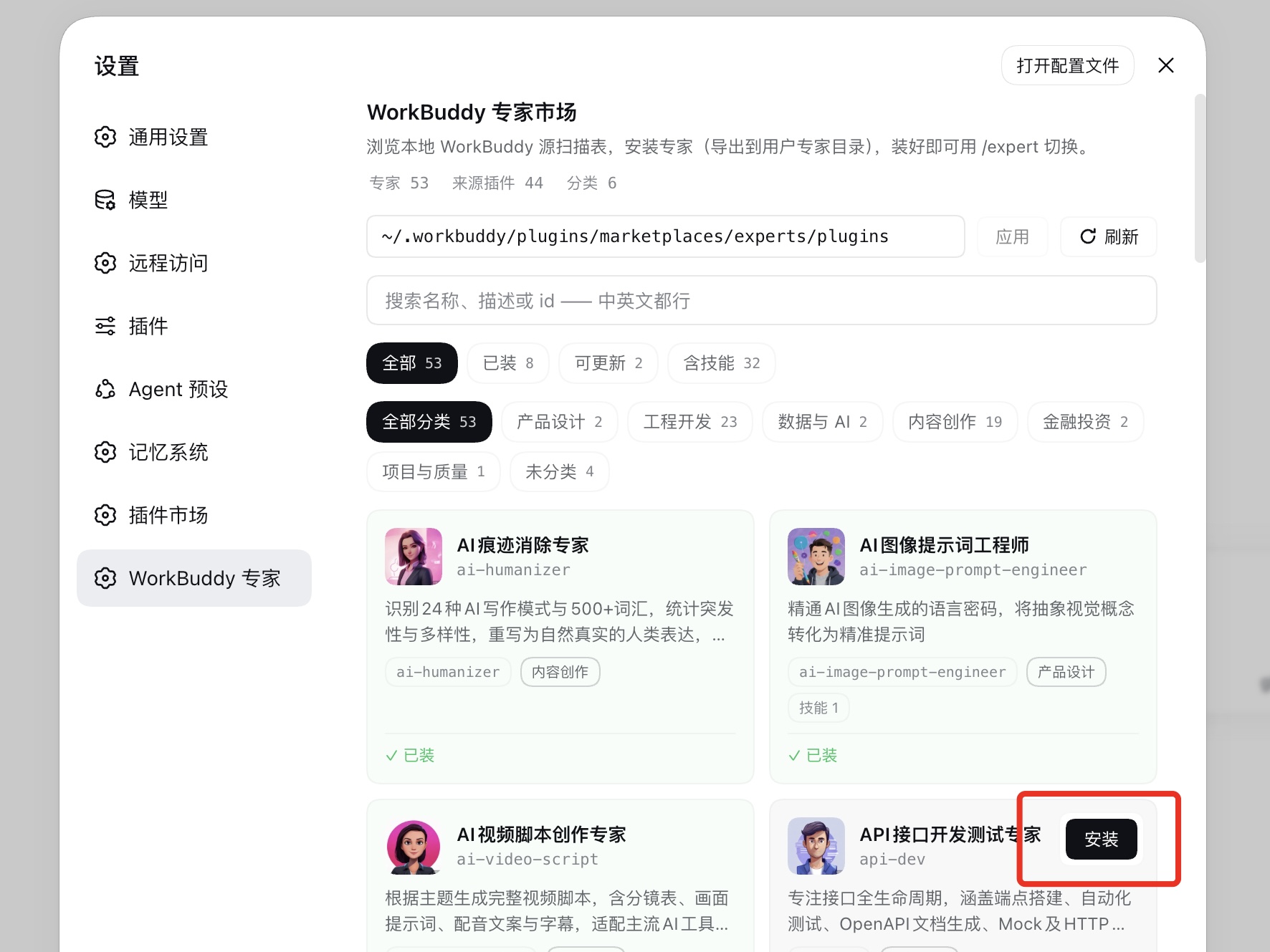
- Expert market (Settings → WorkBuddy Experts) — a read-only scan of your local WorkBuddy expert directory, with card browse/search/categories and one-click install / update / uninstall that exports into standard expert folders;
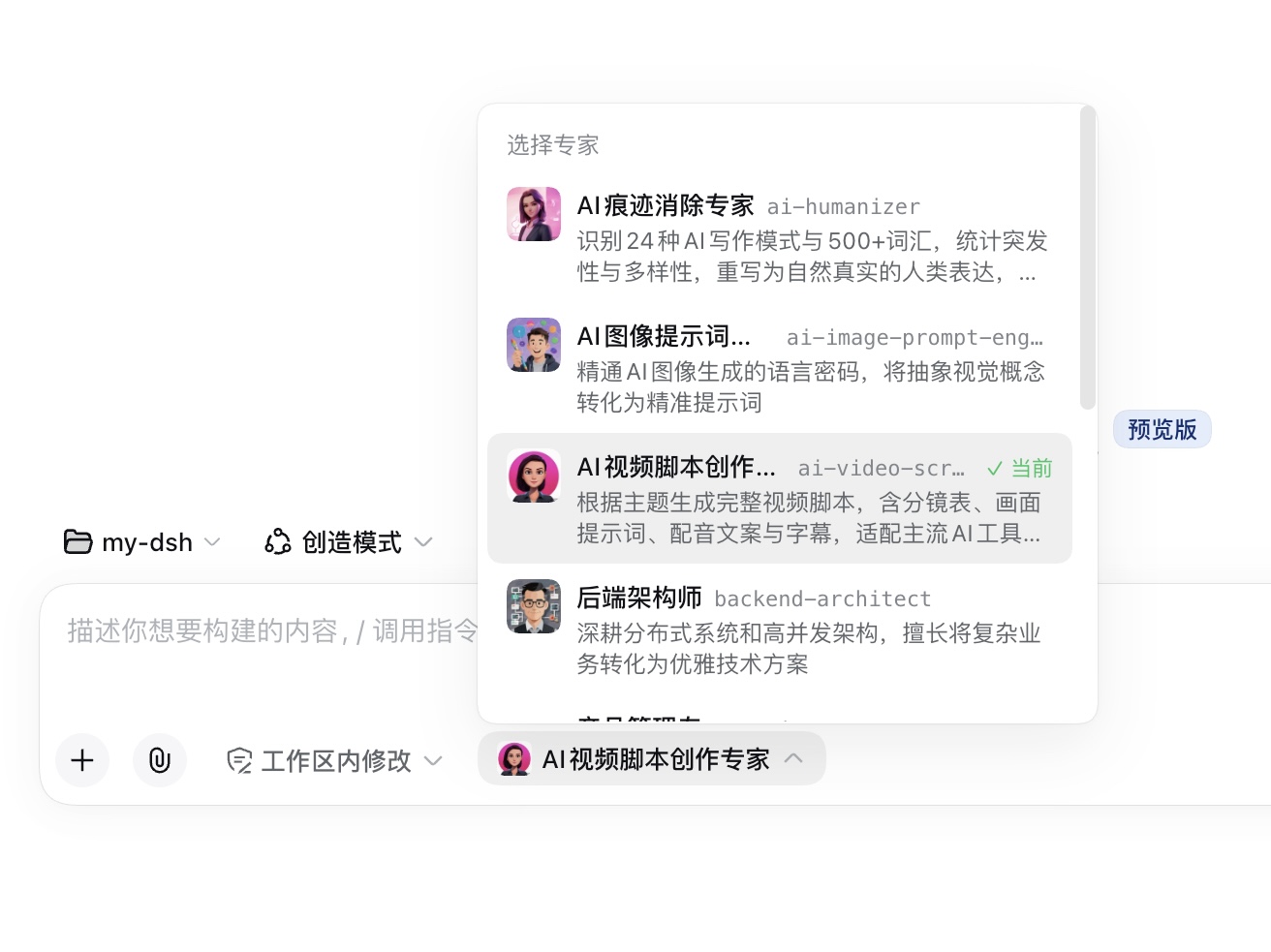
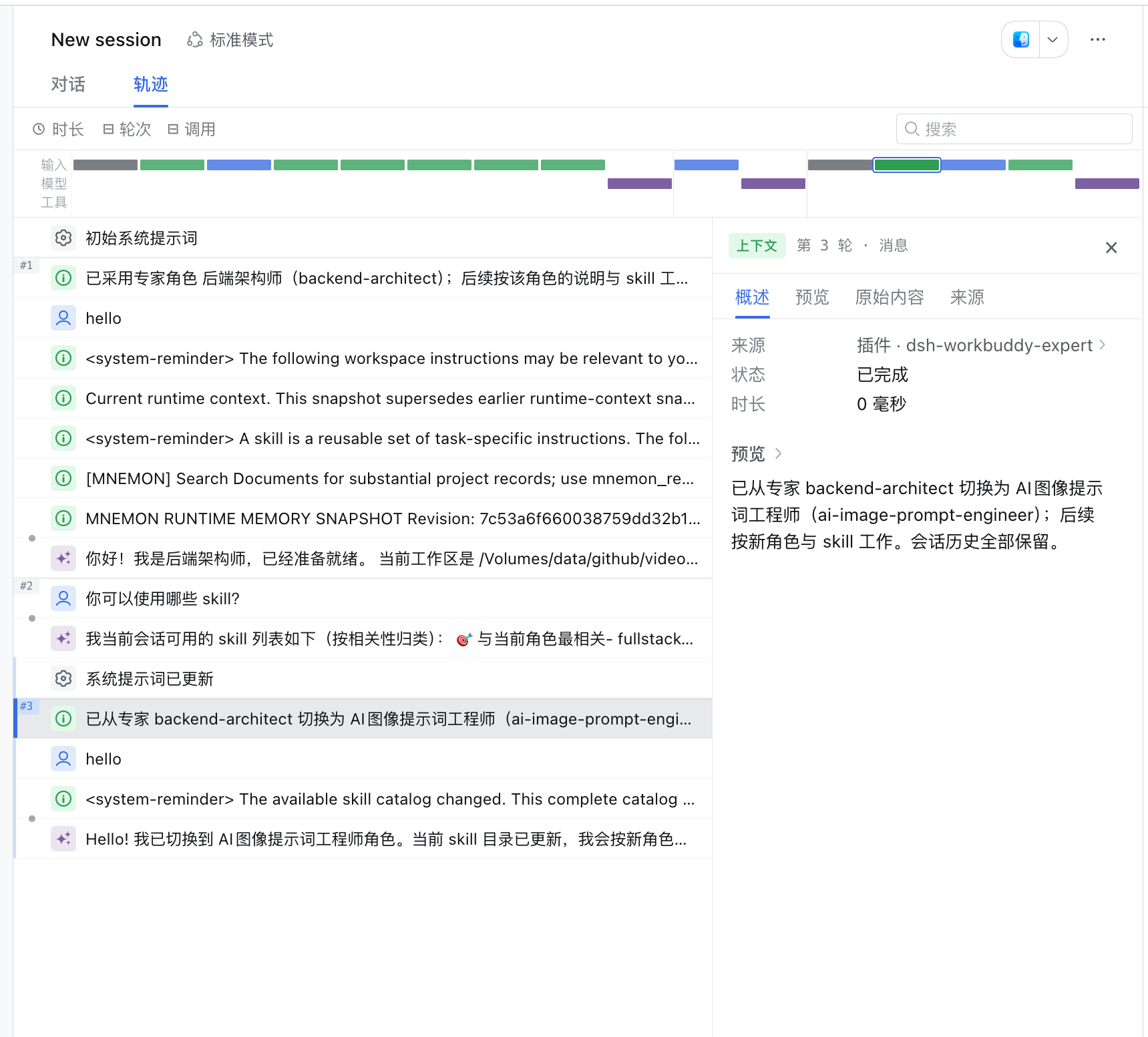
- Session selector — the expert capsule next to the composer switches the current session's expert anytime: the role section and skills are swapped as one group, the full session history is kept, and the change takes effect at the next model-request boundary without interrupting an in-flight turn;
- A complete expert experience — installed experts carry their role description, dedicated skills, and avatar; the selector list is ready to use right away.
Expert source
The plugin does not download experts from the network — the market page reads a local expert directory that the WorkBuddy desktop app maintains (default ~/.workbuddy/plugins/marketplaces/experts/plugins). An expert lands there only after you click Summon on it in the WorkBuddy Expert Center; only then can this plugin scan it:
If you have never summoned any expert, the market page shows an empty list — summon a few in the Expert Center and cards appear automatically. "Default source directory" below always means this path.
Features
1. WorkBuddy expert market (Settings → WorkBuddy Experts)
- Read-only scan of your local WorkBuddy expert directory (default path see "Expert source") — never written to, zero data egress;
- Card browse/search/categories; action buttons live on the card's top-right corner (not installed → Install; installed → Uninstall/Update);
- Install = export into a standard expert folder at
~/.dsh/experts/<id>/(expert.yml, sanitized role.md, the whole skills tree, plus an avatar when the source card has a PNG), with the fingerprint manifest in.expert-source.json; - Update: cards light up updatable when the source changed; update is an in-place re-export. Uninstall: deletes the expert folder;
- Orphans: after switching sources, experts installed from another source are listed under "installed but not in the current source" — listed only, never blocking.
2. Session selector (with avatars)
- The expert capsule next to the composer expands into an avatar-carrying expert list; pick one to switch;
- Avatars are exported at install time (
avatar.png, fetched on demand via/api/expert-avatar); no avatar falls back to an emoji; - Switching keeps the full session history: the role section and skills are swapped as one group, taking effect at the next model-request boundary; an in-flight turn queues the switch until its boundary, never interrupting streaming output;
- Switch transactions are serialized: one switch per session at a time;
- Every registration lands in agent scope: it affects only the current session and unwinds automatically when the session ends;
- You can also pick an expert when creating a new session — it composes immediately on creation, so a cold session never sits in a "selected but not effective" state;
- No restart needed for added/removed experts — the discovery roots are watched and the selector (composer area + session-creation entry) refreshes itself.
3. Expert capabilities ride the session
Once an expert is selected, its capabilities mount onto the current session:
- The role description (role.md) is injected as a system-prompt role section;
- Dedicated skills (the whole skills/ tree) register and unregister with the expert;
- An optional tool allowlist (expert.yml
tools.allow) mounts a scoped tool restriction that lifts automatically on switch-away; - Experts with broken manifests are listed as broken with reasons in the selector — never silently hidden.
Quick start
Prerequisites:
- one of two hosts: the DeepSeek Harness desktop app (Electron) or terminal
dsh web. They run different profiles (desktopvsweb) with different install entrances — see below, and don't install into the wrong one; - the WorkBuddy desktop app installed, with at least one expert summoned — see "Expert source" for the mechanism and default path;
Install the plugin
The two hosts run different profiles (desktop: ~/.dsh/profiles/desktop; CLI: ~/.dsh/profiles/web) that never mix — installing into the wrong one does nothing for your host. The desktop's desktop profile is managed exclusively by Electron — dsh --profile desktop ... fails with managed exclusively by the Electron application — so desktop users should not copy the --profile web commands below.
Desktop app (DeepSeek Harness) — install via the in-app plugin panel:
- Open the sidebar Plugins panel and click Add plugin;
- Enter the plugin's npm package name
dsh-workbuddy-expert(i.e. the part afterdsh plugin addin the official plugin-download instructions; the Git addressgithub:pbwheel/dsh-workbuddy-expert, a tarball, or the absolute path of a local clone also works); - Restart the desktop app after install (the bundle list is read at startup only).
Terminal (dsh web) — one-liner, npm package name or Git address both work (always the latest version, no manual clone):
dsh plugin --profile web add dsh-workbuddy-expert
# or install from GitHub:
dsh plugin --profile web add github:pbwheel/dsh-workbuddy-expert
Or clone and install from the directory:
git clone https://github.com/pbwheel/dsh-workbuddy-expert.git
cd dsh-workbuddy-expert
dsh plugin --profile web add .
dsh --profile web --dump-config
Both install the latest version on the default branch; dsh-workbuddy-expert should appear in the config dump. Then restart dsh web (the bundle list is read at startup only) and hard-refresh the browser. Zero build; the only runtime dependency is the host's own schema factory, @deepseek-ai/schemastery (exact-pinned).
Ask an agent to install it
Inside the desktop app, send this to any agent (it installs into the current profile — no terminal needed):
Please install the DSH plugin dsh-workbuddy-expert (source: github:pbwheel/dsh-workbuddy-expert) into the current profile, then tell me how to restart and start using it.
Terminal users send this to any agent that can run terminal commands on your machine:
Install the DSH plugin dsh-workbuddy-expert from this repository into my web profile: git clone https://github.com/pbwheel/dsh-workbuddy-expert.git, then run dsh plugin --profile web add <directory>. After installation, run dsh --profile web --dump-config, confirm the configuration includes dsh-workbuddy-expert, and explain how to restart dsh web and start using it.
Use a WorkBuddy expert in three steps
- Open Settings → WorkBuddy Experts (default source path see "Expert source"; editable in the topbar). Empty list? No expert summoned yet — see "Expert source";
- Click Install on a card — the expert is exported to
~/.dsh/experts/; - Back in a conversation, click the expert capsule next to the composer, pick the freshly installed expert, and start chatting.
The command line works too: /expert lists all experts, /expert <name> switches.
Configuration
| Option | Default | Purpose |
|---|---|---|
sourcePath |
~/.workbuddy/plugins/marketplaces/experts/plugins |
WorkBuddy source directory; the tilde is stored verbatim and expanded on use; a not-yet-existing path may be saved (the page shows a notice until it exists) |
roots |
— | Optional extra discovery roots; explicit trust: user required |
dshHome |
$DSH_HOME or ~/.dsh |
Overrides DSH home resolution |
Configuration rides DSH 0.2's Config form model: saving sourcePath takes effect through the host's volatile chain without remounting the plugin; roots/dshHome remount per Loader semantics. Form projection and the save chain: see the design doc.
Extra-root example:
- name: 'dsh-workbuddy-expert'
  config:
    roots:
      - path: ~/company-experts
        trust: user
Per-file fingerprints trigger automatic rescans; the Refresh button forces one.
sourcePath has two editing entrances over the same data, kept in step through the host's volatile chain:
- Settings → WorkBuddy Experts (the market-page topbar);
- Plugins → dsh-workbuddy-expert → Configure (the Plugins page's native row config page, with revision conflict protection and reset-to-default).
Development
node scripts/smoke.mjs            # contract/sanitize/registry/switch smoke
node scripts/smoke-client.mjs     # client side
node scripts/smoke-importer.mjs   # importer/market routes
node scripts/smoke-install.mjs    # install=export pipeline
node scripts/verify-host-contract.mjs  # Config/volatile chain against real host packages
Host-side changes (src/, package.json) need a host restart (restart the desktop app, or dsh web on the CLI); client-only changes (client/client.js) take effect on page refresh.
| Module | Responsibility |
|---|---|
src/registry.js |
Expert-folder scanning, validation, sanitization, watcher |
src/compose.js |
Session composition: role section + skills + tool allowlist |
src/switch.js |
Switch transaction |
src/importer/ |
WorkBuddy scanner/fingerprint/export/market routes |
client/client.js |
Selector + market-page UI |
Design and decision log: docs/design.md.
License
MIT © 2026 dsh-workbuddy-expert contributors
Comments
Comments live in GitHub Discussions. Sign in with GitHub to post or react.