
Install
Inside DeepSeek Harness, with dsh-market
dsh plugin --profile web add dshmarket
Or from the command line
dsh plugin --profile web add github:lire1131/dsh-undo-plugin
Installing runs third-party code with your own permissions — it can read your files, use your credentials and reach the network. Review the source first, and pin a commit (github:owner/repo#sha) when you can.
Screenshots

README
DSH crash-rescue plugin: undo config & plugin-code changes, secret-safe snapshots, one-click SAFE MODE, plus offline CLI/GUI that work even when DSH won't boot.
An undo/rollback system for DeepSeek Harness (DSH): every plugin install, skin switch or settings change is auto-snapshotted; manual saves whenever you want; one-click undo / redo / restore to any version — plus offline CLI & GUI tools that still work even when DSH fails to boot.
Preview
| v0.3.5 conversation header: iconized Undo / Redo / Snapshots buttons + auto-snapshot status badge (click the badge to open the panel) |
|---|
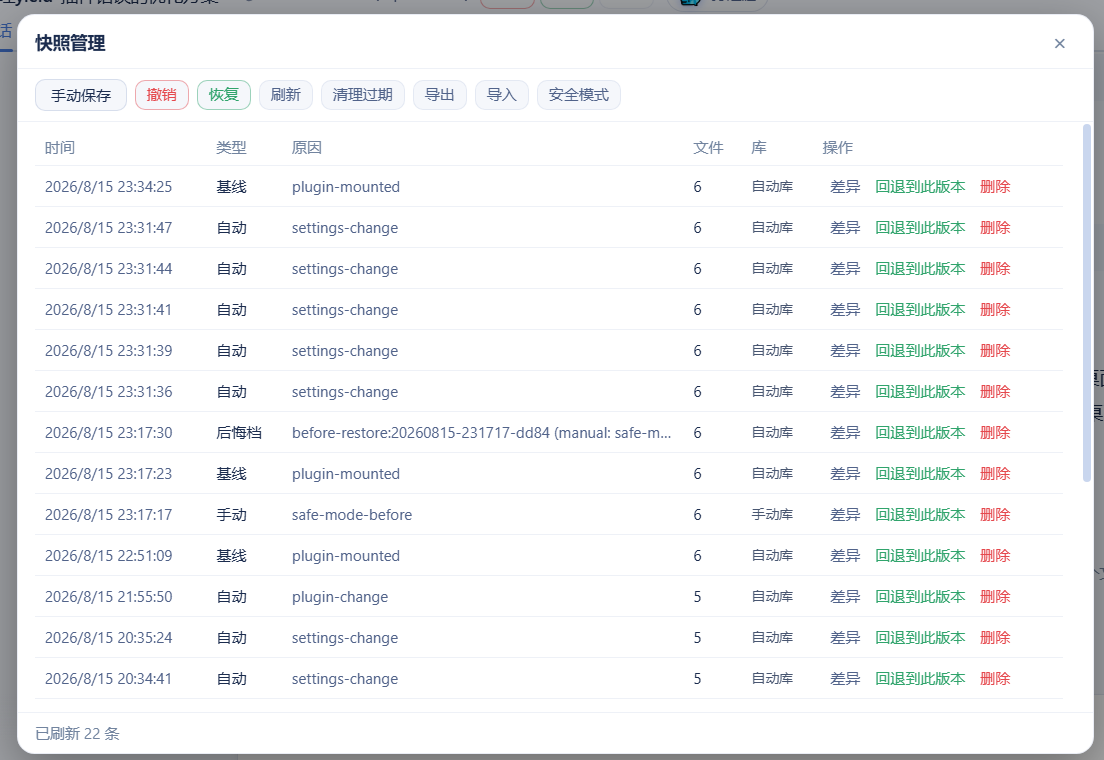
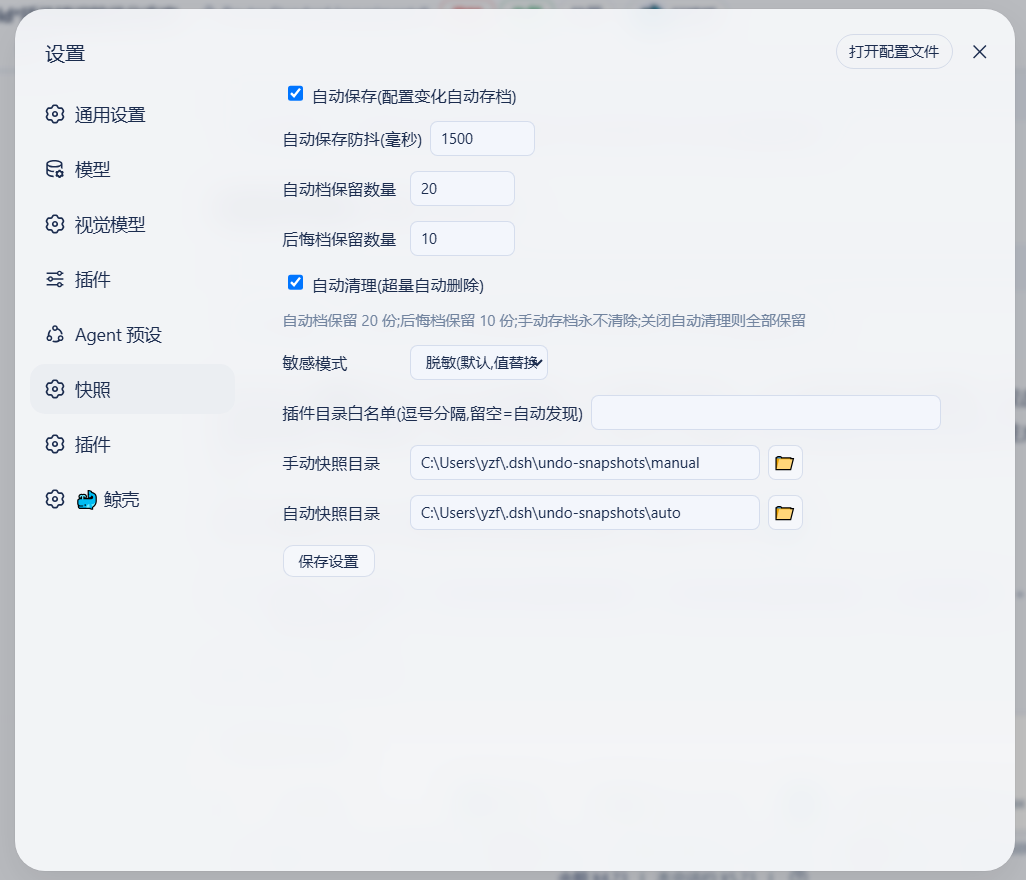
| WebUI snapshot manager (diff / restore / delete / clean-up / export / import / SAFE MODE) | WebUI Settings — own "Snapshots" section (sensitive mode / plugin whitelist / dir pickers) |
|---|---|
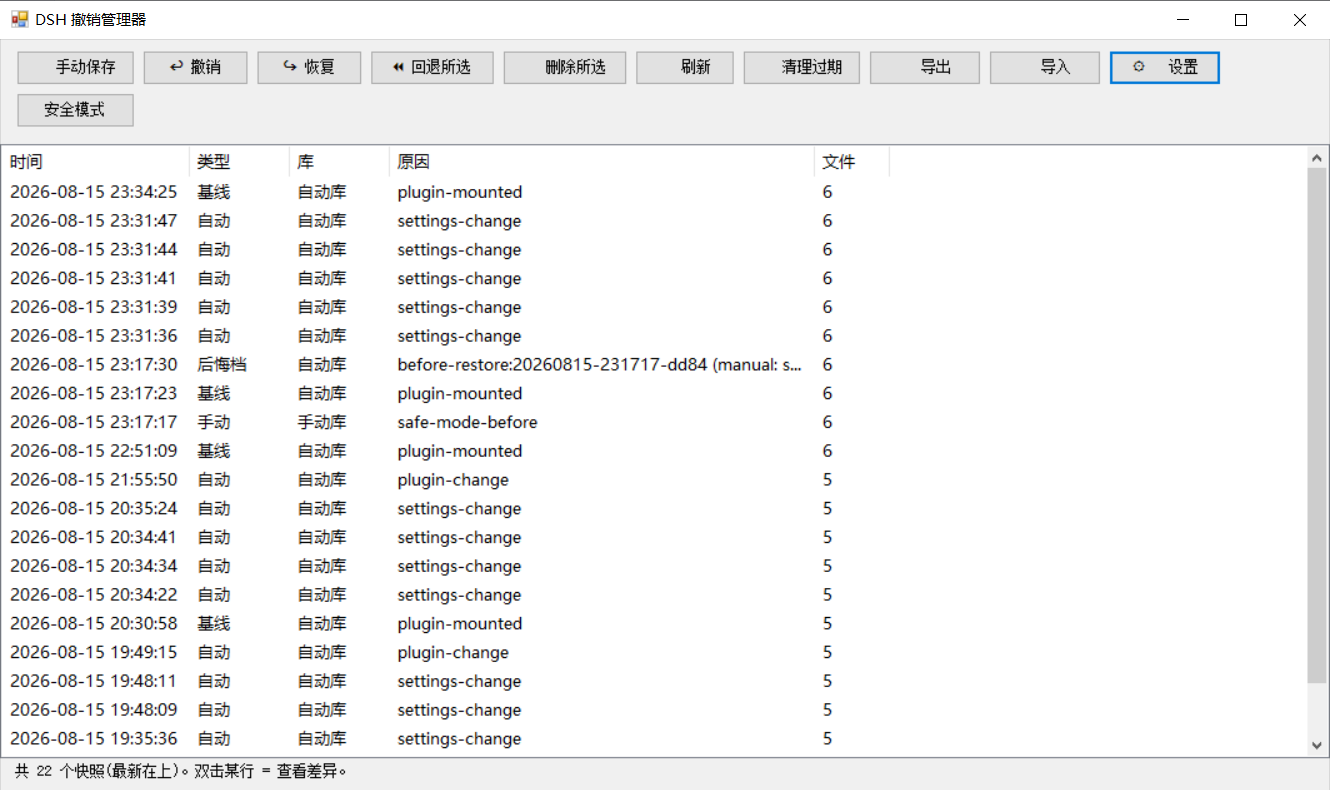
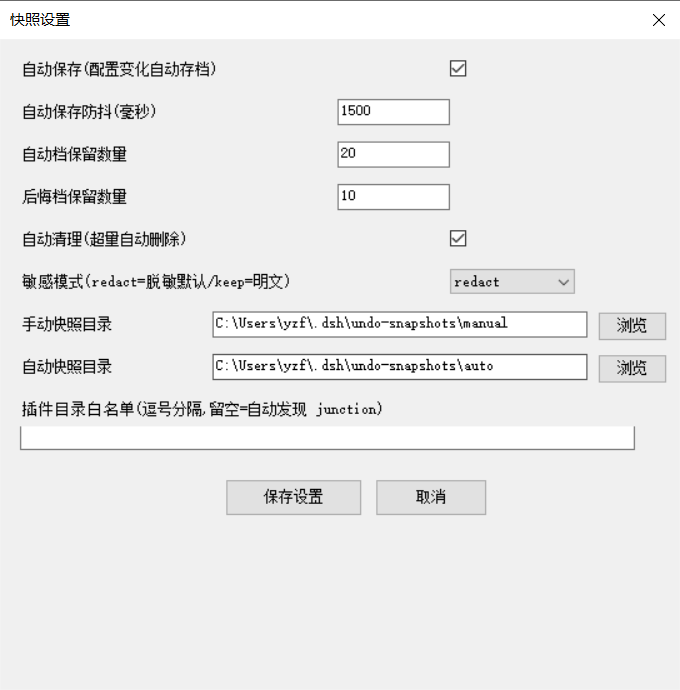
| Offline GUI (two-row toolbar + SAFE MODE button; works when DSH is down) | Offline settings dialog (sensitive mode / Browse dirs) |
|---|---|
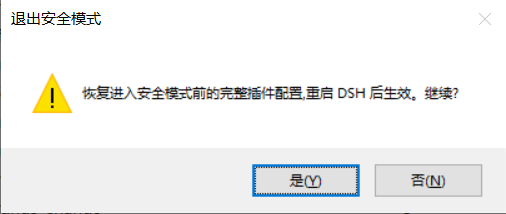
| SAFE MODE confirmation (enter / exit) | SAFE MODE status notice |
|---|---|
Features
| Capability | What it does |
|---|---|
| Config + plugin-code rollback | Snapshots cover config files AND user-plugin code trees — any broken edit is undoable (incl. pure code incidents like the whale-kit yield* crash); undo / redo / restore-to-any-version from WebUI, chat or offline CLI |
| Secret redaction + local vault | .env / credentials enter snapshots auto-redacted (structure preserved) — exported ZIPs are safe to share; real values live in a local vault, local rollbacks restore them fully |
| One-click SAFE MODE | When DSH cannot boot at all, temporarily disables every user plugin except the undo system so it always boots; auto-snapshots + config backup on entry, one-click exit |
| Crash attribution | After an abnormal exit, names the concrete last-known-good snapshot with a one-click rollback button — no guessing |
| Safe cross-machine migration | Restore preflights missing plugins and warns clearly; snapshots export/import as one-click ZIP (see docs/migration.en.md) |
| Offline emergency kit | CLI + GUI window + one-click desktop shortcut: undo / restore / SAFE MODE / crash banner / rollback log — everything works when DSH is down |
Basic capabilities (keyboard shortcuts, chat commands, auto-cleanup, dual save modes, configurable options, …) are covered below and in the Changelog.
Crash rescue quick reference (pick by scenario)
| Scenario | Action |
|---|---|
| Config/plugin mount broken | Chat / WebUI / CLI: undo or restore -Id <id> |
| Plugin code broken | Same (snapshots include plugin code trees, one-click restore) |
| Last run crashed, unsure what to roll back to | WebUI / GUI banner shows the last-known-good snapshot, one-click rollback |
| DSH will not boot at all | Desktop "DSH Undo Manager" → SAFE MODE button (or CLI safe-mode -Label on) → restart DSH, it always boots |
| Missing plugins after restore (cross-machine) | Preflight warning in the restore report; install first or use safe mode |
| "My config suddenly changed" | CLI recent / chat undo_recent check the rollback log |
| Rollback touched plugins/mounts | Report says "restart DSH for it to take effect" |
What is snapshotted & where
The snapshot captures DSH's 6 config files: cordis.patch.yml, package.json, cordis.yml, pnpm-workspace.yaml (under the profile) + settings.yaml, .env (under $DSH_HOME, default ~/.dsh).
| Store | Default path (configurable in settings) | Contents |
|---|---|---|
| Manual store | <snapshot root>\manual\ |
Manual snapshots (never auto-pruned) |
| Auto store | <snapshot root>\auto\ |
Auto snapshots, boot baselines, undo pre-restore snapshots (auto keeps latest 20) |
| Legacy store | <snapshot root>\ root |
Old flat layout — still read, auto-migrated on startup |
⚠️ Snapshots contain copies of
.envetc. which may include secrets — do not share or push them.
Multi-profile support (v0.3.3)
The plugin detects the active DSH profile from the launch arguments (dsh --profile mine / --profile=mine; dsh web falls back to web) and works per profile:
- Config directory: defaults to
$DSH_HOME/profiles/<current profile>(DSH_HOME defaults to~/.dsh; previously hardcoded toweb— under any other profile snapshots read the wrong files, the watcher missed changes, and restores wrote to the wrong place); - Snapshot stores: default to
<snapshot root>/<current profile>/{auto,manual}(per-profile isolation); if the scoped dir does not exist but the old flat store does, the flat store is used so legacy snapshots are never hidden; - Provenance: the manifest records a
profilefield andundo_listshows the current profile.
Offline CLI/GUI cannot see the launch arguments — set the DSH_UNDO_PROFILE environment variable or profileName in settings (default web).
Explicit configuration always wins: profileDir / manualDir / autoDir / profileName (config or settings).
Custom DSH home support (v0.3.5, issue #6)
The DSH data-home resolution matches the official launcher (@deepseek-ai/dsh-home-paths) exactly: $DSH_HOME wins (blank = unset; ~ / ~/ / ~\ prefixes supported), otherwise it falls back to <user home>\.dsh. The settings file ($DSH_HOME\undo\settings.json), default snapshot root ($DSH_HOME\undo-snapshots), profile dir ($DSH_HOME\profiles\<profile>), home root and plugin-discovery paths are all derived from it — third-party clients with a custom DSH_HOME no longer suffer the "two homes" split (settings written to ~/.dsh while DSH actually uses $DSH_HOME), and custom directories survive restarts.
Explicit overrides are preserved: DSH_UNDO_SETTINGS / DSH_UNDO_ROOT / DSH_UNDO_EXPORT (env vars) and the config keys homeDir / profileDir / manualDir / autoDir keep the highest precedence.
Installation
Prerequisites: DSH (@deepseek-ai/dsh) and Node.js (≥20).
Option A (recommended, ecosystem standard) — this plugin declares a dsh.bundle manifest, so install it with the official plugin command:
dsh plugin --profile web add github:lire1131/dsh-undo-plugin#master
Restart DSH after installing. Snapshot directories and options are configurable in Settings.
Option B (local source / pre-release) — clone and mount manually:
- Clone the repository into a local plugins directory (an ASCII path is safer), e.g.
D:\dsh\plugins\dsh-undo-savepoint:
git clone https://github.com/lire1131/dsh-undo-plugin.git D:\dsh\plugins\dsh-undo-savepoint
- Create a junction so DSH's module resolver can find the local package by name
dsh-undo-savepoint(used by both the host plugin and the WebUI client plugin):
mklink /J "<your-dsh-install>\node_modules\dsh-undo-savepoint" "D:\dsh\plugins\dsh-undo-savepoint"
DSH resolves package names by walking up from its own
node_modules. The default location isC:\Users\<username>\node_moduleswhen npm installed into the user directory; if you run DSH from an npx cache, junction into that cache'snode_modulesinstead. Check the path in DSH's startup error output or runnpm root -g.
- Mount it in the profile patch layer: edit
<DSH_HOME>\profiles\web\cordis.patch.ymland append:
- insert:
    - id: dsh-undo-savepoint
      name: dsh-undo-savepoint
- Activate: saving hot-reloads the host part; refresh the page to see the header buttons and settings rows; restart DSH for full steady state (legacy flat snapshots migrate automatically).
Dependency note: the host plugin loads
@deepseek-ai/dsh-toolsviacreateRequire('<dsh-install-root>/package.json'). If DSH lives elsewhere, set the environment variableDSH_ROOT=<dsh-install-root>— no extra package installation needed.
Where are the external tools? ("I installed it and cannot find it")
The external undo tools (GUI window + CLI) are not placed on the desktop — they ship inside the plugin install directory:
| Install method | Tool location |
|---|---|
Method A: dsh plugin add |
$DSH_HOME\profiles\web\node_modules\dsh-undo-savepoint\tools\ (DSH_HOME defaults to %USERPROFILE%\.dsh) |
| Method B: clone + junction | your clone ...\dsh-undo-savepoint\tools\ |
⚠️ The install command references the repo name
dsh-undo-plugin, but the installed folder is named after the package namedsh-undo-savepoint— searching by "repo name" will not find it.
One-click desktop shortcut (recommended — open the tools straight from the desktop afterwards):
Double-click tools\make-desktop-shortcut.bat (it auto-locates the plugin directory) and a DSH Undo Manager icon appears on the desktop;
or copy the whole block below into a PowerShell window and press Enter (no need to locate any file first):
$dshHome = if ($env:DSH_HOME) { $env:DSH_HOME } else { "$env:USERPROFILE\.dsh" }
$d = @("$dshHome\profiles\web\node_modules\dsh-undo-savepoint", "$dshHome\profiles\node_modules\dsh-undo-savepoint", "$env:USERPROFILE\node_modules\dsh-undo-savepoint") | Where-Object { Test-Path (Join-Path $_ 'tools\dsh-undo-savepoint-gui.bat') } | Select-Object -First 1
if ($d) {
  $w = New-Object -ComObject WScript.Shell
  $s = $w.CreateShortcut((Join-Path ([Environment]::GetFolderPath('Desktop')) 'DSH Undo Manager.lnk'))
  $s.TargetPath = Join-Path $d 'tools\dsh-undo-savepoint-gui.bat'
  $s.WorkingDirectory = Join-Path $d 'tools'
  $s.Save()
  Write-Host "Desktop shortcut created: $($s.FullName)"
} else { Write-Host 'Plugin directory not found — install it first: dsh plugin --profile web add github:lire1131/dsh-undo-plugin#master' }
Just want to open the tools folder:
$dshHome = if ($env:DSH_HOME) { $env:DSH_HOME } else { "$env:USERPROFILE\.dsh" }
explorer "$dshHome\profiles\web\node_modules\dsh-undo-savepoint\tools"
After that, double-click the desktop DSH Undo Manager icon to open the external tools (they work even when DSH itself fails to boot).
Usage
- Undo: header Undo button /
Ctrl+Alt+Z/ tell the AI "undo the last step". - Redo: Redo button /
Ctrl+Alt+Y(only when nothing changed since the undo). - Manual save: "Save" in the panel / tell the AI "save a snapshot" / CLI
snapshot. - Restore to a fixed version: click "Restore to this" on a row in the panel; or tell the AI "restore to "; or CLI
restore -Id <id>. - Delete a snapshot: "Delete" in the panel; or CLI
remove -Id <id>. - Custom shortcuts: Settings → General → Undo/Redo shortcut (click the box then press a combo; Backspace clears).
- Save options: Settings → General → Snapshot Settings (auto-save toggle, debounce, keep count, two directories; the 📁 button opens the native folder picker).
Offline tools (works even when DSH won't boot)
GUI language: the manager window follows the system UI language (zh/en); force it with
DSH_UNDO_LANG=zh|en.
From the repository directory:
# GUI window (recommended): double-click tools\dsh-undo-savepoint-gui.bat, or:
powershell -NoProfile -ExecutionPolicy Bypass -File "tools\dsh-undo-savepoint-gui.ps1"

# CLI
powershell -NoProfile -ExecutionPolicy Bypass -File "tools\dsh-undo-savepoint.ps1" list
powershell -NoProfile -ExecutionPolicy Bypass -File "tools\dsh-undo-savepoint.ps1" snapshot -Label "reason"
powershell -NoProfile -ExecutionPolicy Bypass -File "tools\dsh-undo-savepoint.ps1" undo
powershell -NoProfile -ExecutionPolicy Bypass -File "tools\dsh-undo-savepoint.ps1" redo
powershell -NoProfile -ExecutionPolicy Bypass -File "tools\dsh-undo-savepoint.ps1" restore -Id <id> -Force
powershell -NoProfile -ExecutionPolicy Bypass -File "tools\dsh-undo-savepoint.ps1" remove -Id <id>
powershell -NoProfile -ExecutionPolicy Bypass -File "tools\dsh-undo-savepoint.ps1" prune -KeepAuto 20

# Safe plugin install (auto snapshots before/after; auto-rollback on failure)
powershell -NoProfile -ExecutionPolicy Bypass -File "tools\dsh-plugin.ps1" add <package>
Typical rescue scenario: DSH fails to boot with something like duplicate loader entry id → open "DSH Undo Manager", pick the snapshot from before the change → Restore → restart DSH. No reinstall, no lost sessions.
REST API (backend of the WebUI)
| Endpoint | Description |
|---|---|
GET /api/undo/status |
{canUndo, canRedo, total} |
GET /api/undo/list |
Snapshot list (with location: manual/auto/legacy) |
GET/POST /api/undo/settings |
Read/write save options (auto-save, debounce, keep count, dirs); POST applies immediately |
POST /api/undo/undo |
Undo the last change |
POST /api/undo/redo |
Redo the last undo |
POST /api/undo/restore |
body {id} — restore to a fixed version |
POST /api/undo/remove |
body {id} — delete a snapshot |
POST /api/undo/snapshot |
body {reason} — manual save |
POST /api/undo/pick-dir |
Open the native folder picker, return the chosen path |
Design notes
- Undo semantics: auto snapshots are taken after a change, so "restoring the newest snapshot" would be a no-op; real undo restores the newest snapshot whose state differs from the current one. When everything matches, a clear "nothing to undo" message is shown instead of pretending.
- Undo can never undo itself: after restoring
cordis.patch.yml, the plugin re-ensures its own mount entry automatically. - Auto-archiving never sabotages undo: the watcher records content hashes of what a restore wrote, so the restore's own file changes are not auto-snapshotted (which would block redo); real changes are snapshotted as usual.
- Format parity: the Node plugin and the PowerShell tools share the same snapshot stores and manifest format; compatible with both Windows PowerShell 5.1 and PowerShell 7.
Development
- Dependency resolution: the host plugin loads
@deepseek-ai/dsh-toolsviacreateRequire(<dsh-install-root>/package.json)(override withDSH_ROOT), no in-repo dependencies required. - Tests (no DSH needed; run in the repository directory):
node tools\smoke-test.mjs     :: 29 logic tests (snapshot/undo/redo/store split/no-change hint)
node tools\e2e-watch.mjs      :: 6 real-timing regressions (auto-save/undo-no-harm/redo)