
Install
Inside DeepSeek Harness, with dsh-market
dsh plugin --profile web add dshmarket
Or from the command line
dsh plugin --profile web add github:izz-BLUE/dsh-deepseek-usage-dashboard
Installing runs third-party code with your own permissions — it can read your files, use your credentials and reach the network. Review the source first, and pin a commit (github:owner/repo#sha) when you can.
README
简体中文 | English
A standalone, installable Web UI plugin for DeepSeek Harness that:
- counts the daily DeepSeek token usage of this DSH instance from session logs (exact provider usage only — cache hit / cache miss input, output, reasoning),
- estimates today's cost per model from a user-editable price table,
- watches the DeepSeek account balance (Host-side, 10-minute refresh, manual refresh supported),
- shows it all in a Web GUI dashboard, a composer dock line, and a settings card.
Preview
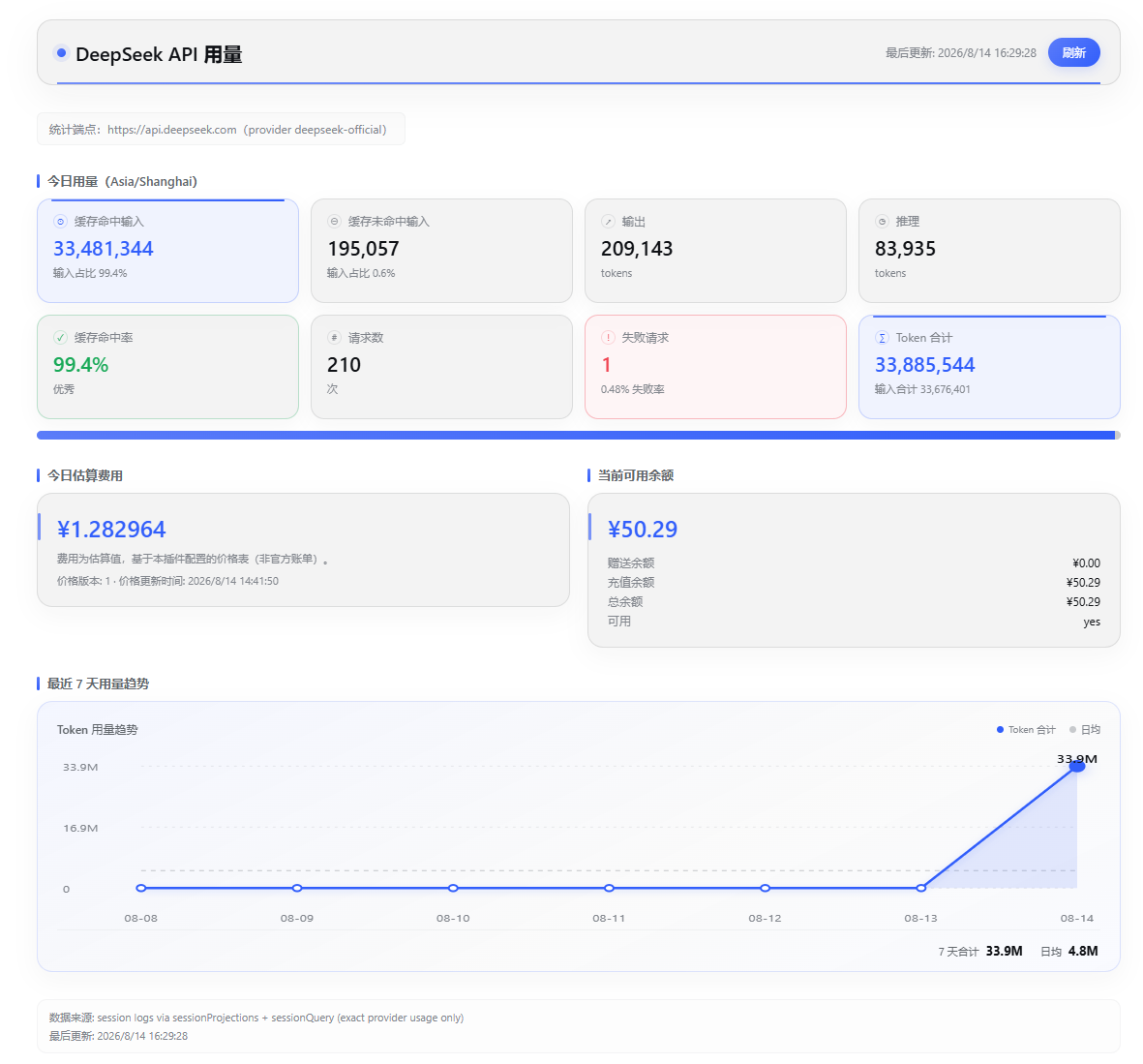
Built only on the official @deepseek-ai/* NPM SDK. It never modifies DSH sources; installation goes through cordis.patch.yml + the profile plugin mechanism. The plugin never calls any LLM interface: capture, refresh, display, and balance queries perform zero model calls, so idle running and page refreshes cost 0 tokens.
Features
- Daily statistics (Asia/Shanghai): cache-hit input, cache-miss input, output, reasoning (when reported), total input, total tokens, request count, failed request count, cache hit rate.
- Only real DeepSeek traffic counts: provider route
deepseek-official(configurable) and effective base URL hostapi.deepseek.com— a custom gateway does not pollute the statistics. - Streaming-safe: only the FINAL usage settles a record; streamed estimates are never written to the exact daily statistics.
- Idempotent + durable: SQLite (
node:sqlite, built into the Node 24 runtime) with aUNIQUE (session_id, turn, step)constraint andINSERT OR IGNORE, so projection replays, duplicate streaming usage, restart re-scans, and duplicate event submissions can never double-count. Survives restarts; corrupt files are moved aside and recreated. - Decimal money: cost is accumulated in integer micro-units (1e-6 CNY) with BigInt — no float accumulation. Prices are configured per model (
cacheHitInputPricePerMillion,cacheMissInputPricePerMillion,outputPricePerMillion,currency,effectiveFrom) with a*fallback, editable in the settings page; the UI displays the price-table version and its update time, and every amount is labelled estimate, not an official bill. - Balance: Host-only
GET https://api.deepseek.com/user/balance(fixed base URL, 10 s timeout, 401/402/429/5xx/timeout/malformed handled separately); the last good snapshot is retained and shown as stale after a failure; manual refresh included. The API key never reaches the browser, logs, or request parameters. - Host HTTP API:
/api/deepseek-usage/stats+/api/deepseek-usage/refresh, gated by the DSH browser-trust fence (Host / Origin / Sec-Fetch-Site, reproduced from the official api-request-trust semantics) plus a loopback-socket check; balance detail is loopback-only; POST requiresapplication/json; bodies are size-capped; no arbitrary URL/file/command proxy. - Web UI: sidebar entry "API 用量" (or "API Usage"), dashboard with today cards, cache hit/miss bar, hit rate, estimated cost, balance (total / granted / topped-up), 7-day trend, last-updated + data-source footer; a compact
conversation.composer.dockline (今日:命中 X · 未命中 X · 输出 X · 估算 ¥X · 余额 ¥X); full zh + en locales; DSH CSS tokens only (light/dark themes); nodangerouslySetInnerHTML.
Install
dsh plugin --profile web add https://github.com/izz-BLUE/dsh-deepseek-usage-dashboard.git
Restart dsh web. The sidebar gains an "API 用量" entry; the composer shows the today line.
For local development, install a checkout with:
dsh plugin --profile web add link:<path-to-this-repository>
To register it into the
dsh-web-ui-allaggregate, append the package topackages/dsh-web-ui-all/aggregate.yml(patchFrom+deps) and runnode scripts/aggregate.mjs.
Verify
pnpm typecheck
pnpm test
pnpm build
Configuration
Settings namespace deepseek-usage (settings page → plugin config, or ~/.dsh/settings.yaml):
| field | default | meaning |
|---|---|---|
enabled |
true |
master switch |
providerId |
deepseek-official |
provider route counted as DeepSeek |
balanceRefreshMinutes |
10 |
balance refresh interval |
prices |
see DEFAULT_PRICE_ENTRIES |
per-model price table |
Data lives in ~/.dsh/deepseek-usage/usage.db (SQLite). The API key is resolved through @deepseek-ai/dsh-credentials on the llm-deepseek credential reference (default DEEPSEEK_API_KEY), with the host process environment as the documented fallback.
Data source & mapping
The statistics come from session event logs via the official replayable projection registry (ctx.sessionProjections, the same seam @linxin666/dsh-live-stats uses) plus a startup catch-up scan over ctx.sessionQuery. The runtime capture only ever sees the harness TokenUsage produced by the official DeepSeek adapter (@deepseek-ai/dsh-llm-deepseek, translate.mapUsage):
| DeepSeek wire field | harness TokenUsage (adapter-converted) |
dashboard bucket |
|---|---|---|
prompt_cache_hit_tokens or prompt_tokens_details.cached_tokens (adapter prefers the latter) |
cacheReadTokens |
cacheHitInputTokens |
prompt_tokens - cacheRead (disjoint; the adapter discards the native prompt_cache_miss_tokens) |
inputTokens |
cacheMissInputTokens |
completion_tokens |
outputTokens |
outputTokens |
completion_tokens_details.reasoning_tokens |
reasoningTokens |
reasoningTokens |
| (never reported by DeepSeek) | cacheWriteTokens (absent) |
contributes 0 |
The plugin's own exported wire reference mapping mapWireUsage (src/core/mapping.ts) prefers the native DeepSeek billing fields: cacheHit = prompt_cache_hit_tokens ?? prompt_tokens_details?.cached_tokens, cacheMiss = prompt_cache_miss_tokens ?? max(0, prompt_tokens - cacheHit). cached_tokens is only a fallback spelling and never unconditionally overrides a native hit (the two are not proven semantically identical), and the fallback miss can never go negative. Because the runtime capture path only sees the adapter-converted TokenUsage, the buckets stay exactly as the harness reports them (cacheHit = cacheReadTokens, cacheMiss = inputTokens); the reference mapping is for integrations that map wire payloads themselves. Tests: tests/mapping.spec.ts.
Security
- The API key exists only in the Host process (credentials seam → env fallback); it is never logged, never sent to the browser, and never accepted from request parameters.
- Balance responses are sanitized to
is_available+balance_infos[].{currency,total_balance,granted_balance,topped_up_balance}; raw error bodies, headers, and the credential never cross the boundary. - Routes are loopback-only with the DSH browser-trust fence; no arbitrary URL/file/command proxying exists.
Known limitations
isTrustedApiRequestis not exported by the official SDK, so the fence reproduces its documented semantics locally (same Host/Origin/Sec-Fetch-Site rules, no trustedHosts).- A step whose provider reported no usage and whose turn completed normally produces no row (usage is unknown); failed requests are counted from
error/abortedturns without usage. - Steps are attributed to the header in force when they start; a mid-turn header change applies to the following steps.
- The balance endpoint is fixed to
https://api.deepseek.comand is not configurable (per spec). - Estimates are based on the configured price table — DeepSeek's official bills are authoritative.
- Runtime token buckets come from the official adapter's
mapUsage: it prefers theprompt_tokens_details.cached_tokensspelling and discards the nativeprompt_cache_miss_tokens(deriving miss asprompt_tokens - cacheRead). The plugin cannot recover the native fields at runtime (nonode_modulespatching), so when the two cache spellings disagree, the hit/miss split of newly captured usage may diverge from the official bill; the plugin-side reference mappingmapWireUsagealready prefers the native fields. - SQLite uses Node's built-in
node:sqlite; the database file is a single machine-level store under~/.dsh/deepseek-usage/.
License
BSD-3-Clause
Comments
Comments live in GitHub Discussions. Sign in with GitHub to post or react.