
Install
Inside DeepSeek Harness, with dsh-market
dsh plugin --profile web add dshmarket
Or from the command line
dsh plugin --profile web add dsh-custom-mode
Installing runs third-party code with your own permissions — it can read your files, use your credentials and reach the network. Review the source first, and pin a commit (github:owner/repo#sha) when you can.
README
English | 中文
DeepSeek Harness (dsh) custom mode plugin — edit a mode's system prompt, base mode and plugin switches in the settings page, and keep several assistants side by side (multi-mode / multi-persona, coding, chat or role-play). · 中文:DeepSeek Harness(dsh)自定义模式插件 —— 在设置页编辑系统提示词、选择基础模式、逐行 开关插件,可并存多个助手(多模式 / 多角色扮演 RP)。
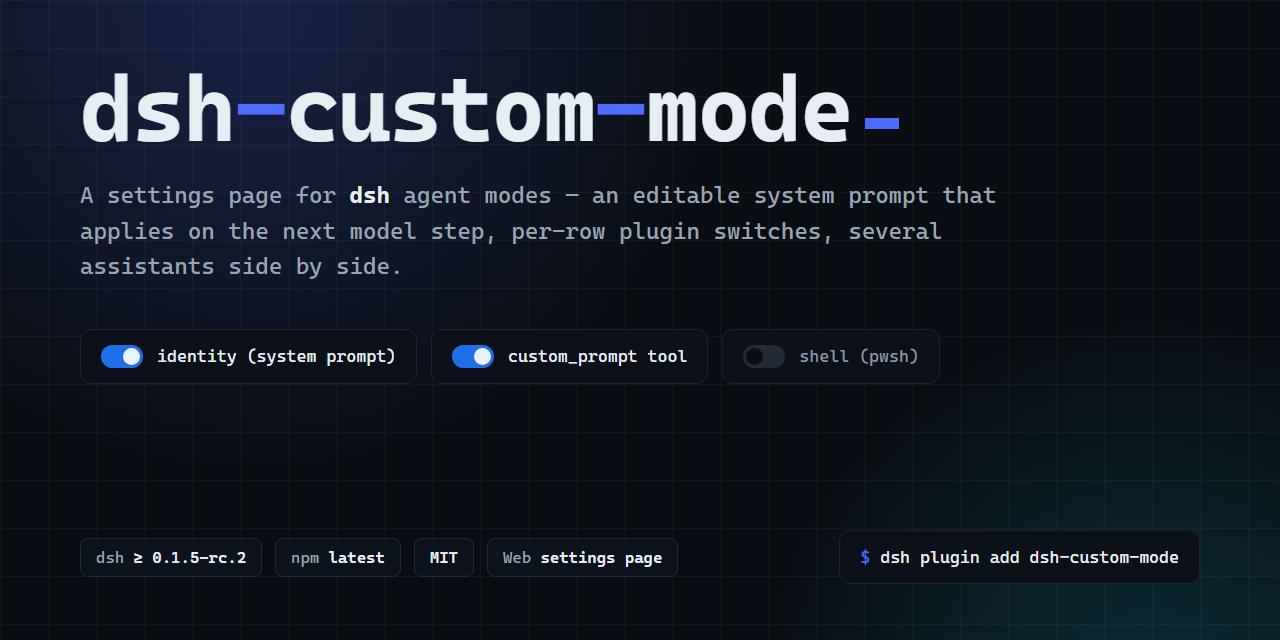
A custom mode for DeepSeek Harness (dsh). Its system prompt is a plain file you can edit on the Web settings page, and an edit takes effect on the next model step — no restart, no new session.
In one line: a settings page for dsh agent modes — choose a mode's base composition, toggle the plugin rows it mounts, and edit its system prompt, which the agent loop re-reads before every model step. Several modes ("assistants") can live side by side, each with its own prompt.
Also searched for as: custom mode · custom prompt · system-prompt editor · multi-mode / several assistants · multi-agent · roleplay (RP) / chat personas.
Two dsh lines are supported: the newest line and the previous stable — both checked on every push,
neither merely claimed. npm's latest and next have both pointed at 0.2.0-rc.2 since 2026-09-29, so
"latest stable" and "latest preview" are one release now; the second leg stays because most installs in
the field are still on 0.1.7-rc.2:
| dsh | role | status |
|---|---|---|
0.2.0-rc.2 |
newest line — npm's latest and next, and the line the official desktop app ships (it is version-locked to dsh) |
✅ CI (ubuntu node 20/24 + windows) + a real instance: install, composition and the seeded preset verified on this line (the full render gate runs here) |
0.1.7-rc.2 |
previous stable — still inside the declared range, and what most existing installs run | ✅ CI + a real instance: verified rendered on this line since 1.9.15 |
Older builds (0.1.5-rc.3, 0.1.6-alpha.*) use the same mechanisms and remain inside the declared peer
range, but they no longer get a CI leg of their own.
The four official modes (standard / ptc / minimal / cordis) are untouched.
 |
 |
 |
 |
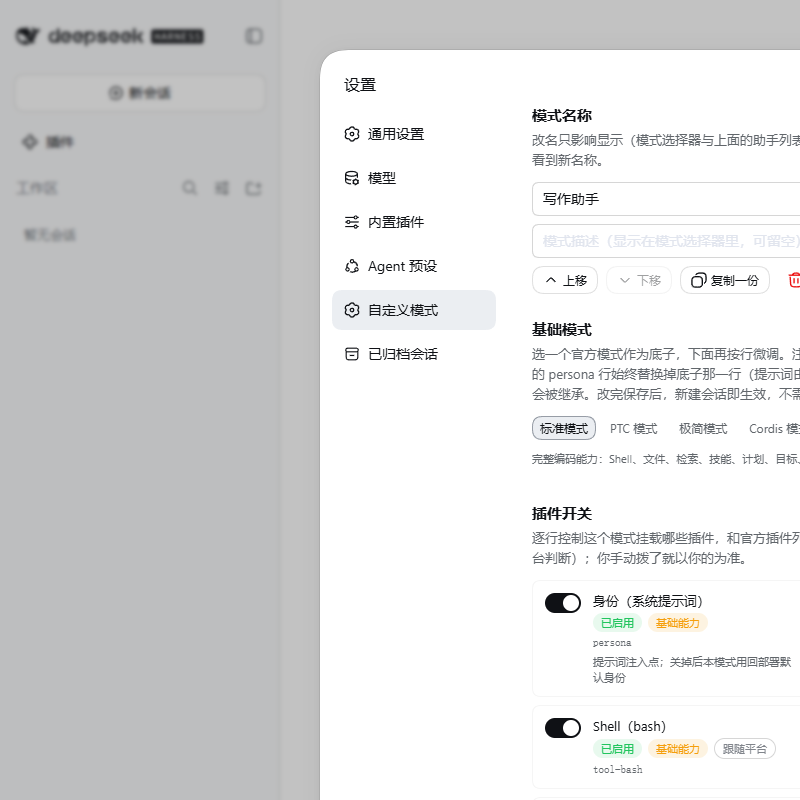
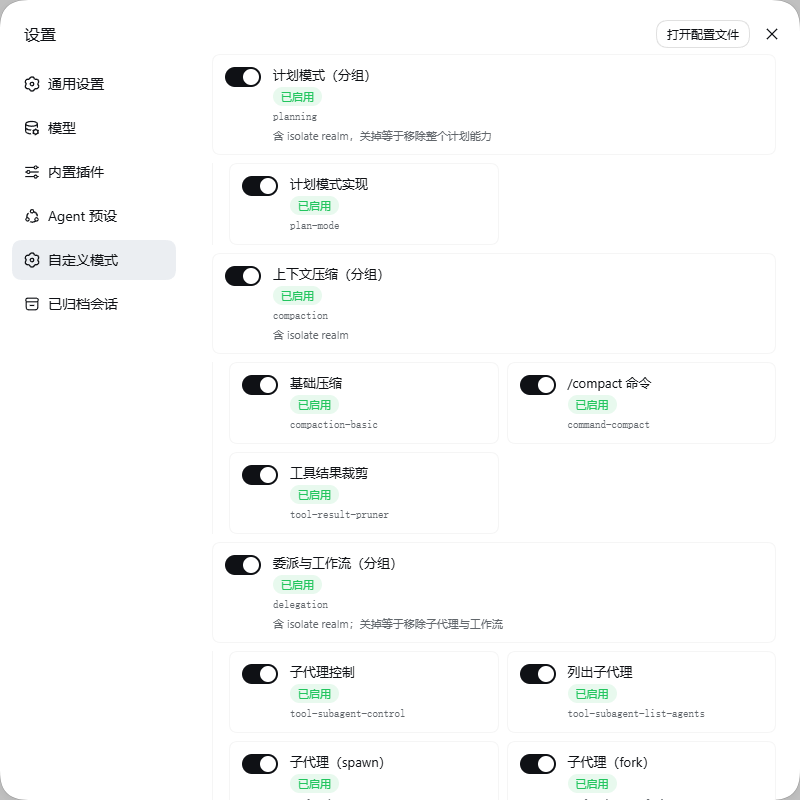
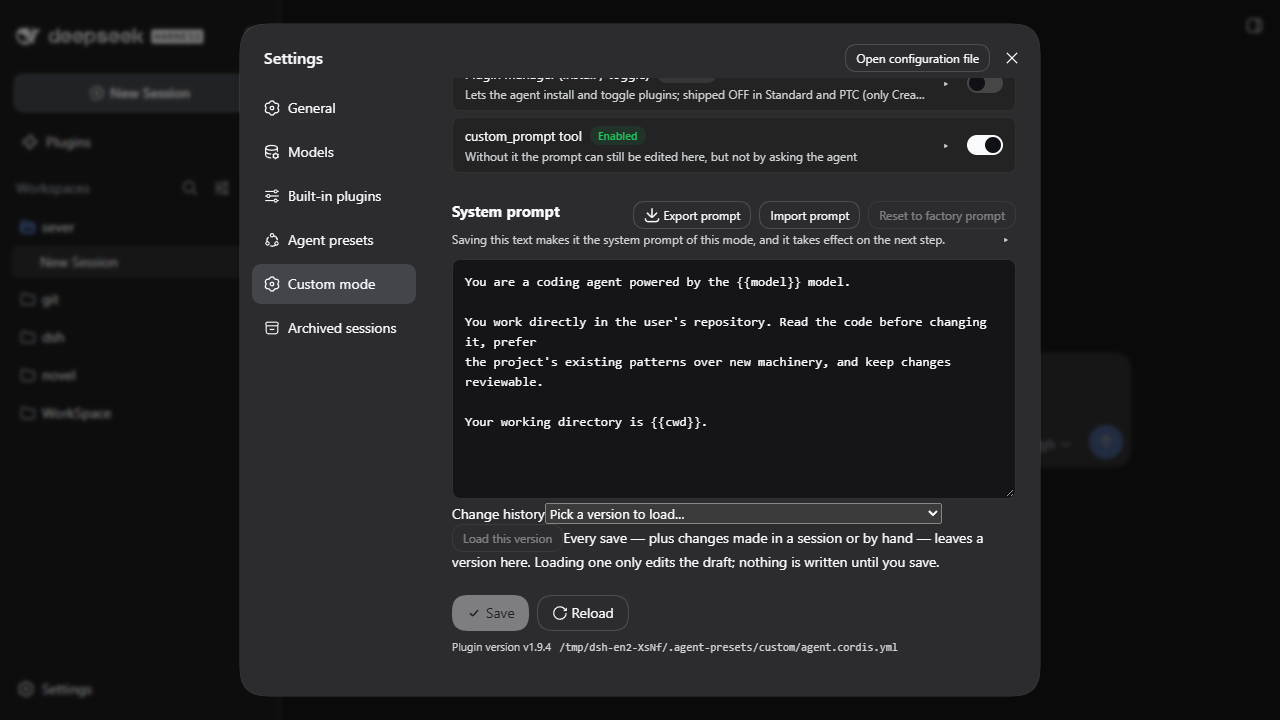
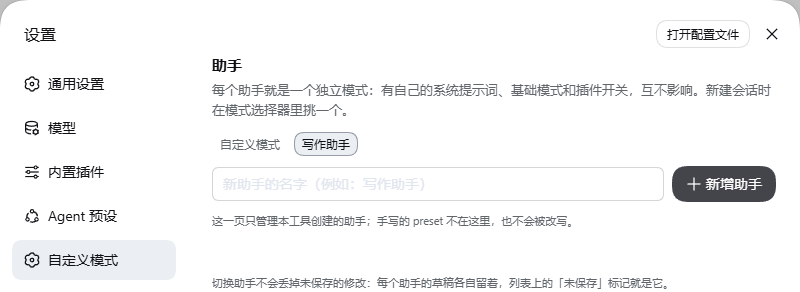
The assistant manager, cropped to its own section. All five images are English, all exactly 800x800, and
shot on a throwaway DSH_HOME with no sessions by tools/screenshots/shoot-fresh.mjs (the rendered page
is what tools/browser-verify.mjs checks):
Install
One command installs everything — the settings-page plugin, and the preset it seeds on first activation:
dsh plugin --profile web add dsh-custom-mode@1.11.5   # pin the version to get this one for sure
# A bare `add dsh-custom-mode` is subject to pnpm's release cooldown (`minimumReleaseAge`, 1 day by
# default): for hours after a release it can silently install an OLDER version — measured: a bare
# install 38 minutes after 1.3.0 shipped landed on 1.0.3. Check what you got with `npm ls
# dsh-custom-mode` inside the profile, or pin the version as above.
Restart dsh afterwards, then choose「自定义模式」for a new session. The preset is written to
$DSH_HOME/.agent-presets/custom/; anything already there is left alone, so a prompt.md you wrote
yourself is never overwritten.
Platforms: the suite runs on every push under Ubuntu (Node 20 and 24) and Windows (Node 24) — the
Windows job exists because that platform has its own failure modes (MSYS paths in install.sh, rename
locking under concurrent saves, platform expressions evaluating the other way). Both shell scripts work in
any POSIX shell, Git Bash included.
Installing from the interface (no terminal)
From dsh 0.1.6-alpha.2 there is a Plugins page: sidebar → Plugins → Add plugin. It takes three
kinds of input, and all three work here:
| Input | What to paste |
|---|---|
| Package name | dsh-custom-mode |
| GitHub repository URL | https://github.com/BOWLUNA/dsh-custom-mode (the repository root) |
| Local plugin directory | <your clone> — the repository root, which is the package |
There is also an in-app market for browsing the whole ecosystem: install dshmarket
(dsh plugin --profile web add dshmarket), open Settings → Plugin Market and search
dsh-custom-mode — its cards read the engines.dsh range this plugin declares, and the curated shots
listed in the repository's screenshots.json (five images; they are the same docs/images/*.png
files the README shows, so each picture exists once).
All three work because the repository's root package.json is the published package: dsh.bundle,
main and exports["./client"] are declared there, so an npm install and a GitHub-URL install fetch
the same files. Before 1.10.0 this repository carried two manifests — a private: true wrapper at the
root plus editor/package.json — and that is what made third-party catalogues render the plugin as
dsh-custom-mode#editor and what made dshfind-derived cards read the wrapper's private: true and
report "not published to npm". One manifest at the root, and test/manifests.test.mjs keeps it that way.
On the desktop app
The desktop application is part of dsh itself (apps/desktop), version-locked to it — Electron and
@deepseek-ai/dsh always carry the same exact version — and it is the complete Web application in an
Electron shell, so this plugin's page renders there unchanged. One install path, and it is the one above:
- Install from inside the app: sidebar → Plugins → add plugin → search
dsh-custom-mode. The app runs the shared plugin manager with its own bundled pnpm. - Do not try to use a standalone CLI for it — dsh itself refuses (measured on 0.1.7-rc.2, and again on
0.2.0-rc.2):
The desktop owns$ dsh plugin --profile desktop add . error: profile "desktop" is managed exclusively by the Electron application$DSH_HOME/profiles/desktop: package operations there hold a profile transaction lock and startup recovery renamescordis.patch.yml.install.shtherefore refuses--profile desktoptoo and points you at the app, so the two agree instead of one silently working around the other. (A lab simulation of the profile shape can override it withDSH_ALLOW_DESKTOP_PROFILE=1.) The app's own bundled CLI is the exception —<install>\resources\runtime\cli\bin\dsh.cmdis allowed to operate on that profile (measured on 1.11.1:add dsh-custom-mode@1.11.5→+ dsh-custom-mode 1.11.1). It is a launcher, not a dsh feature: it starts Electron withELECTRON_RUN_AS_NODE=1and runs the desktop-host CLI, so it is the app talking to its own profile rather than something driving from outside. - Nothing else to do on the preset side:
$DSH_HOME/.agent-presets/is product data shared by the desktop app and the CLI, and the preset is seeded by the plugin on first activation. - If the mode does not show up in the picker, open Settings → Custom mode and read the warning. A preset
whose rows cannot start on that machine is marked broken by the platform and dropped from every picker;
the settings page names the rows and offers Fix for this line. On the desktop line that can take one
click and then a restart of the app — the picker re-reads the registry only at boot (measured on
1.11.1, see
docs/MEASUREMENTS.mdsection 34). - If a third-party bundle ever keeps the app from starting, the native recovery dialog offers Disable third-party plugins; installed packages and the plugin's own data stay on disk.
Compatibility is declared, not assumed. dsh checks every plugin's
peerDependencies["@deepseek-ai/dsh"] against the running runtime (prereleases included), and since
0.2.0 that check is an installation gate, not a warning: a range that does not cover the runtime
means dsh plugin add refuses the package outright
(installation rejected: Plugin … is incompatible with dsh 0.2.0-rc.2). The declared range therefore
is the support statement, which is why it moves only after the new line has been installed and tested
— a range that "probably" works is exactly the kind of claim that turns into a support ticket.
To keep the sources around as well — or to install without npm — clone and run the script, which does the same two things explicitly:
git clone https://github.com/BOWLUNA/dsh-custom-mode
cd dsh-custom-mode
./install.sh            # copies preset/ into $DSH_HOME/.agent-presets/custom/ and installs the plugin
./uninstall.sh          # removes the plugin; keeps your prompt unless you pass --purge
The mode needs a profile that ships agent-presets — the web profile does, tui and headless do
not.
Trying it without installing anything
Every release carries a dsh-custom-mode.dshpreset beside the source
(latest).
It is a zip holding one ready-to-use assistant: manifest.json plus preset/ — the composition, a
prompt.md, the reader that re-reads it before every model step, and a model-facing tool that reads and
rewrites that prompt. Import it in the desktop app and you have a working「自定义模式」without
installing a package:
| What you get | one assistant whose system prompt is a plain file. Edit it in any editor — the agent loop re-reads it before every model step, so the change applies on the next step, with no restart. Or just ask the model to rewrite it: the preset ships exactly that tool. |
| What you don't get | the settings page. That is what the plugin adds — the page itself, plus managing several assistants side by side and picking one from the new-session menu. |
So the preset is the 30-second way to see what this is, and the plugin is the way to live with it.
Importing the preset does not conflict with installing the plugin afterwards: the plugin seeds its own
preset under $DSH_HOME/.agent-presets/ and never overwrites a prompt.md you wrote.
Usage
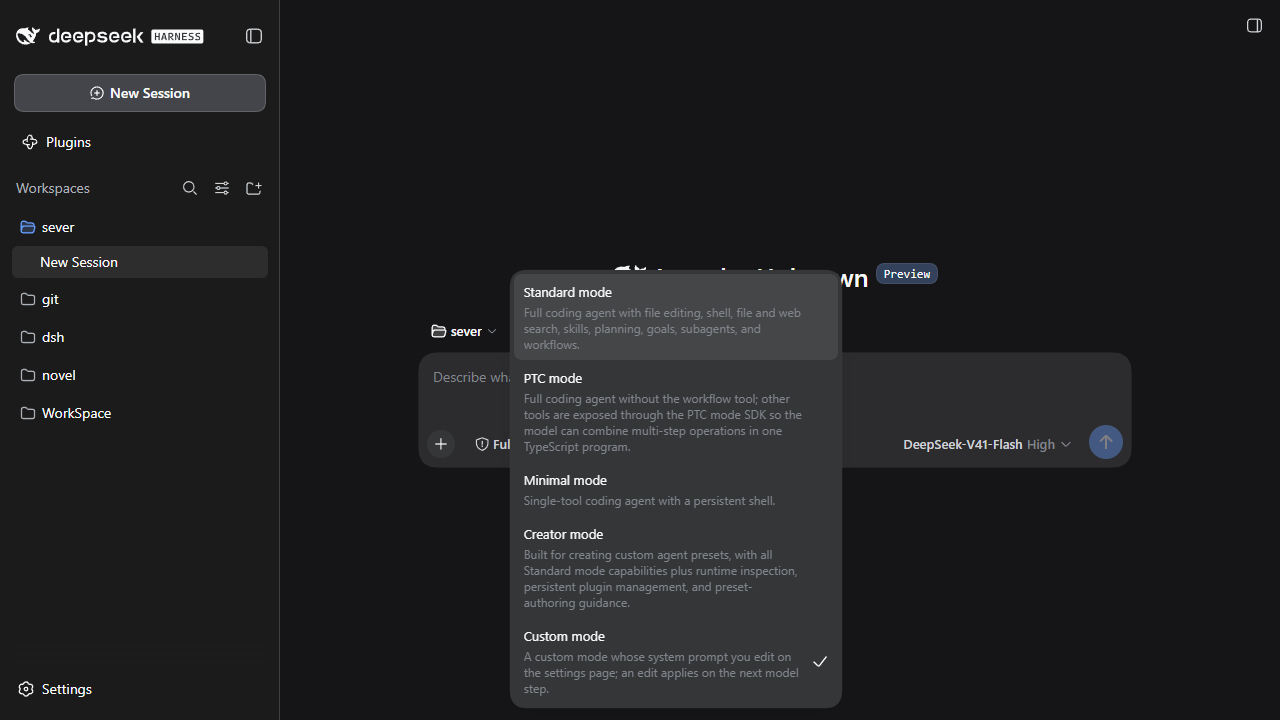
The settings page (Settings → "Custom mode") is an assistant manager: the top of the page lists every custom mode you have — create, switch, delete — and the four blocks below (name, base mode, plugin switches, system prompt) edit whichever one is selected.
- Ordering — "Move up / Move down" writes the order into each assistant's
preset.yml(order, the roster's own sort key), so it survives a restart and the new-session picker follows it. - Import / export a prompt — "Export prompt" saves the current text as a
.md; "Import prompt" reads a file into the editor (nothing is written until you save), so an import goes through the same{{…}}validation as anything typed. - Asking the agent to change its own prompt requires your approval. The in-session
custom_prompttool goes through the platform's approval seam (tools/pre-executereturningask), so the request waits for an explicit「允许一次」and shows what would be written and where. Measured: with theaskapproval policy the panel appears and approving really writes; withnever(full access) nothing prompts and the call is denied. The worst case is therefore "the change does not happen", never "it happened quietly". - 配置了却不生效会被点名 — the page warns when a setting cannot take effect: the「身份(系统提示词)」
row is off while
prompt.mdstill has content (so your prompt is silently ignored), thecustom_prompttool row is off, the assistant has no name or no description (the picker shows the bare id /「暂无描述」). - The agent can change its own prompt, with your approval — the in-session
custom_prompttool reads the prompt, replaces it, or appends to it. Appending matters because it never has to reproduce the whole prompt: an agent that wants to remember one rule cannot lose existing content on the way (measured: it may still read first to see what it is adding to). Both writing actions go through the platform's approval panel first. - Change history — every save, and any change made outside this page (the in-session
custom_prompttool, a hand edit ofprompt.md), leaves a version in the history list under the prompt box, labelled with when and where it came from. Loading one only edits the draft: nothing is written until you save, so browsing old versions cannot destroy the current one. Before this, a prompt changed from inside a session was invisible — the page only ever showed "the current text". - Reset to the factory prompt — one click puts the shipped template (the text a new assistant starts from) back into the editor. It is draft-only like every other edit: nothing is written until you save, and Reload discards it. Before this existed, a prompt you had edited into a corner could only be recovered by deleting the assistant and creating it again.
- New assistant — type a name and click "New assistant". It is seeded from the packaged template: the full Standard row set plus a starter prompt, selectable in a new session as soon as you save it — in an already-open page the picker's list is a load-time snapshot, so refresh (F5) once to see a new assistant there (measured; the roster itself is up to date).
- Duplicate — copies the selected assistant's prompt, base mode and row switches into a new one; the two are independent afterwards.
- Each assistant is independent — its prompt, base mode and row switches are its own; changing one leaves the others alone.
- Base mode is the row set, not the prompt — it decides which rows exist and which tools the mode has;
this plugin always replaces the base's
personarow with its own reader (complete: false), so the base's prompt semantics are not inherited. Minimal is the visible case: you get minimal's tool set, not minimal's prompt. - A fifth base mode: Custom — the union of every shipped row. The first four are dsh's own; the fifth is
synthesised by this plugin. Its row set is the union of those four, and a row declared by more than one
mode keeps the text and shipped default of whichever mode comes first in
standard → ptc → minimal → cordisorder — so standard's shipped state wins where there is a conflict. Why it has to exist: a switch can only rewrite a row the base text already has, so on Standard the rows only PTC declares (tool-presentation), only Minimal declares (the persistent-terminal group) and only Cordis declares (tool-cordis) were unreachable — not hidden in the UI, just absent from the composer. Measured on0.2.0-rc.2: standard 32 rows, PTC 33, Cordis 33, Minimal 7, and the union 40. Groups travel whole with theirisolaterealms and!!jsconditions intact, so the union cannot invent a row thatdsh-agent-presetswould refuse to mount. - The two shells cannot both be on, and the plugin moves the switch for you. The union contains one
mutually exclusive pair: Minimal's "persistent terminal" set and standard's
tool-bash/tool-pwshare two implementations of the same thing — both register a tool calledbash. Enabling both makesdsh-agent-presetsmark the whole mode broken, and a broken mode is silently dropped from every picker while the settings page stays green. So in Custom mode, turning one side on turns the other off, and the save message says which row moved. A conflicting combination written outside the page (hand edit, another tool) is named by a warning instead of failing silently. - Switching assistants never discards drafts — each keeps its own unsaved edits, marked "Unsaved" in the list; the only path that throws edits away is the reload button, which renames itself to say so.
- Delete — a confirmation, then the plugin does the removal itself. Which confirmation depends on the
line: when the shell hands a third-party client plugin its
RiskConfirmationatom you get the shell's own dialog with a tick-box; on0.1.7-rc.2the client seed table only exposesButton/Input/Switch/Tag/Pill, so it degrades to a nativeconfirm(same guardrail, one prompt instead of a dialog). Removal works on both lines:0.1.6and older haveagentPresets.remove(), while0.1.7+ has no such call at all — there the plugin disposes its own registration and removes the directory. It only removes the mode directory from disk: sessions already using it keep running (their composition was read when they started), and new sessions no longer offer it. - Ask the agent — every assistant ships a
custom_prompttool, so a session can read or rewrite its own prompt. - Edit the file —
$DSH_HOME/.agent-presets/<assistant id>/prompt.mdis that assistant's single source of truth.
Only {{model}}, {{cwd}} and {{provider}} are interpolated. An unknown {{…}} is rejected when
saved: the renderer throws on it, which would fail every request in that mode.
Every control (buttons, inputs, switches, tags, the confirmation dialog, icons) comes from the
shell's own @deepseek-ai/dsh-client-ui-primitives, so theme, light/dark and future restyling reach
this page automatically; a shell that does not provide those atoms falls back to built-in plain
controls with the same behaviour.
An "assistant" is one directory under the user preset root (default $DSH_HOME/.agent-presets/),
and its directory name is its internal id. The page manages only presets this tool created — the
test is that the directory carries prompt.md and that its composition injects identity through
prompt-reader.mjs. Any other hand-authored preset is neither listed nor touched: the page
regenerates a composition from a base mode, and doing that to a hand-written one would destroy it.
How this differs from the built-in Plugins page
From dsh 0.1.6-alpha.2 the harness ships a Plugins page that can enable and disable plugins live.
It and this mode's per-row switches act at different levels:
| Built-in Plugins page | This mode's per-row switches | |
|---|---|---|
| Scope | The whole profile — what this machine has installed | One agent mode — which rows its composition mounts |
| Typical use | Turn a plugin off globally | Keep Standard fully loaded and trim this mode to what it needs |
They coexist: the harness decides what the machine has, this mode decides which of it the mode uses.
The boundary is drawn by upstream: the Plugins page documents that it manages "the profile's bundles and their uniquely addressable rows", and states plainly that agent-preset rows remain read-only. The preset layer is therefore out of its reach — and that is exactly the layer this mode covers.
A demonstrable example: tool-plugin-manager (the agent-facing install/toggle tool) ships off in
Standard and PTC — only Creator enables it. The official modes give you no way to change that; here
you flip one switch.
How it works
dsh normally takes the system prompt from a preset's YAML, and @deepseek-ai/dsh-persona resolves its
prefix once at mount. This preset registers the same deployment:persona-prefix section but makes
its text a function, which the agent loop calls before every model step.
Two different things therefore decide when a change lands:
- Prompt text is re-read per step, so an edit applies to the running session immediately.
- Switches and base mode rewrite the composition file.
agent-presetsremounts a preset when that file'smtimeMsandsizechange, so a new session picks them up; a running session keeps the configuration it started with, which is deliberate — swapping a tool set mid-conversation would be wrong.
Row switches are tri-state. A row you never touched stays byte-identical to the shipped one, including
its !!js platform condition and its shipped disabled state; an explicit on/off replaces that
condition with a boolean. Platform expressions are evaluated on the host, so the page shows the state
actually in force on this machine rather than whether a key exists.
Several assistants need no new mechanism: dsh-agent-presets already scans every directory under
the user preset root, and re-reads those roots on each roster call, so a directory created just now is
selectable the next time a session is started. Each assistant's prompt-reader.mjs / prompt-tool.mjs
resolves prompt.md relative to its own module location, so N copies are N independent prompts.
Creation seeds the packaged template; deletion goes through the platform's agentPresets.remove() where it
exists and through the plugin's own dispose-and-remove path where it does not (0.1.7+),
which refuses a shipped preset and re-checks that the directory really lives under the writable root.
Versioning
The package version is its own line — 1.0.0, then 1.0.1, … It does not mirror the DSH release.
What this plugin supports is declared in engines.dsh and the @deepseek-ai/dsh peer range in
package.json, and tools/verify-version-consistency.mjs (run in CI) asserts that the DSH
version CI installs and tests falls inside those ranges.
Two lines are supported: the newest line (0.2.0-rc.2, which npm's latest and next both point at
since 2026-09-29, and the line the desktop app ships) and the previous stable (0.1.7-rc.2 — still inside
the declared range, and what most existing installs run) — declared as
>=0.1.5-rc.2 <0.2.0-0 || >=0.1.6-alpha.1 <0.2.0-0 || >=0.1.7-alpha.1 <0.2.0-0 || >=0.2.0-0 <0.3.0-0 (the extra clauses exist because
semver only matches a pre-release inside a range that names its own major.minor.patch), and CI installs both
and runs the whole suite against each — the rendered gate runs on the newest line, because that is
where the shell's own UI changes land first.
The official desktop app (DeepSeek Harness Desktop) is covered too: it is version-locked to dsh and now
ships 0.2.0-rc.2, i.e. the same combination this matrix pins. Install it from inside the app (sidebar →
Plugins); the CLI is refused for that profile by dsh itself. On 0.2.0-rc.2 measured (2026-09-30, clean
throwaway DSH_HOME): dsh plugin --profile web add dsh-custom-mode resolves the package in 640 ms, the
composition tree carries the row, boot seeds all five preset files, the declarative registry syncs the
assistant, and the agentPresets capability set is unchanged (list, register, inventory, select, document).
Two reasons for the split. A bare x.y.z is what directories and markets require before they will
auto-install a package — several resolve npm latest and reject anything carrying a prerelease tag.
And a version string was never a checkable claim anyway: the declared range is, and it is the thing
that goes stale when upstream moves. What decides compatibility in practice is still whether the APIs
below exist, which is what the ranges are for.
| Dependency | Failure if it changes |
|---|---|
ctx.systemPrompt.section() with a function text |
the prompt stops hot-reloading — the point of the project |
agentPresets remounts on composition mtimeMs+size |
switches need a process restart to apply |
ctx.tools.register() |
loses the custom_prompt tool |
ctx.connection.fetch.register({ path, methods, requestBody, fetch }) |
settings page 404s — nothing is registered |
kind: 'prefix' matching both path and path/… |
only the list opens; /state, /create, /delete all 404 |
agentPresets.list() rows carrying id / trust / path, with preset.yml supplying name / description |
the assistant list is empty or unrecognisable |
agentPresets.remove(id) (legacy only), refusing trust: 'system' |
0.1.7+ deletion no longer needs it — the declarative backend disposes the registration and deletes the directory instead |
the /api channel's fence (Host/Origin + browser auth) |
the page cannot authenticate at all; do not "fix" it by moving the route to the raw webServer table |
ctx.inject(deps, cb) (scoped wait) |
the row parks in pending in profiles without a web server |
dsh.client + exports["./client"], client bundle id == package name |
the browser half is not discovered |
settings.section slot (id / order / label) |
page placement and label |
settings.section no longer takes locale: (since 0.1.6-alpha.2) |
the shell does not hand over a t bound to this namespace; the page carries its own dictionaries as a floor — see ARCHITECTURE §15 |
preset.yml's order participating in the roster sort |
move up/down stops working |
ctx.locale.register/bind |
falls back to Chinese |
where the base composition comes from — agentPresets.readDocument(<mode>).content on 0.1.7+, the @deepseek-ai/dsh-agent-presets files before that |
the base mode and the plugin switches become read-only (the prompt still saves); see base-composition.mjs |
shipped layout <presets>/<id>/agent.cordis.yml and row text shape |
base-mode switching breaks |
!!js platform expressions |
platform rows display the wrong state |
Documentation
docs/TROUBLESHOOTING.md— failures reproduced on a real machine, with symptoms, cause and a way out.docs/MEASUREMENTS.md— the commands and raw output behind each claim.docs/ARCHITECTURE.md— why this is two artifacts, and which host APIs it depends on.docs/PUBLISHING.md— how the npm package is published.AGENTS.md— agent-facing notes, including the full recipe for verifying the UI in a real browser on the lab (tools/browser-verify.mjs).CHANGELOG.md·SECURITY.md·CONTRIBUTING.md
Development
node test/run.mjs # 15 suites; resolves the shipped presets itself (0.1.7+ derives them from the host)
Edits to client.js are hot-swapped by @deepseek-ai/dsh-client-hmr about a second later; the
host half (index.mjs, composition.mjs, meta.mjs, paths.mjs) needs a restart. See
test/README.md for what each suite protects, and CONTRIBUTING.md
before changing behaviour.
If it helps
A ⭐ on GitHub is what makes a plugin findable in a catalogue of thousands — it costs you nothing and it is
the whole reason this page keeps getting maintenance. If it is not working on your dsh line, open an issue
with the output of dsh --version: that is the fastest path to a fix, and the compatibility table above is
what came out of the last one.
License
MIT
Built with
| Model | DeepSeek V4.1 Flash (deepseek-v4-flash, provider deepseek-official) |
| Runtime | DeepSeek Harness 0.2.0-rc.2 (newest line) / 0.1.7-rc.2 (previous stable) — the two supported lines; the token figures below are from an earlier 0.1.6-alpha.2 session |
| Uncached input | 224,058 tok |
| Cache reads | 125,638,016 tok |
| Output | 425,539 tok |
The whole project, research and dead ends included, cost the DSH client 126,287,613 tokens at a 99.8% cache hit rate (cache reads ÷ all input, 125,862,074).
What the review-driven iterations cost
Four external reviews turned into releases 1.4.0 … 1.9.0 (the stable-line picker fix, the Windows write
races, the i18n leaks, the portability fixes, the two UI passes). Measured in the same client:
| Uncached input | 3,973,904 tok |
| Cache reads | 711,962,624 tok |
| Output | 1,559,791 tok |
That is 717,496,319 tokens (3,973,904 + 711,962,624 + 1,559,791) at a 99.4% cache hit rate (711,962,624 ÷ 715,936,528). Counting the first pass as well, the project stands at 843,783,932 tokens, 99.5% cached (837,600,640 ÷ 841,798,602).
Updating
The plugin lives in the profile's node_modules and the platform owns that installation, so updating means
installing again — your data is not touched:
# the pinned form: what you ask for is what you get
dsh plugin --profile web add dsh-custom-mode@1.11.5
# then restart the DSH process that serves the web profile
Do not install by bare name if you want this release. pnpm applies a release cooldown (minimumReleaseAge,
24 hours by default) and a bare dsh plugin add dsh-custom-mode resolves to the newest version older than 24
hours. Measured on a clean machine while 1.9.0 was latest: the bare command installed 1.0.1. Pinning the
version bypasses the cooldown, which is why the command above carries @.
How to know what you are running: the settings page shows the installed version at the bottom (插件版本).
Compare it with npm view dsh-custom-mode version.
What an update does not touch: $DSH_HOME/.agent-presets/<your assistants>/ — prompt.md, preset.yml and
your row switches are yours. Seeding only fills in missing files, so a prompt you wrote is never overwritten.
If the base mode and the plugin switches are greyed out with a one-line warning: this dsh line exposes no
shipped composition to this plugin (the resolver tried the host's readDocument(), the legacy presets package
and the packaged dsh-web-app patch — the host log names each attempt). The system prompt still saves on its
own; nothing else about the mode is touched. On 0.1.7 that was a hard 500 until 1.9.13.
If a mode stops appearing in the picker after an update: an assistant created by an older version keeps its old composition file, and if that file enables a plugin row this dsh line does not ship, the platform marks the whole preset broken and silently drops it while the settings page keeps working. Open the settings page: it says so and offers 「Fix for this line」, which turns exactly those rows off and leaves everything else alone.
Comments
Comments live in GitHub Discussions. Sign in with GitHub to post or react.