
Install
Inside DeepSeek Harness, with dsh-market
dsh plugin --profile web add dshmarket
Or from the command line
dsh plugin --profile web add @xgone/dsh-netshell
Installing runs third-party code with your own permissions — it can read your files, use your credentials and reach the network. Review the source first, and pin a commit (github:owner/repo#sha) when you can.
README
DSH-NetShell lets you manage servers, use a live terminal, and keep a clear human checkpoint before risky commands run in DSH. Human input and AI actions share the same command guard.
Highlights
| Capability | What you get |
|---|---|
| Local terminal | Start bash, sh, PowerShell, or cmd on the current device without SSH setup |
| Remote SSH | Manage hosts, ports, users, and authentication with multiple sessions |
| Command guard | allow runs immediately, ask waits for approval, deny blocks |
| Visible execution | Human input and AI commands appear in the same live terminal panel |
| Credential isolation | SSH passwords stay in DSH's encrypted store and never enter AI messages, tool results, or logs |
| Command history | Review run, blocked, and allowed counts plus every decision record |
Install
Published package:
dsh plugin --profile web add @xgone/dsh-netshell
From a local checkout:
dsh plugin --profile web add link:/path/to/dsh-netshell
Restart DSH Web after installation, then open Settings → Terminal.
Quickstart
Local terminal
- Open the Terminal tab in the main area.
- Click New on the Local terminal row.
- Type commands and watch the live output.
The local terminal does not read remote profiles or SSH passwords.
Remote server
- Open Settings → Terminal → New.
- Enter a name, host, port, and username.
- Choose password, private key, or
ssh-agentauthentication. - Choose a permission level; keep
guardedfor a first connection. - Return to the Terminal tab and click Connect on the server row.
A saved password is shown only as configured status and is never displayed again.
Risky commands
Commands are checked when you press Enter:
| Level | Behavior |
|---|---|
open |
Everyday use; hard-deny rules still apply |
guarded (default) |
High-risk commands pause for approval |
locked |
Only explicitly allowed commands run directly |
For an ask command, choose Run once, Always allow this command, or Deny. A permanent allow applies only to the current server and exact command text.
UI Preview
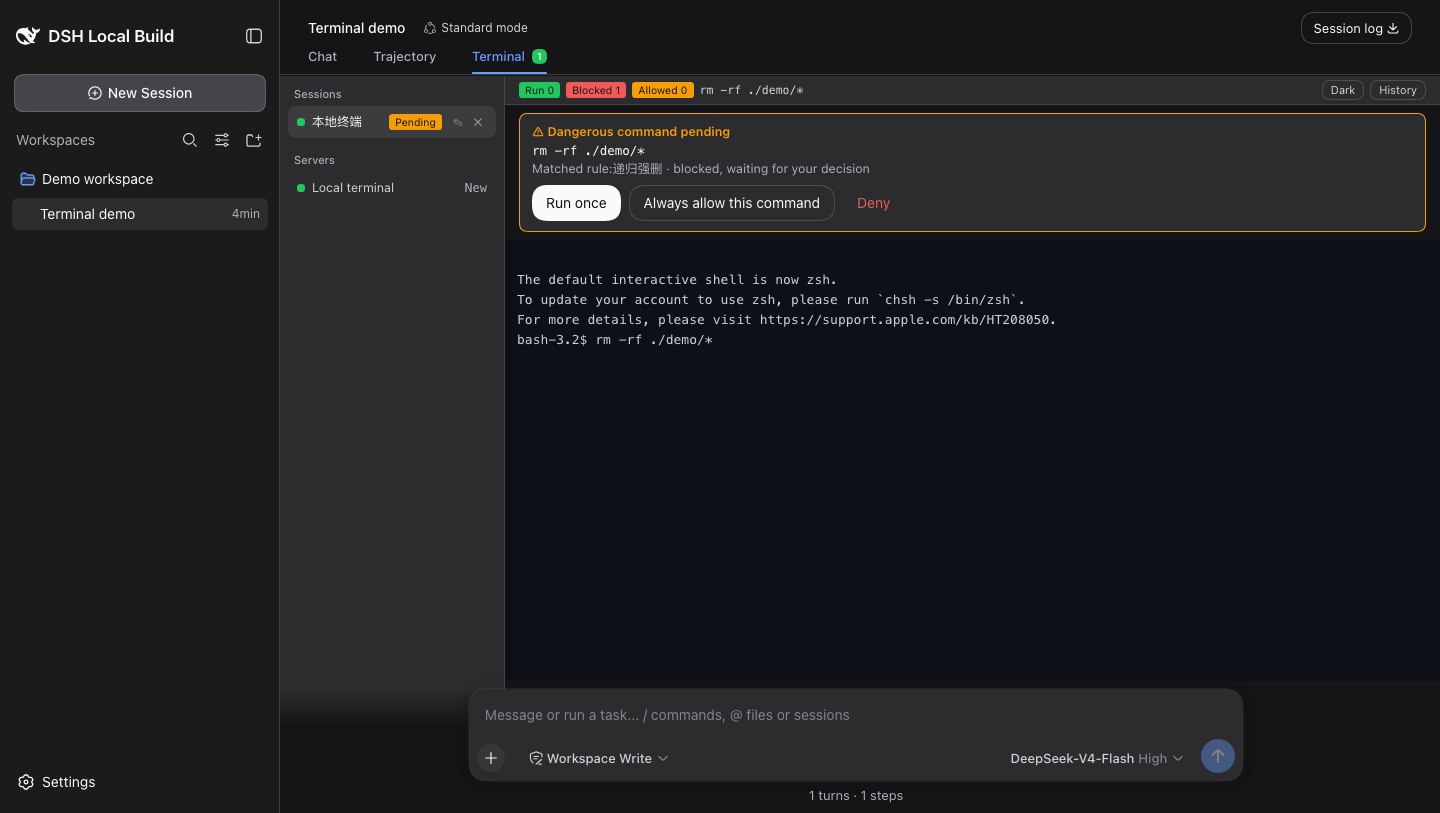
The terminal footer shows run, blocked, and allowed counts. Open History to review command records. Switching to another DSH tab does not disconnect a background session.
AI Tools
The plugin exposes two model tools:
| Tool | Purpose |
|---|---|
netshell_servers |
List server profiles without passwords |
netshell_run |
Run one command on a selected server |
AI commands and human input use the same Guard. deny commands never run, and ask commands require a decision from you in the DSH confirmation UI or terminal panel. The AI cannot see passwords or forge approval results.
On the first use of a server by a model session, or after the user manually disconnects that server, netshell_run asks for remote-connection approval before starting SSH. Approval is retained per model session and server for the current plugin lifetime; different model sessions must approve independently even when they reuse the same SSH session. A network failure, SSH exit, or connection timeout only triggers reconnection for the already-approved model session. A manually opened GUI session does not replace model approval. If the confirmation service is unavailable, the plugin fails closed and does not connect automatically.
Security Boundary
This is an operation guard, not a complete security sandbox. It protects commands entering through this plugin's terminal and netshell_run; SSH connections created by other plugins or generic shell tools are outside its scope. Use locked for sensitive environments and review actions inside interactive programs carefully.
SSH host keys are stored in the plugin-private ~/.dsh/netshell/known_hosts, separate from the user's ~/.ssh/known_hosts.
Documentation
- 中文 README
- Updates
- Technical notes
- Dynamic loading guide
- Design and host-contract notes
- Full historical changelog
FAQ
What should I check when a connection fails? Verify the host, port, username, and authentication method. If the host key changed, confirm the server was intentionally rebuilt before removing the stale entry from the plugin-private known_hosts file.
Can the AI see my password? No. The Host reads it from DSH's encrypted credential store only while establishing SSH; profile listings, tool results, logs, and terminal output never contain the password value.
Comments
Comments live in GitHub Discussions. Sign in with GitHub to post or react.