
Install
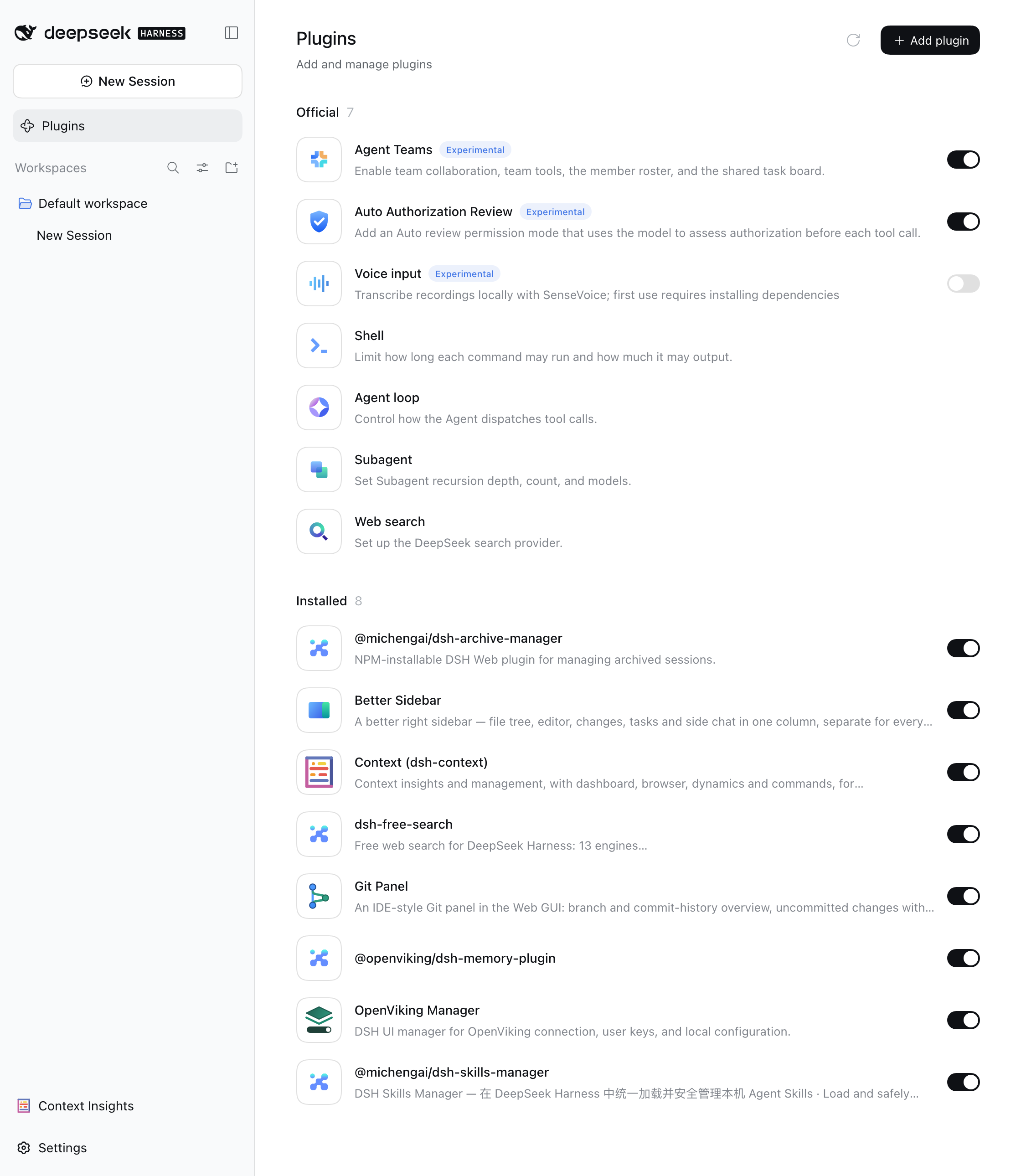
Inside DeepSeek Harness, with dsh-market
dsh plugin --profile web add dshmarket
Or from the command line
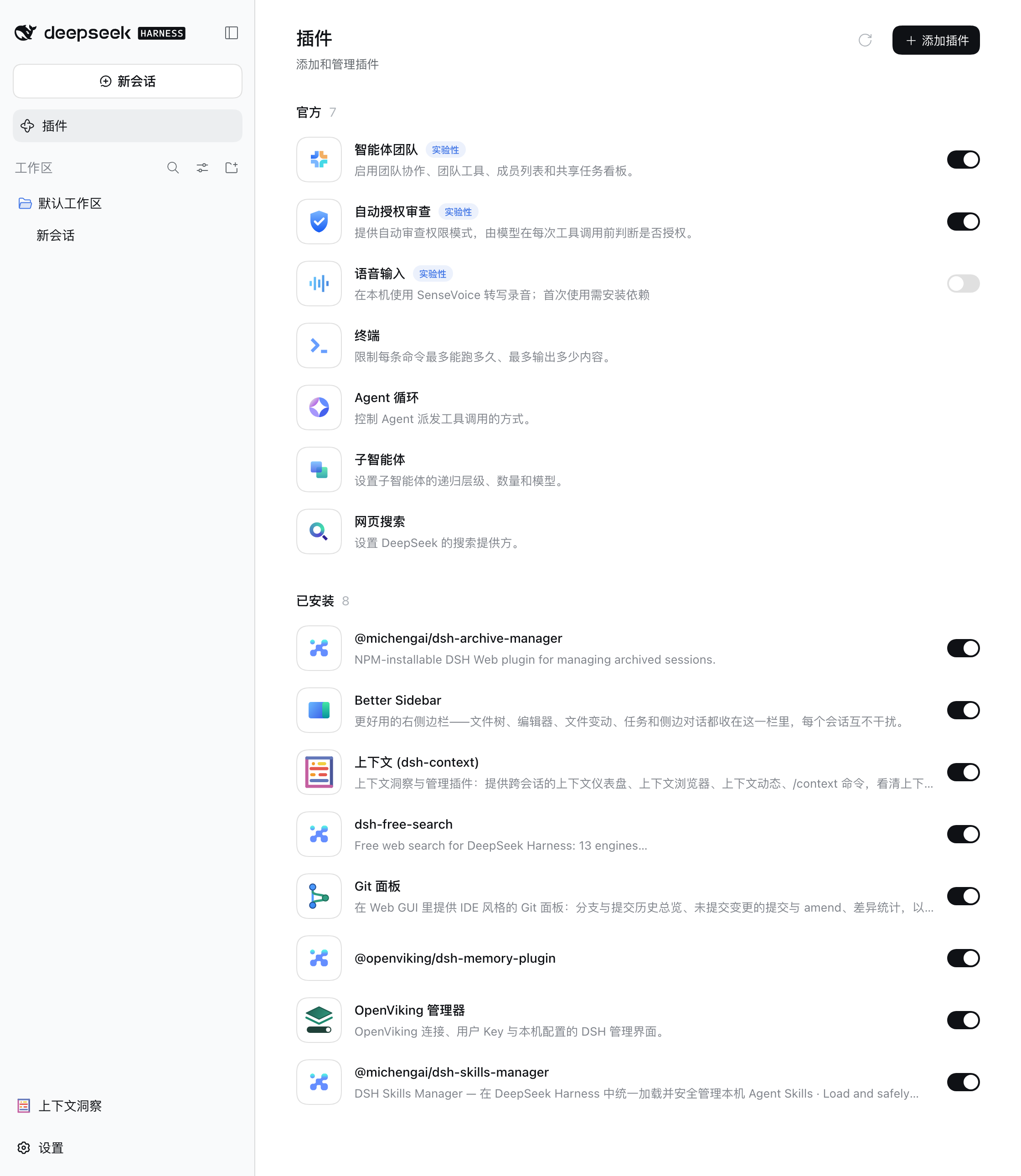
dsh plugin --profile web add dsh-openviking-manager
Installing runs third-party code with your own permissions — it can read your files, use your credentials and reach the network. Review the source first, and pin a commit (github:owner/repo#sha) when you can.
Screenshots
README
English | 简体中文
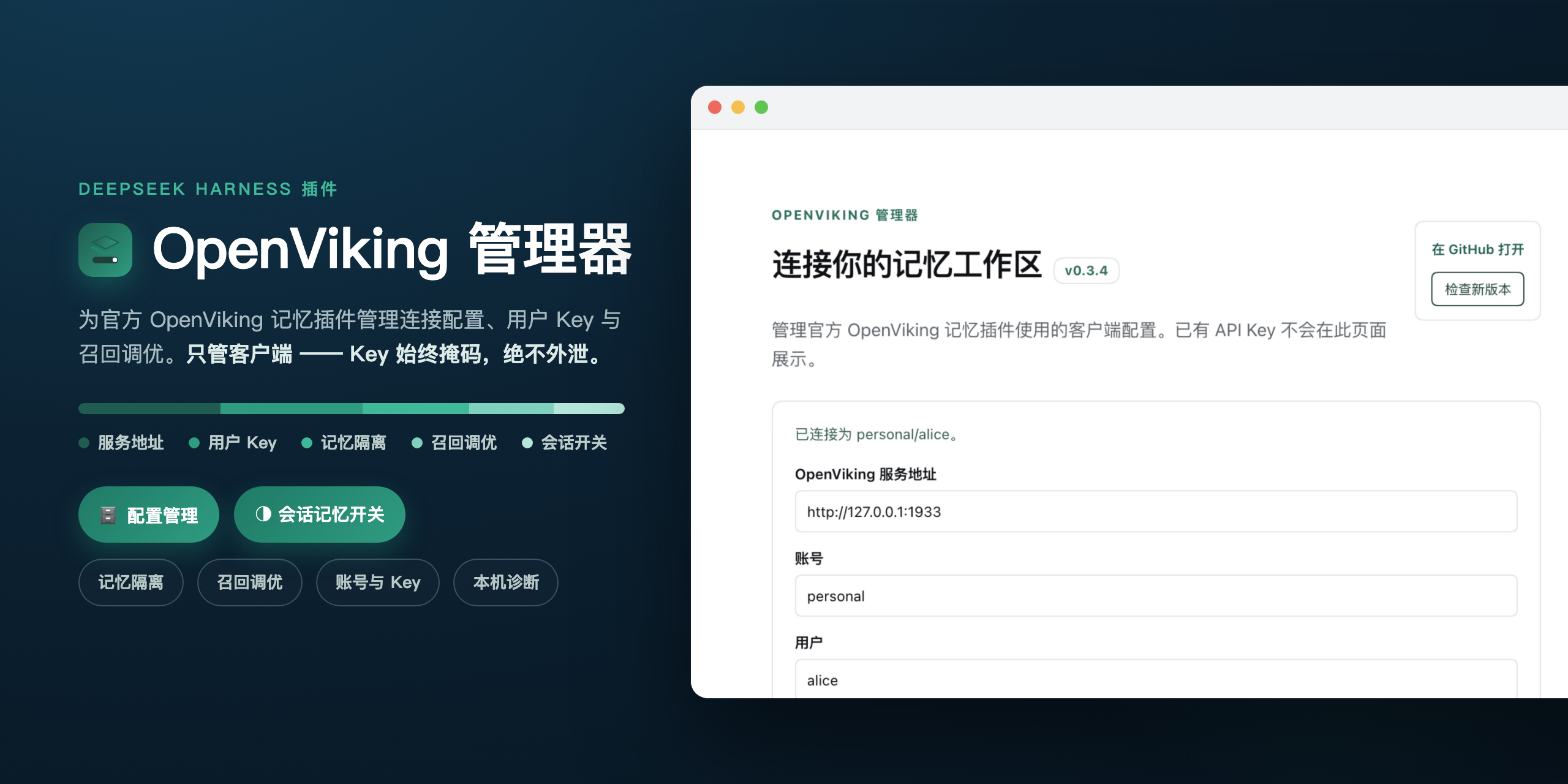
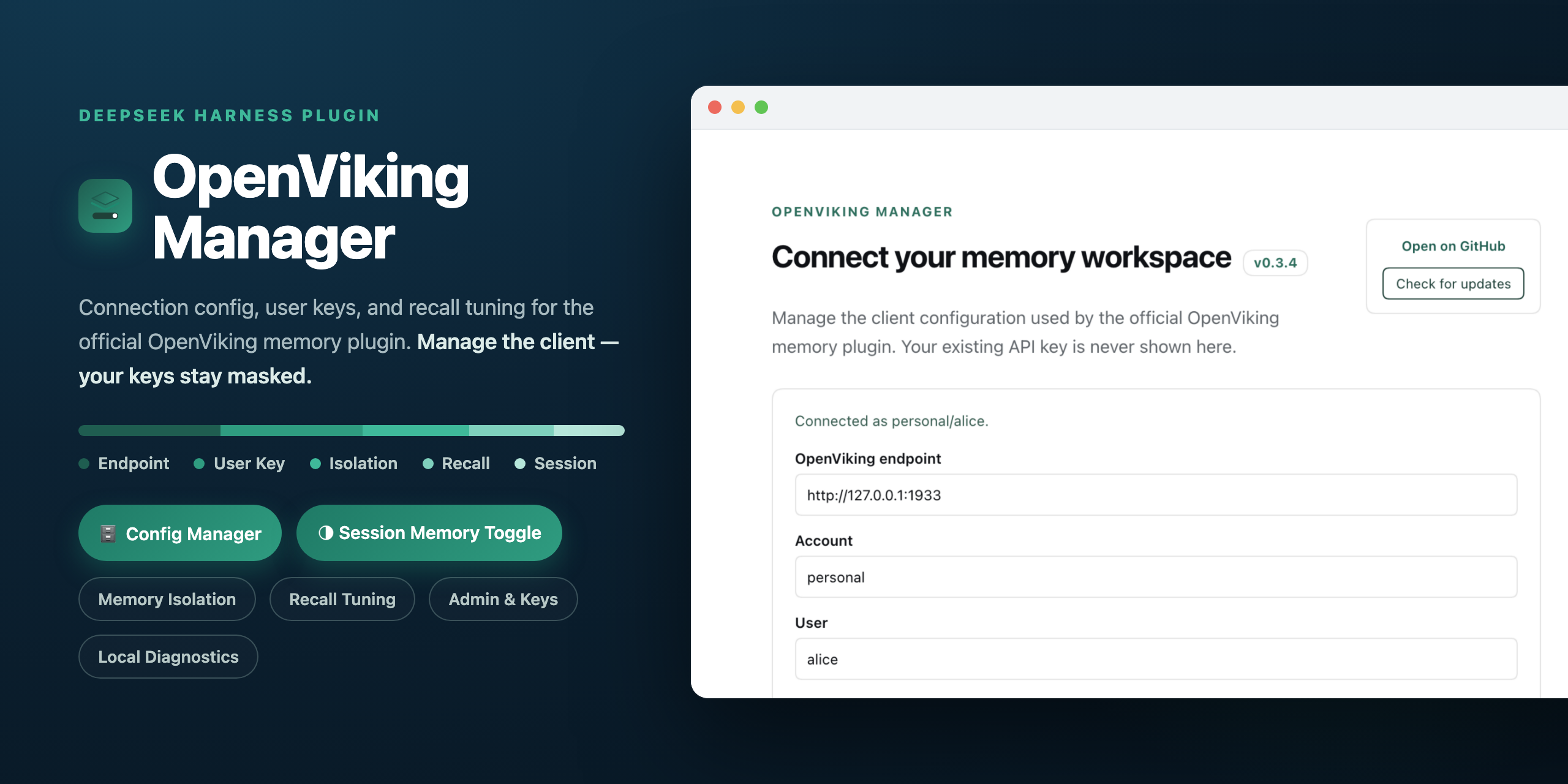
dsh-openviking-manager is a DSH Web UI plugin for managing an existing OpenViking service connection, user keys, and local configuration diagnostics, plus a per-session OpenViking memory toggle. It manages client configuration and enablement only; memory synchronization, commit, and recall remain the responsibility of the official @openviking/dsh-memory-plugin.
OpenViking is an open-source context database from Volcengine, purpose-built for AI agents, solving long-context, memory, and knowledge-base management for agents. It requires deploying the corresponding server; because the service supports remote access and account isolation, it also serves as a remote memory hub shared across devices and sessions. This plugin only adds a configuration UI for OpenViking, to make the local client configuration easier to manage.
See the official documentation for installing and configuring OpenViking: DeepSeek Harness Memory Bundle
Install
# Install the official OpenViking plugin
dsh plugin --profile web add @openviking/dsh-memory-plugin
# Install the configuration manager
dsh plugin --profile web add dsh-openviking-manager
# You can also install straight from the GitHub repository, or from a local file path
dsh plugin --profile web add github:xbzbing/dsh-openviking-manager
Restarting the corresponding DSH profile may be required afterwards; the openviking-manager configuration page is then available on the DSH plugins page.
Features
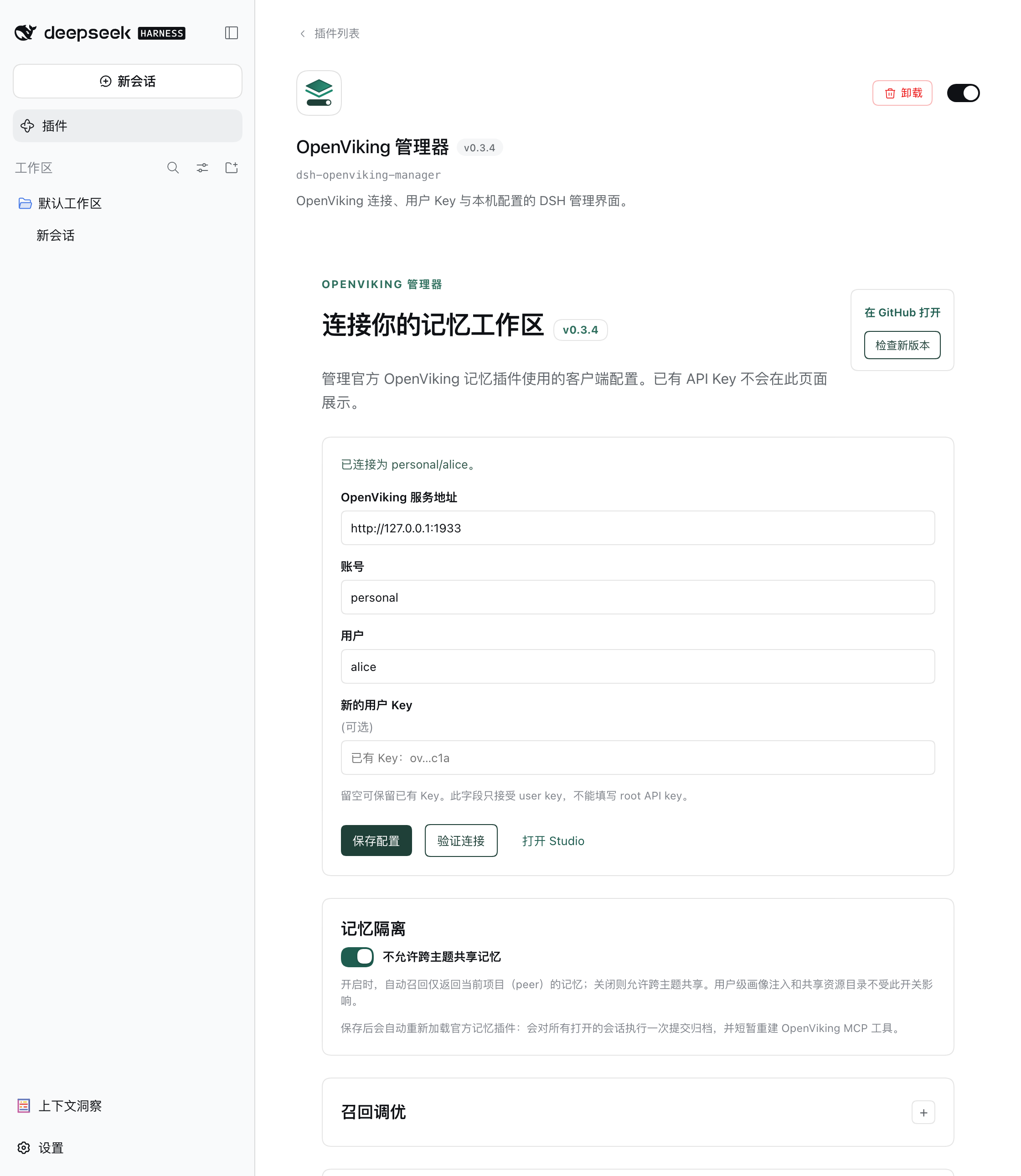
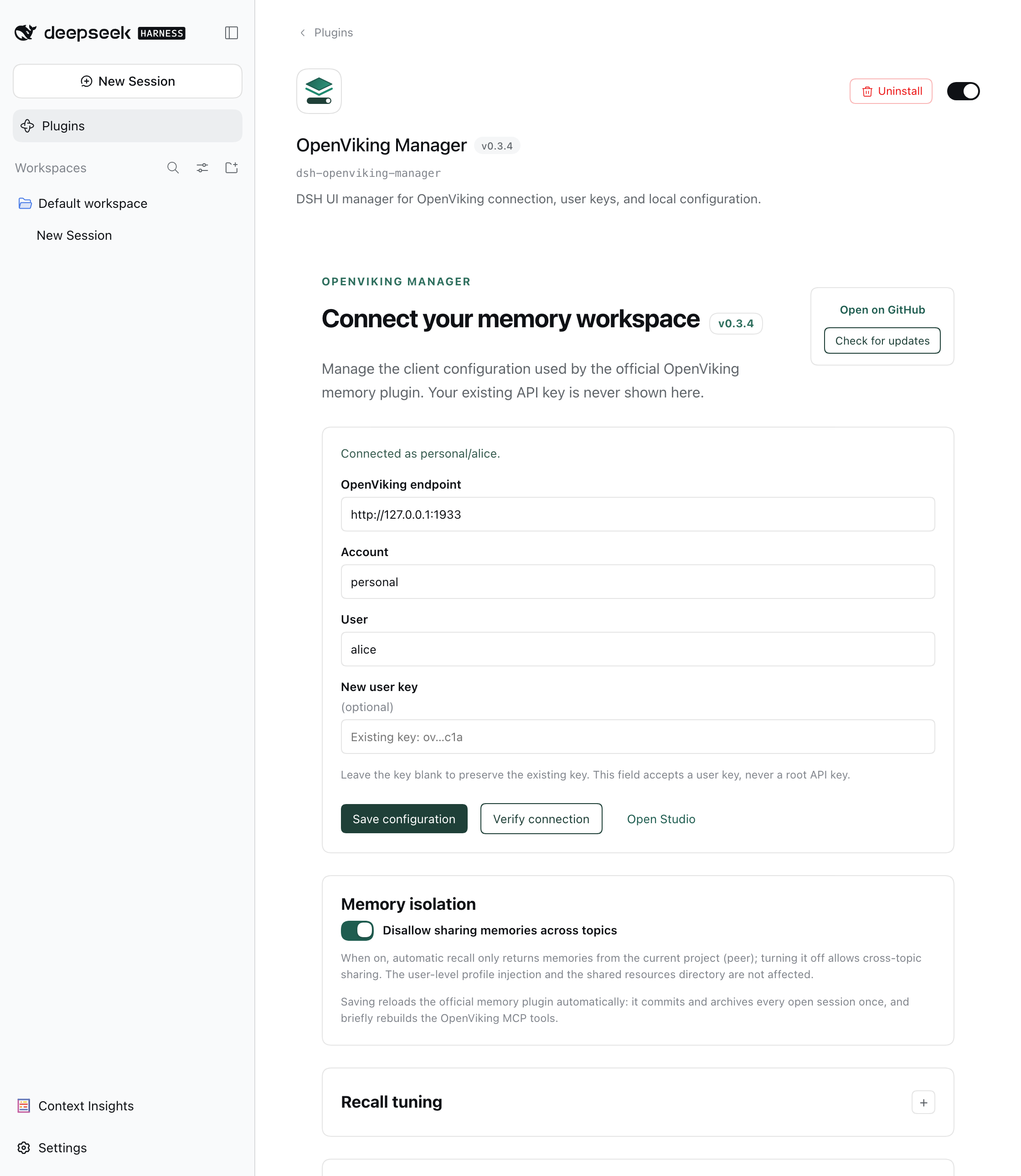
- Read, import, and atomically update
~/.openviking/ovcli.conf. - Preserve an existing
user_key; the browser receives a masked value only. - Check OpenViking
/health,/ready, and authenticated user identity. - Detect malformed JSON and unsafe
ovcli.confpermissions; offer a confirmed local permission repair. - Local discovery reads non-sensitive
~/.openviking/ov.confstate, such as authentication mode and root-key availability.ovcli.confalways takes precedence. - Temporarily use a
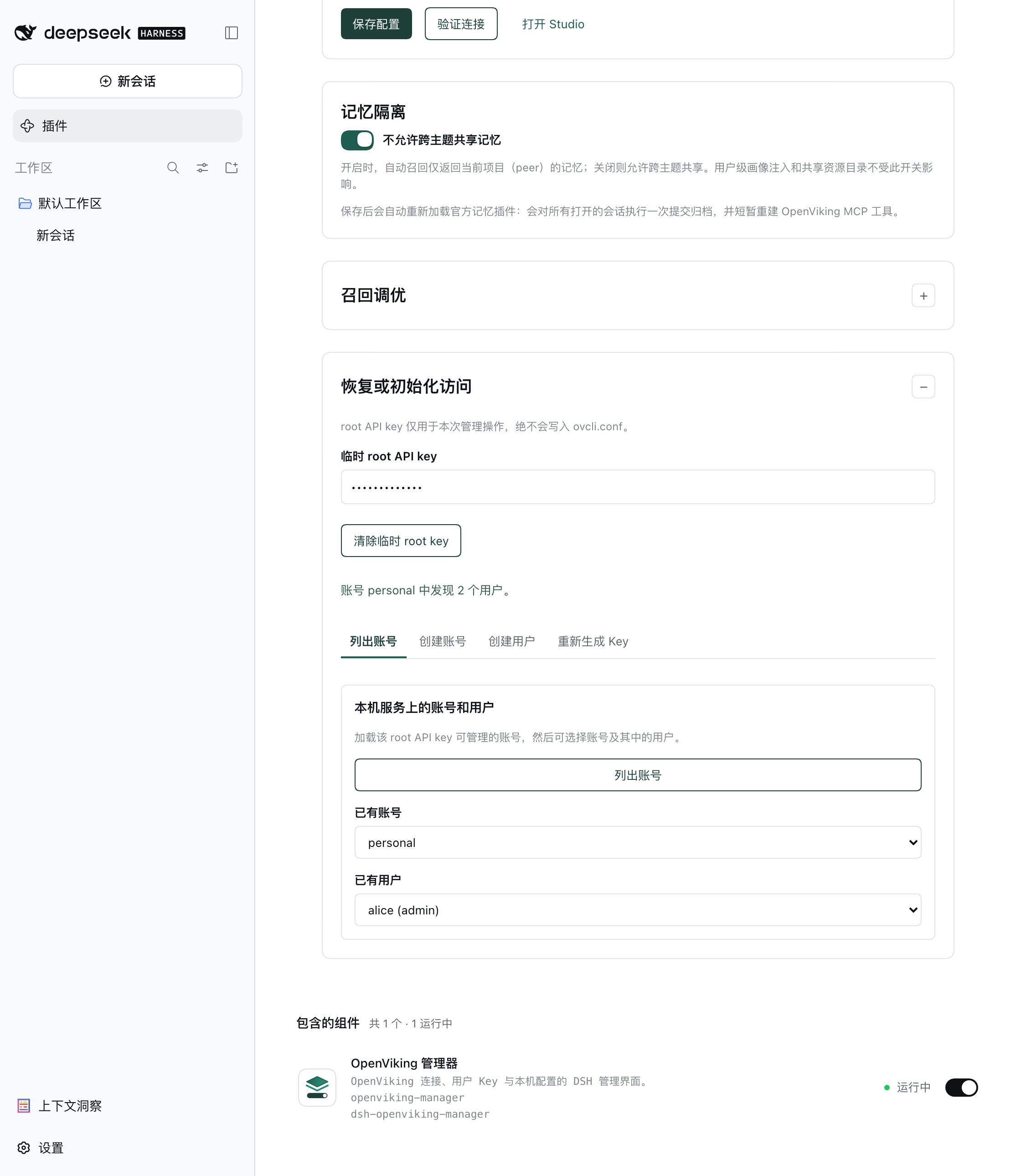
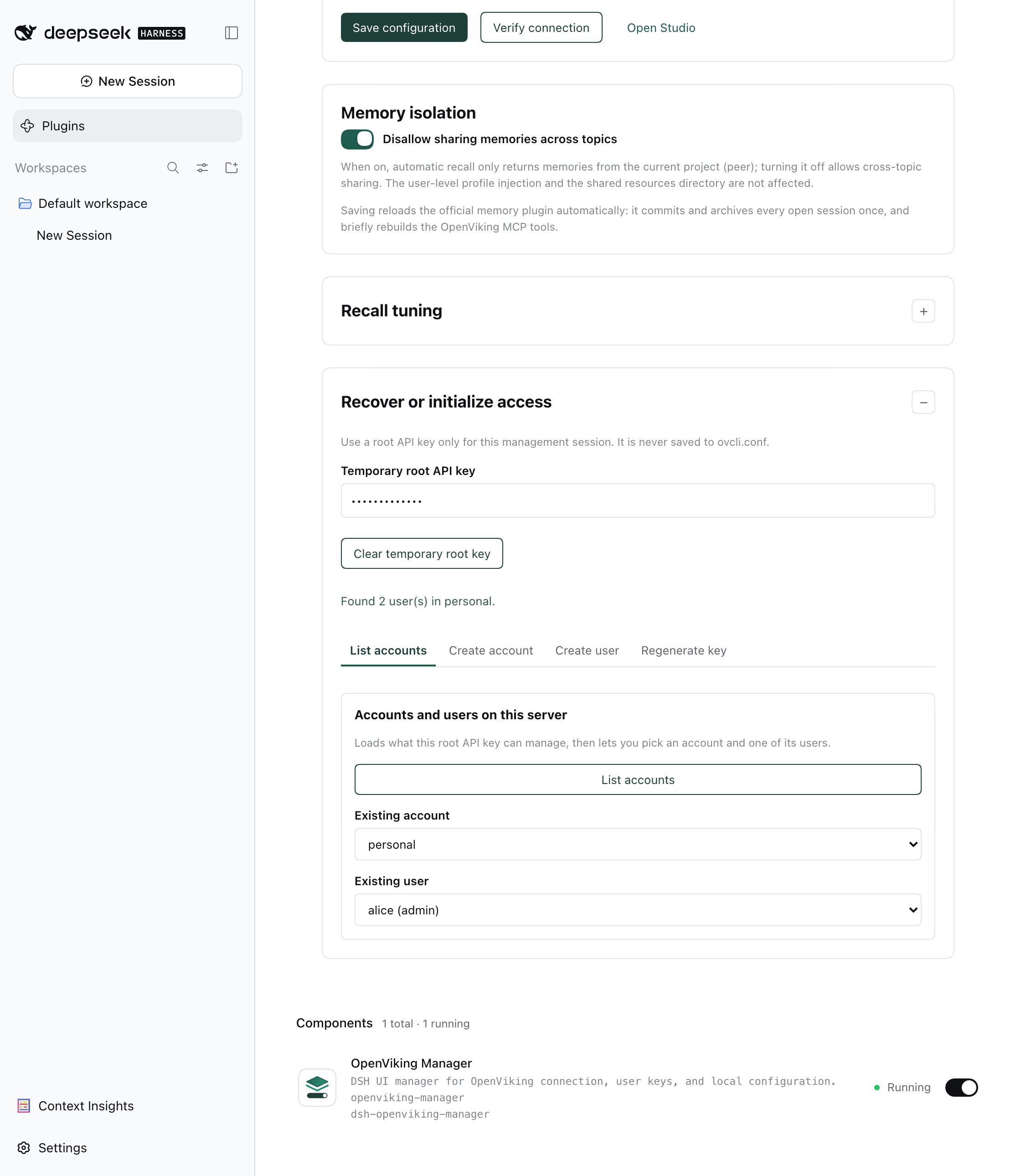
root_api_keywith the official Admin API to list accounts/users, create accounts/users, and rotate a user key. - Derive the Studio URL as
<endpoint>/studio; users can override it for a reverse proxy. - Per-session OpenViking toggle: a button on the left of the conversation input toolbar (on by default). Turning a session off makes this plugin intercept the official plugin's context injection and memory writes/commits for that session and deny its
mcp__openviking__*tool calls, so the session no longer reads or writes OpenViking. - Memory isolation switch "Disallow sharing memories across topics": writes the official
plugin.recallPeerScopekey inovcli.confand is on by default — on the first config-page load, when the file does not define the key yet, the plugin default pinsactoronce and reloads, so out of the box memories are isolated per topic; turning it off writes back the official defaultallto allow cross-topic sharing. The official memory plugin reloads automatically after saving so the change applies immediately (the card warns about the reload and its side effects up front, and reports the outcome on the status line). The user-level profile injection and shared resources are not affected by this switch. Workspace configuration such as.openviking/config.jsonis managed by the user; this plugin neither reads nor writes it. - Recall tuning: adjust the official plugin's automatic recall from the same page —
scoreThreshold(recall score threshold: this plugin defaults to 0.5, the official default is 0.35),recallLimit(maximum injected items, official default 10),recallQueryExpansion(query expansion: this plugin defaults to off, the official default is auto),recallExcludeUris(URI subtrees that are never recalled, handy for boilerplate directory files such as skills or resources indexes),timeoutMs(request timeout: this plugin defaults to 15000ms, the official dsh default is 10000) andrecallContextTimeoutMs(recall search timeout: official default 0 = derive from the request timeout and the expansion/rewrite floor). When the backend's search/rerank hangs, lowering these two timeouts lets recall fail fast instead of stalling the whole turn (session-aware search has a 15s/45s floor, so only a positiverecallContextTimeoutMsshortens it). Key names and value domains come straight from the official config-schema; onlyovcli.conf'spluginsection is written and every other key is preserved. The threshold, the expansion and the request timeout carry a product default: the first config-page load writes them when the file does not define them and reloads, the same mechanism the isolation switch uses. Clearing a field returns that knob to its default, while the remaining keys are removed to restore the official default.OPENVIKING_*environment variables outrank the file, so an overridden field is read-only and shows a warning. Saving reloads the official memory plugin automatically, exactly like the isolation switch. - Actor peer id (advanced, empty by default): writes the official
plugin.peerIdkey inovcli.confto declare which peer (topic) this DSH process belongs to. It is different from the isolation switch —recallPeerScopesets only the recall range, while the peer id sets which peer you are:- Empty (recommended, multi-repository setup): the official plugin derives a peer from each session's workspace git identity, so every repository automatically becomes its own topic with recall across sessions inside it, and no per-repository configuration is needed. When one DSH instance works across multiple repositories, keep this empty — the
OpenViking MCP: actor-scoped recall needs an explicit peer id ...log line is expected then and can be ignored: it only affects the manual MCP tools (which fall back to broad cross-peer recall), not the automatically injected, isolated memories. - Set: every session in this process is pinned to this one peer and the automatic per-repository derivation is overridden. Use it only when one DSH instance serves a single repository, or when you deliberately want several repositories to share one topic; once set, the manual MCP tools scope to this peer and the log line disappears. The "Fill from current repository" button derives the peer id from the current repository's git remote via the official workspace-identity logic. Clearing the field removes
plugin.peerIdand restores automatic derivation.OPENVIKING_PEER_ID, and a top-levelactor_peer_id/peer_idcredential inovcli.conf, outrank this file: when either is in effect the field is read-only with a warning (this plugin does not edit the top-level credential key). Saving reloads the official memory plugin automatically as well.
- Empty (recommended, multi-repository setup): the official plugin derives a peer from each session's workspace git identity, so every repository automatically becomes its own topic with recall across sessions inside it, and no per-repository configuration is needed. When one DSH instance works across multiple repositories, keep this empty — the
- Follow the DSH system language setting with Simplified Chinese and English UI dictionaries.
Screenshots
| In DSH | Recovery and initialization |
|---|---|
|
|
|
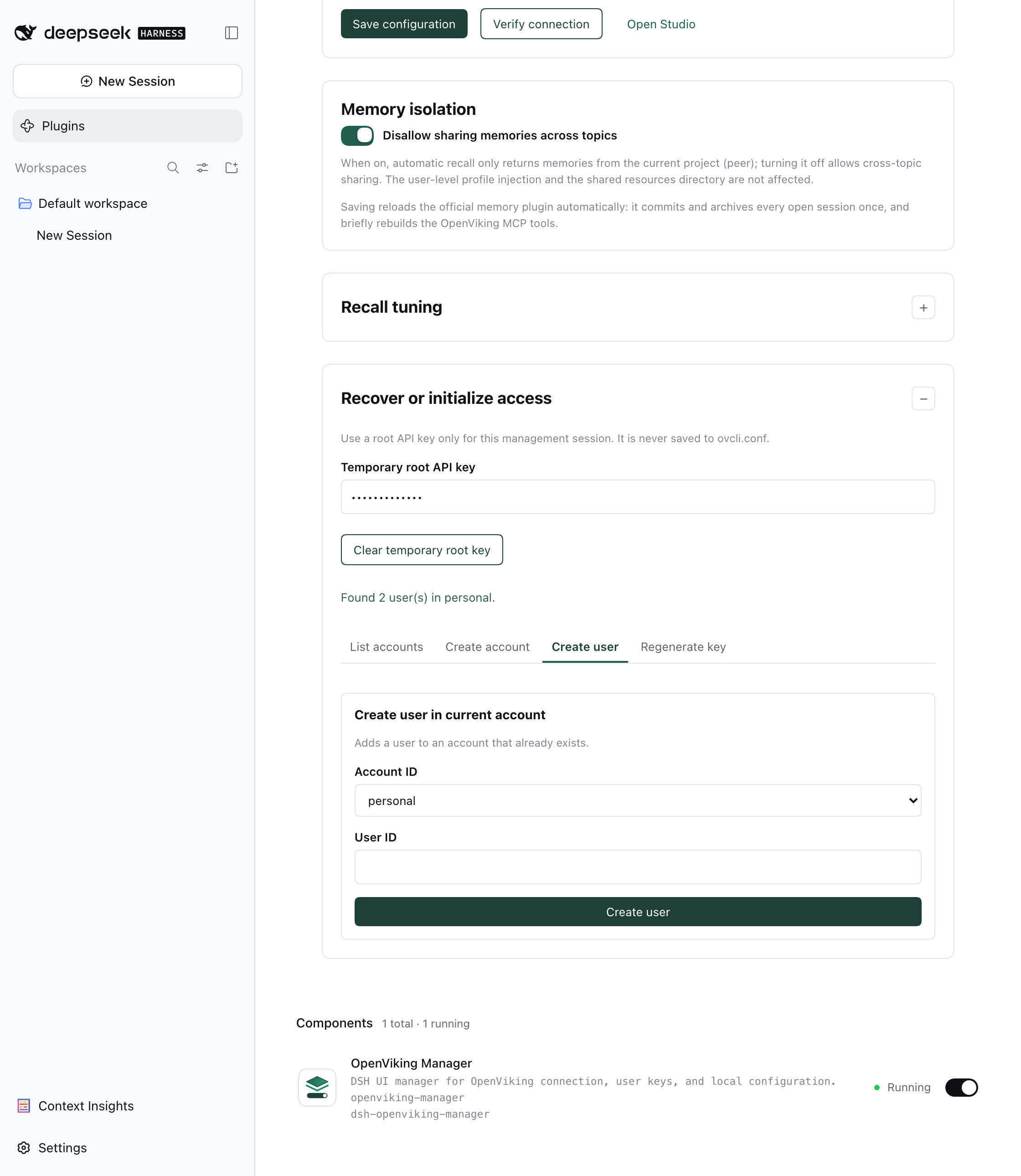 |
Screenshots are captured from an isolated DSH instance by npm run screenshots; the Simplified Chinese set lives in README.md.
Security boundaries
root_api_keyis used only for the current browser form and a same-origin management request. It is never written toovcli.conf; the form is cleared after creation or key rotation succeeds.- An existing
user_keyis read locally by the server and never returned to the browser in plaintext. Connection verification works without exposing that key. - Management routes accept same-origin requests only, use
no-storeresponses, and do not log authorization headers. - Toggle state lives only in plugin process memory; restarting DSH resets every session to the default (on).
- Turning a session off only affects subsequent agent steps: OpenViking context already injected into history remains until compaction, and writes the official plugin queued while the session was on may still be replayed by its global recovery. This plugin does not start, stop, or reconfigure the OpenViking server, and does not replace the official memory plugin.
- The sharing switch only writes the officially declared
plugin.recallPeerScopekey and preserves every unknown key inovcli.conf. The automatic reload after saving goes through the host's public Cordis mechanisms so the official plugin re-reads its configuration; it never modifies official code. Side effects (disclosed on the card): one final commit/archive pass over open sessions and a brief MCP tool rebuild. If the automatic reload does not complete, the status line reports it; when the official plugin is not loaded, the page asks you to restart the DSH instance manually. TheOPENVIKING_RECALL_PEER_SCOPEenvironment variable outranks every file and shows an override warning on the page. - Recall tuning writes only the officially declared
scoreThreshold,recallLimit,recallQueryExpansion,recallExcludeUris,timeoutMsandrecallContextTimeoutMskeys. Values are validated against the official config-schema's domain, so an out-of-range or malformed request is rejected without touching the file, and every other key inovcli.conf(credentials included) is preserved. The product defaults (scoreThreshold0.5,recallQueryExpansionoff,timeoutMs15000) only write an official key on the first config-page load — they never redefine the official default, so a file or environment value still wins and a keyless file behaves officially until it is initialised.OPENVIKING_SCORE_THRESHOLD,OPENVIKING_RECALL_LIMIT,OPENVIKING_RECALL_QUERY_EXPANSION,OPENVIKING_RECALL_EXCLUDE_URIS,OPENVIKING_TIMEOUT_MSandOPENVIKING_RECALL_CONTEXT_TIMEOUT_MSoutrank the file, so an overridden field is read-only and shows a warning. - Actor peer id writes only the officially declared
plugin.peerIdkey (clearing itspeer_idalias and anyplugin.dshoverride), and preserves every unknown key and the top-level credentials inovcli.conf. Validation rejects only clearly invalid input (out-of-range length or a non-official charset) and does not stand in for the server's own sanitisation. Clearing the field removes the key and restores the official per-session git-identity derivation (it never redefines the official default); this plugin does not edit the top-levelactor_peer_id/peer_idcredential key and only shows a read-only warning when one is in effect.OPENVIKING_PEER_IDoutranks the file. "Fill from current repository" derives only through the officialshared/workspace-peer.mjswithout reimplementing the rules, and yields an empty suggestion rather than an error when the official package is absent or the directory is outside a git repository. For multi-repository memory isolation this field should stay empty, and the OpenViking MCP log about a missing explicit peer id can be ignored.
Requirements
- Node.js
>= 22 - DSH
>= 0.1.6-alpha.2 < 0.2.0 - A reachable OpenViking service
- Official
@openviking/dsh-memory-plugin>= 0.3.2(no upper bound; this repository has been fully tested through0.5.0)
Server compatibility
This plugin writes only the plugin section of ovcli.conf and calls only the data-plane /health, /ready and /api/v1/system/status endpoints plus the Admin accounts/users/key endpoints. It relies on no removed or deprecated endpoint, so the breaking changes in OpenViking server v0.4.22 (removal of the session used report, deprecation of /admin/accounts/{id}/settings and /admin/agent-evolution, the restructured skills/find response, and so on) need no adaptation here.
The one semantic change worth noting (v0.4.22 #5358): the local vector engines (vectordb.backend = local/cuvs) map pure cosine scores from [-1,1] to (cos + 1) / 2, i.e. [0,1]. Ranking is unchanged, existing indexes need no rebuild, and a server downgrade restores raw scores — but thresholds are not adjusted automatically. This plugin's scoreThreshold default (0.5) and the official default (0.35) are passed through verbatim as the server's score_threshold/min_score, so after the mapping the same threshold admits more weak matches:
| Threshold | Old domain ([-1,1]) means | New domain ([0,1]) means |
|---|---|---|
| 0.35 (official default) | cos ≥ 0.35 |
cos ≥ -0.3 |
| 0.5 (this plugin's default) | cos ≥ 0.5 |
cos ≥ 0 |
| 0.75 | cos ≥ 0.75 |
cos ≥ 0.5 (equivalent to the old 0.5) |
- To keep the same filtering strength as ≤ 0.4.21, set
scoreThresholdto 0.75; - Remote vector backends (
http/volcengine/vikingdb) and IP/L2/sparse-fusion scores are unaffected — no adjustment is needed; - If weak matches become more visible after upgrading, tune between 0.5 and 0.75 as needed.
Development
npm ci
npm run build       # Generates lib/; no .tgz is produced
npm test            # Unit tests + Playwright E2E
lib/ ships through git, so after changing src/ you must rebuild and commit it; otherwise a GitHub install loads a missing or stale entry point. lib/standalone.js exists only for Playwright: it is neither committed nor published. The build workflow neither creates nor retains a .tgz package.
Tests
npm run test:unit
npm run test:e2e
The Playwright suite covers ovcli.conf import and save, invalid endpoint protection, server-side user-key validation, temporary-root-key account/user selection, and Chinese browser-language rendering.
Project layout
src/
  ovcli-config.ts       ovcli.conf read, validation, atomic writes, permissions
  local-discovery.ts    non-sensitive ov.conf discovery
  openviking-client.ts  data-plane connection and identity validation
  openviking-admin.ts   official Admin API adapter
  manager-api.ts        DSH same-origin HTTP routes (including session toggle)
  session-toggle.ts     in-memory per-session OpenViking toggle state
  ov-prestep.ts         identify and strip official-plugin pre-step injections
  ov-tool-guard.ts      deny mcp__openviking__* tools while a session is off
  openviking-gate.ts    per-session short-circuit wrapper over OpenVikingRuntime
  client/               DSH Web UI, input-bar toggle button, styles, i18n
License
Comments
Comments live in GitHub Discussions. Sign in with GitHub to post or react.