
Install
Inside DeepSeek Harness, with dsh-market
dsh plugin --profile web add dshmarket
Or from the command line
dsh plugin --profile web add github:senyayume/dsh-edit-diff
Installing runs third-party code with your own permissions — it can read your files, use your credentials and reach the network. Review the source first, and pin a commit (github:owner/repo#sha) when you can.
Screenshots
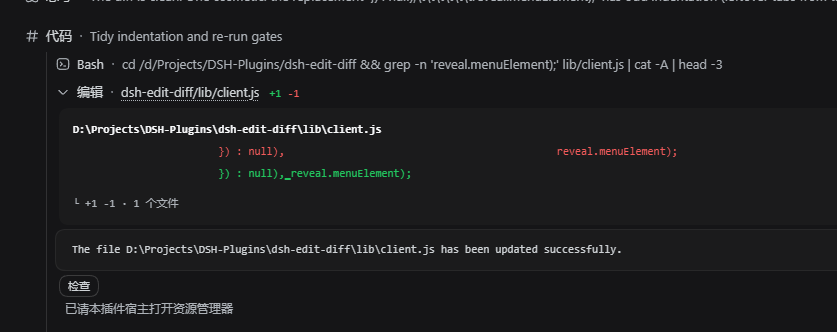
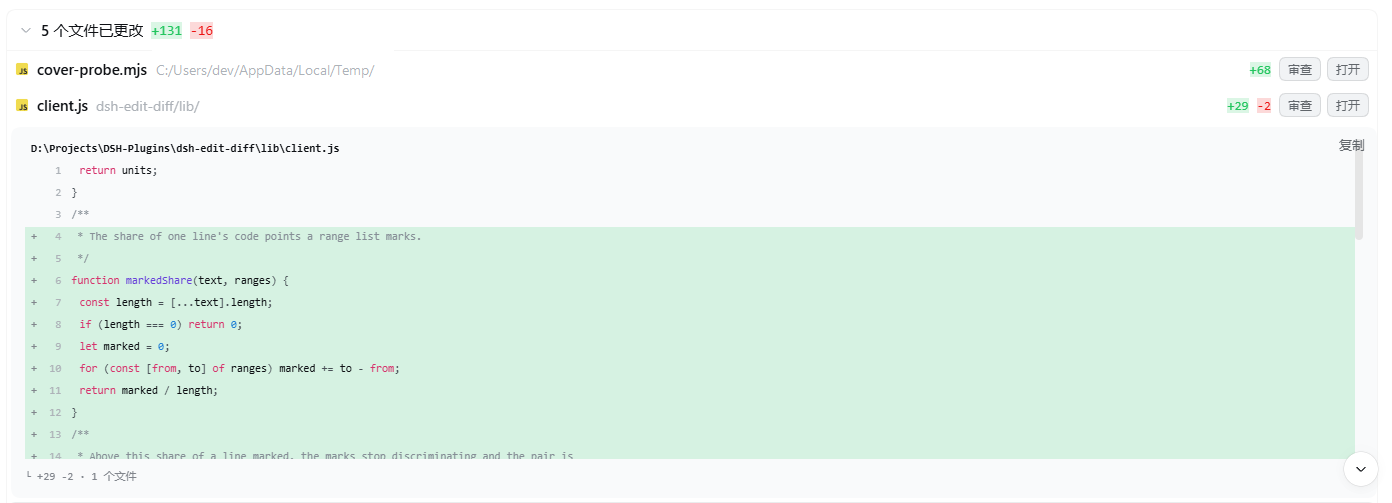

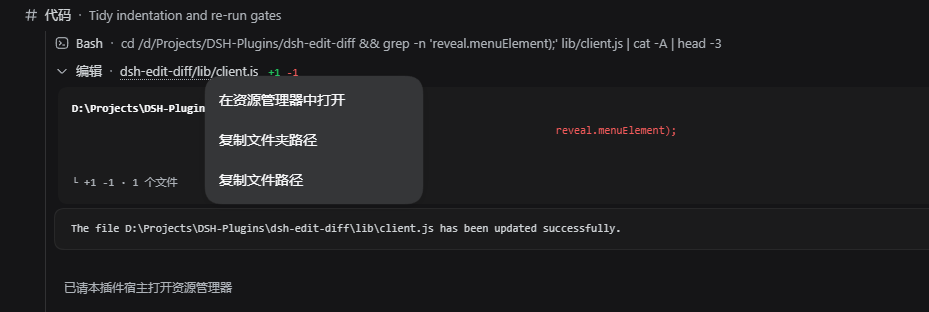
README
English | 中文
A DeepSeek Harness client plugin that redraws line-level diffs on file-mutation tool cards: unchanged
context lines render once, changed lines carry a full-width red/green background rather than coloured
text, and the characters that actually changed take a darker shade of that same background. The code
itself is syntax-highlighted by a tokenizer shipped inside this plugin, using the same
--shiki-token-* theme variables the built-in code and read blocks colour their tokens with — so the
palette matches, both themes are followed, and no DSH core file is touched. It takes over the edit /
write / insert / str_replace_editor rows and the edit /
write sub-calls that run_code (PTC) makes — the two shapes the built-in diffCardModel refuses
outright. A long hunk is not folded: it lives in a max-height: 320px scroll container with every row in
the DOM, while the copy button and the footer stay outside the scroll area. A zero half of +N -M is
dropped on the header and on each per-file row (+87, not +87 -0). At the end of a turn it adds a
changed-files card for that turn (per-file +N -M, collapse, review, open).
Right-clicking a row — on the turn card or on a tool row — offers reveal in file manager, copy file
path and copy folder path. Reveal runs through a host route the plugin serves itself
(explorer.exe /n,/select,… on Windows, open -R on macOS, xdg-open on Linux), with the official
session/openWorkspacePath opener as a fallback that reports why it was used.
This page is a summary. The Chinese README (README.md) is the canonical document: it carries the measured numbers, the data contracts that were checked against the shipped bundles, and the reasons behind what we do not do. Where the two disagree, the Chinese one wins.
Screenshots
All four are real screenshots taken on this machine (light theme, the harness bundled with DSH Desktop). The line numbers shown in the two diff bodies are window-relative — the fallback used when the host half is not loaded in the running process — not the file's own lines. The anchored form is described under 已知限制 in the Chinese README.
Install
dsh plugin add github:senyayume/dsh-edit-diff --profile desktop
The package declares dsh.bundle → cordis.patch.yml, so it mounts itself as a profile layer — no
manual entry to write.
Two halves, two reload rules. lib/client.js is read from disk on every page load, so a window
refresh is enough. lib/index.js is loaded when the harness process starts, and DSH Desktop only hides
to the tray when its window is closed — restart it from the tray. Reloading only the window leaves the
reveal route unregistered, and the client's POST comes back as 405 from the static frontend.
Requirements
- Tested on the DSH Desktop harness
0.2.0-rc.1(@deepseek-ai/dsh-client-ui-primitives0.2.0-rc.1); the 0.1 line was developed on0.1.5-rc.2, and route registration was also checked on CLI harness0.1.1. The only client API difference between the two lines is the exported icon names:IconEditOutline16/IconChevronRightOutline14on 0.1 areIconEditOutlineRegular/IconChevronRightOutlineRegularon 0.2 (the…Artwork/…Regular/…Mediumfamily all take the samesizeprop), andlib/client.jsresolves both. On a harness withoutuiConversation.eventsand theconversation.chat.turnTailslot the plugin degrades quietly to taking over the tool rows only. That slot is a chain on 0.1 but a list on 0.2: list cells are keyed by a requiredidand only the lowest priority inside a cell is drawn, with no election at render time. The entry carries bothidandselect, so it registers either way — on 0.2 it borrows the built-in card's cell id and claims the turn itself from the owner props (matched ?? selectChangedFiles({ turn, seq })), returningnullfor a turn with no changes. - DSH 0.2 gates plugin bundles by
peerDependencies: a bundle whose@deepseek-ai/dsh*ranges do not accept the running engine is skipped silently at profile load — installed, still listed indsh.profile.bundles, loaded by nobody. On an untested harness grant an exemption for the exact version pair:dsh plugin allow-version dsh-edit-diff@<plugin version> --dsh-version <harness version> --accept-risk. - Node ≥ 18 and React 18 to run this repository's tests.
- Reveal is verified on Windows 11. The macOS and Linux commands exist in the code but are untested on real machines.
Verify
npm test                    # = node test/smoke.mjs && node test/host.mjs
node --check lib/client.js
Limits
No undo/redo. Real file line numbers are shown: the host half stamps oldStart/newStart into the
settled hunks, and a hunk whose result block carries no meta (a PTC sub-call, pre-install history) is
located in the current file through a fenced read route instead. Only a row neither path can anchor
falls back to a window-relative number, told apart by a dimmer colour alone. Do not add a marker
glyph: ~ is a low-profile squiggle that smears into the CSS-drawn - /+ row marker at 10px, and
? read worse still — both were tried and both were worse than no marker. The cost (a colour-only
distinction is invisible to a colourblind reader) is accepted, not overlooked. Each
remaining omission is recorded in the Chinese README's 已知限制 section, including why a DSH core patch
is not an option here.
Syntax highlighting uses a local tokenizer shipped with this plugin, because
@deepseek-ai/dsh-client-ui-primitives (checked on both 0.1.5-rc.2 and 0.2.0-rc.1) does not export its highlighter:
highlightLines, subscribeGrammarLoaded and grammarLoadCount are defined but not exported — they
are visible inside the module and used by the package's own CodeBlock, yet absent from its export {}
list. So the plugin cannot reuse the built-in highlighter, and patching the shipped primitives is not an
option either (that is an official file).
The palette is still shared with the built-in blocks: CodeBlock tokenizes through shiki's
createCssVariablesTheme (variablePrefix: "--shiki-"), so every token colour is a --shiki-token-*
custom property that the theme package defines in :root for light and body[data-ds-dark-theme] for
dark. The local tokenizer maps its own token classes onto those same variables, so a token in a diff and
the same token in a code block render the same colour, in both themes. No colour literal is hard-coded
in the plugin. Note those variable names belong to the theme package: renaming them there means
updating TOKEN_COLOR here.
The tokenizer is an approximation, coarser than shiki: it recognizes comments, strings, keywords, numbers, call names and punctuation from small literal tables rather than a grammar, so nested interpolation, regex-versus-division and heredocs are not understood. An unrecognized word simply keeps the default foreground — it is never mis-coloured. Multi-line strings (Python docstrings, JS template literals) are threaded across lines as scanner state, and all offsets are code-point based so an astral glyph cannot shift a token boundary.
Bundling shiki instead is the other option and it was decided against (see the Chinese README's 路线选择): it buys a real grammar, at the cost of a build step and roughly a 3.5 MB client artifact on this machine. Every colouring complaint that actually reached us turned out to be in the mark layer, not the tokenizer, so shiki would have fixed none of them.
Prose is not tokenized, and data is coloured lexically only — added after a user screenshot showed
the first cut colouring English at random. A code tokenizer reading prose highlights in, as, with,
this, for, is, not, and, or and package (all keywords), lets an apostrophe in shiki's
open a string that swallows the rest of the line, and paints MIT / WASM / TODO as constants. So:
- plain (
md,mdx): markdown is prose and is not tokenized at all; the red/green wash and the inline change marks still apply. The built-inCodeBlockhandles markdown because shiki's markdown grammar separates prose from fenced code — an approximation cannot, so it colours nothing rather than colouring wrongly. - lexical only (
yaml,toml,ini): comments, strings and numbers are coloured, but words are never classified, sodescription: install in the for as is notis not speckled with keyword colours. - full (every other code language): comments, strings, keywords, numbers, call names, punctuation.
Two more rules keep prose readable everywhere: a single-character quote only opens a string when the
preceding code point is not a word character (shiki's, don't, 12" wide no longer swallow a line,
while 'abc' in real code still works), and SCREAMING_CASE must be longer than one character (a lone
A is no longer painted as a constant).
A file whose extension is not in the allowlist — Makefile, .gitignore, no extension at all —
renders as plain text rather than guessing a language. Nothing is lazily loaded, so there is no
first-frame plain render and no grammar subscription.
License
MIT — see LICENSE.
Comments
Comments live in GitHub Discussions. Sign in with GitHub to post or react.