
Install
Inside DeepSeek Harness, with dsh-market
dsh plugin --profile web add dshmarket
Or from the command line
dsh plugin --profile web add dsh-panda-calendar
Installing runs third-party code with your own permissions — it can read your files, use your credentials and reach the network. Review the source first, and pin a commit (github:owner/repo#sha) when you can.
Screenshots
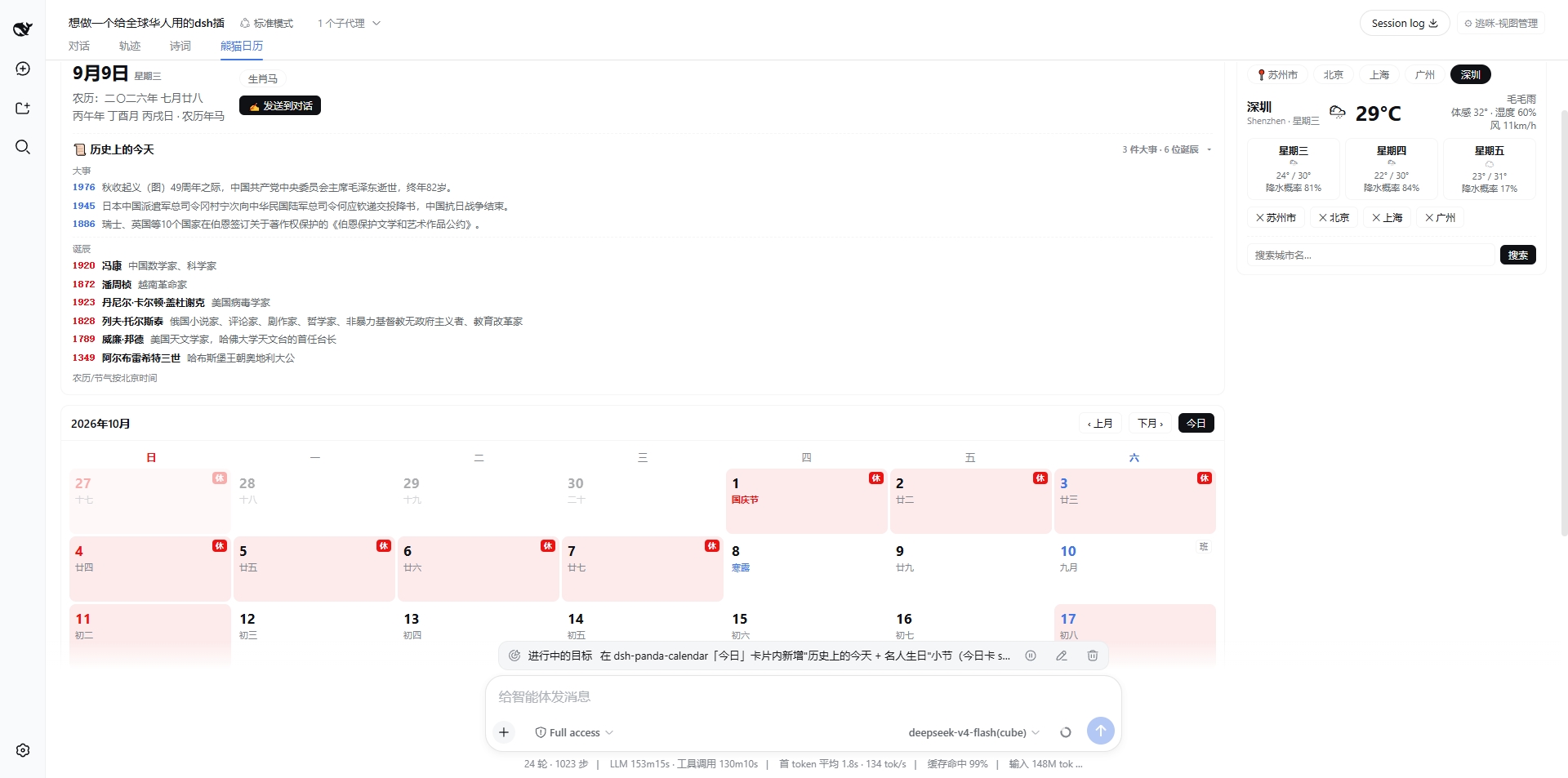
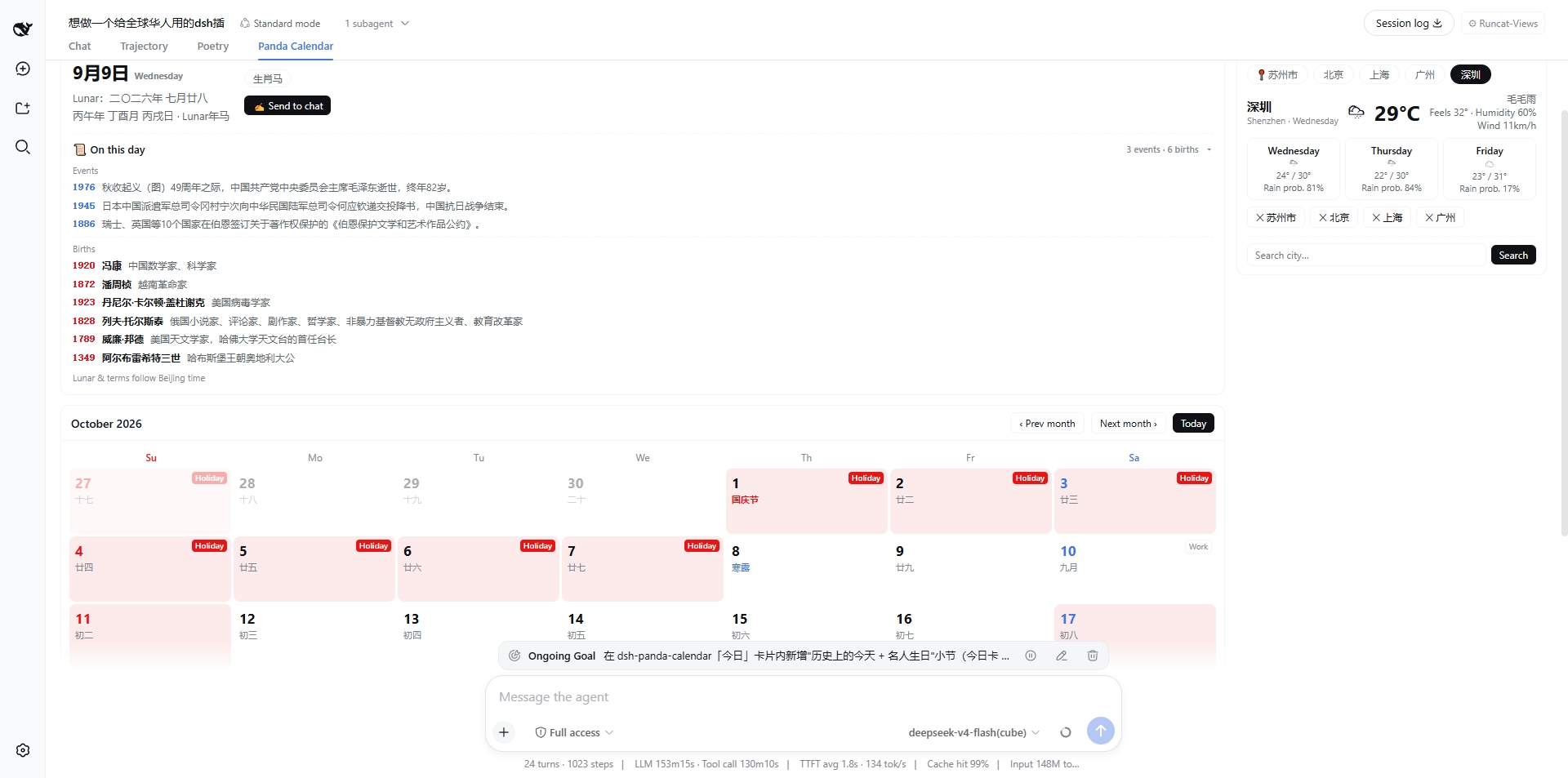
README
A token-free calendar & weather plugin for DeepSeek Harness Web. Adds a "Panda Calendar (熊猫日历)" tab to the session header (next to 对话/Chat, Trajectory and 诗词/Poetry, right after Poetry), giving you solar/lunar dates, ganzhi, Chinese zodiac, solar terms, festivals, China public holidays (incl. make-up workdays), multi-city weather, an ⏱ epoch converter and 📜 on-this-day history in one place.
- Lunar engine: built-in offline data tables for 1900–2100, generated from and validated day-by-day against lunar-javascript (6tail, MIT) — works offline, no API key
- Public holidays: free public feed holiday-cn (MIT, based on State Council announcements) with built-in 2025/2026 snapshots plus rule-based fallback
- Weather / geolocation: Open-Meteo (current + 3-day), BigDataCloud reverse geocoding, ip-api.com fallback — all free, no sign-up, no API key
- Pure front-end (no backend); state stays local
- Requires a
dsh webbuild that supports client plugins (same mechanism as dsh-chinese-poetry)
Features
- Today card: local solar date/weekday → lunar (labelled Beijing time) · ganzhi year/month/day · zodiac → solar terms → festival chips (Chinese primary, English in tooltip) → 🇨🇳 statutory status (off / make-up workday, incl. "holiday day N/M") → ✍ Send to chat (writes the day summary into the input box; press Enter to hand it to the AI)
- 📜 On this day: a collapsible section in the today card showing ~3 events + 4–6 curated notable births for the date (historical figures first); the collapsed state already shows the first entry (click it to expand) and the right-hand control is a solid primary button reading "Show all N ▾ / Collapse ▴" (same treatment as the timestamp card's "Now" button: solid fill, 8px radius, shadow, 13px/600); backed by a built-in 366-day offline snapshot (incl. 2/29, fully usable on mainland networks with no Wikipedia access), auto-enhanced with the latest on-this-day content from the Chinese Wikipedia when reachable (12 h cache); source noted as CC BY-SA
- Month grid: 6×7 calendar with solar day + lunar/term/festival subtitle per cell; red 休 / grey 班 statutory badges; today outlined; click any day to inspect it in the today card (cross-month clicks jump months)
- City weather: locate chain (browser geolocation → ip-api.com → default cities) + manual city search (Open-Meteo Geocoding with
language=zh, country disambiguation), switch/remove cities, current + 3-day, refresh — the city list and active city persist to localStorage, surviving plugin updates and reinstalls - Public holidays: red = off day, grey = make-up workday; unpublished/offline years fall back to snapshots and rule tables, with the data source noted
- ⏱ Timestamp converter (its own card below the weather card, computed purely on the client, works offline): timestamp → date (auto-detects 10-digit seconds vs 13-digit milliseconds, or set the unit yourself) and date → timestamp (Y/M/D h:m:s → epoch seconds or milliseconds); a time-zone selector in the card (Local / UTC / Beijing-Shanghai / Hong Kong / Taipei / Tokyo / Singapore / New Delhi / Dubai / Moscow / London / Paris / New York / Chicago / Los Angeles / Sydney, offsets resolved through
Intlso DST is handled); results include weekday, UTC offset, ISO 8601 (UTC) and one-click copy - Bilingual UI: zh/en follows the dsh UI language
Install
Option 1: npm package (once published)
dsh plugin --profile web add dsh-panda-calendar
Option 2: from source (development)
cd dsh-panda-calendar
dsh plugin --profile web add .
For live development use a linked install (source changes take effect after a Web UI restart):
dsh plugin --profile web add link:.
Restart dsh web after installing, open any session — the Panda Calendar tab appears in the header bar.
If you don't have pnpm yet:
npm i -g pnpm(dsh plugindepends on pnpm).
Usage
- Open a session and click the Panda Calendar tab.
- The today card shows today's lunar date, ganzhi, zodiac, terms, festivals and statutory status; "📜 On this day" already previews its first entry while collapsed — click that preview or the "Show all N ▾" pill to reveal every event and notable birth ("Collapse ▴" folds it back).
- Click ✍ Send to chat to drop that day's summary into the input box (it is not sent automatically); switch back to Chat and press Enter to have the AI elaborate.
- Flip months, use Today, or click any day for details; add/switch cities from the weather card.
- ⏱ Timestamp converter (below the weather card): switch to "Timestamp → Date" and paste a 10-digit (seconds) or 13-digit (milliseconds) value to get the full date & time instantly; switch to "Date → Timestamp" and fill in Y/M/D h:m:s to get epoch seconds and milliseconds. Both share the time-zone selector in the card header (Local / UTC / Beijing-Shanghai / Hong Kong / Taipei / Tokyo / Singapore / New Delhi / Dubai / Moscow / London / Paris / New York / Chicago / Los Angeles / Sydney, DST-aware); results include ISO 8601 (UTC) and one-click copy.
Data sources & credits
| Data | Source | License |
|---|---|---|
| Lunar / ganzhi / zodiac / terms (built-in 1900–2100 tables) | 6tail/lunar-javascript | MIT |
| China public holidays (yearly JSON, State Council basis) | imldres/holiday-cn | MIT |
| Weather (current + 3-day daily) | Open-Meteo | CC-BY 4.0 (data), free API |
| On-this-day history (events / births, 366-day snapshot + live enhancement) | Chinese Wikipedia (REST onthisday / "M月D日" pages) | CC BY-SA |
| Reverse geocoding (lat/lon → city) | BigDataCloud reverse-geocode-client | Free, no key |
| IP geolocation fallback | ip-api.com | Free, no key (non-commercial) |
Updating public-holiday data (for users / maintainers)
The plugin ships with published statutory holiday data built in (休/班 markers show offline too). Each time the government publishes the next year's holiday schedule, run this command to refresh the built-in data:
node tools/gen-holiday-snapshot.mjs
It fetches the latest schedule, writes it into the bundle and regenerates the test fixtures; afterwards restart dsh web (Ctrl+C → run dsh web again) to apply it.
💡 The plugin page shows the same plain-language hint (with a "copy command" button) whenever the built-in data does not yet cover next year — copy, run in a terminal, restart. No need to memorise the command.
Development
npm test # node --test (evals the client bundle with stubbed react/fetch — zero network, deterministic)
The suite covers: calendar engine (911 day-by-day fixtures + leap months / Spring-Festival year boundary / term rules / round-trip / out-of-range), festival rules (incl. Easter and lunar-year boundary), statutory normalization & badges, weather parsing & city search, on-this-day history (snapshot lookup / live-fetch caching & silent failure / markup-free data with no fixture drift), the timestamp converter (seconds-vs-milliseconds detection and limits, multi-zone formatting and inverse conversion, DST transitions, invalid input), view models (month grid / today card / send text / history section / timestamp card placement) and a registration smoke test.
Layout:
dsh-panda-calendar/
├── package.json          # dsh.bundle.patch + dsh.client declaration
├── cordis.patch.yml      # profile bundle patch
├── LICENSE               # MIT
├── lib/
│   ├── index.js          # node half (no-op host)
│   └── client.js         # browser half: ModuleLoader bundle (single file, no build)
├── tools/                # reproducible engine-table / statutory / history snapshot generators
├── test/                 # node --test suite
└── docs/                 # feasibility / Q&A / design (implementation memo)
Roadmap
- M0: skeleton + "Panda Calendar" tab registration (order 30, after Poetry)
- M1: CalendarCore (lunar/ganzhi/zodiac/terms, 1900–2100 day-validated) + festival rules
- M2: statutory layer (holiday-cn primary + 2025/2026 snapshots + rule fallback); weather layer (Open-Meteo + city management)
- M3: view — today card + month grid (休/班 badges, terms, festivals) + city weather; click-to-inspect days
- M4: locate chain (browser → ip-api → defaults) + weather auto-refresh per city list
- M5: send-to-chat (setDraft + switch to Chat view), bilingual README, CHANGELOG, npm publish prep
- M6: "📜 On this day" in the today card (366-day snapshot + Chinese-Wikipedia live enhancement, CC BY-SA)
Changelog
See CHANGELOG.md.
Comments
Comments live in GitHub Discussions. Sign in with GitHub to post or react.