
Install
Inside DeepSeek Harness, with dsh-market
dsh plugin --profile web add dshmarket
Or from the command line
dsh plugin --profile web add dsh-odoo-sdd
Installing runs third-party code with your own permissions — it can read your files, use your credentials and reach the network. Review the source first, and pin a commit (github:owner/repo#sha) when you can.
Screenshots
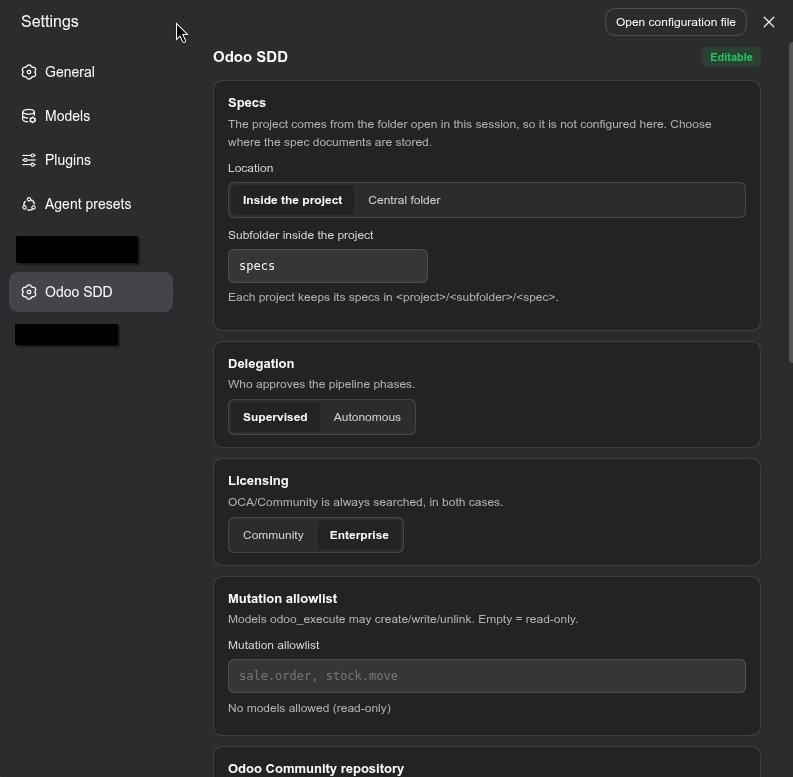
README
Spec-Driven Development for Odoo
⚡ Summary
dsh-odoo-sdd turns DeepSeek Harness into a specification-driven (SDD)
Odoo development pipeline. Two ideas hold it together:
- Closed feedback loop — the agent installs and upgrades modules, reads the
server traceback and retries against a real, running Odoo instance. The
plugin never starts Docker or
odoo-bin: you point it at an instance you already have (dev/staging) through a gitignored.env, and the tools speak plain JSON-RPC. - Pipeline safety — every phase persists to disk, the gates are fail-closed
on an explicit
APPROVEDmarker, three consecutive failures force a root-cause diagnosis, verify/fix iterations are capped,stop.mdhalts everything, and verdicts are honest: a failed verification is persisted as FAILED and can never be reported as success. - No change without a spec — a request that arrives after the pipeline closed ("now also change X" in the same chat) is a new change, so it gets its own (small) spec or an explicit waiver from you. The guard covers instance mutations and source edits alike, and says which of the three ways out is available instead of quietly editing.
[!NOTE] What it is not: an infrastructure orchestrator, a credential manager over chat, or an auto-committer. It writes no commit and never asks you for a password.
Requirements
| Need | Why |
|---|---|
| DSH ≥ 0.1.2-rc.1 on Node ≥ 20 | the plugin mounts as a Cordis bundle and uses the tools service |
| An existing Odoo instance reachable over HTTP(S) | the loop needs a real server to install into and read tracebacks from |
| A disposable dev/staging database | verification installs modules and writes test data |
| (optional) a Playwright browser tool | only for the UI layer of verification; without it those scenarios are marked for manual checking |
🔭 How it works
graph TD
    A(["Idea or request"]) --> C1

    subgraph P [SDD protocol - fail-closed gates]
        C1["1 CLARIFY<br/>interview and security questions"] --> R2["2 READ_SPEC<br/>immutable spec.md"]
        R2 -->|APPROVED| A3["3 ARCHITECTURE<br/>models, views, security, test plan"]
        A3 -->|APPROVED| W4["4 WRITE_CODE<br/>module source and OCA docs"]
        W4 --> V5["5 VERIFY<br/>static, install, RPC, UI"]
        V5 -->|PASSED| D9(["handoff.md - DONE"])
        V5 -->|FAILED| F6["FIX_LOOP<br/>root cause, max 5 iterations"]
        F6 --> V5
    end

    subgraph L [Closed loop against a real instance]
        W4 -.-> M7["odoo_module install or upgrade"]
        M7 -.->|traceback| E8["odoo_errors"]
        E8 -.-> F6
    end

    style P fill:#1e1e2e,stroke:#89b4fa,stroke-width:2px,color:#cdd6f4
    style L fill:#181825,stroke:#a6e3a1,stroke-width:2px,color:#cdd6f4
The specification is the single source of truth and it is immutable: the code adapts to the spec, never the other way around. Gates are human-answered by default, and can be delegated to a human-proxy agent when you choose the autonomous mode.
✨ Key features
- 🎯 Spec before code, always.
spec.mdcarries numbered acceptance criteria;DONEis unreachable without a persistedPASSEDverdict on disk. - 🔁 A real feedback loop.
odoo_module installreturns the server's own output or traceback;odoo_errorsreadsir.logging; failures become a persisted FAILED verdict instead of a hopeful summary. - 🧾 Not only modules. The same machine also runs a functional spec
(
mode=functional): configure a live instance and load data in human-approved batches, with Odoo's own importer for CSV/Excel, and close with a runbook a person can repeat. → The functional path - 🔒 Credentials are not consent. The first socket of a project needs an
explicit human authorization bound to
url + db + user(.sdd/grants.json). - ⏪ Rollback that tells the truth. Checkpoints snapshot files and journal
every
odoo_executepre-image, and a restore always reports the files created after the checkpoint. What it cannot undo, it says so. - 🧱 Documentation as a gate.
odoo_docsproduces the OCAreadme/fragments, the Appsindex.htmland a mandatory changelog entry — and it works on an existing module with no spec, no phase and no instance. - 🧪 Instance-free static layers.
odoo_validate(structure + ACL coherence) andodoo_security_scan(raw SQL,sudo(),auth="none", QWebt-raw…) give findings withfile:linebefore anything is installed. - 🧑⚖️ Policy the model cannot relax. Allowlist, guards and delegation mode all require native human approval to change.
- 🤖 Supervised or autonomous. The same pipeline runs with a human answering
each gate, or with a human-proxy agent and unattended goal rounds until
DONEorBLOCKED. - 📁 Specs where you want them. Keep them beside each project, or collect every project's specs in one folder you can search.
- 🖥️ Linux, macOS and Windows. Paths, atomic writes and
.envpermissions are handled per platform and tested on Windows in CI.
🚀 Quick start
1. Install into a profile
dsh plugin --profile web add dsh-odoo-sdd
That installs the published package from the npm registry — no clone, no
build, nothing to compile on your side. dsh plugin is a thin pnpm forwarder:
it runs pnpm add inside the profile directory and then registers the bundle
(dsh.profile.bundles). Two consequences worth knowing:
- pnpm must be on your
PATH(dsh pluginreports it when it is not). - Any pnpm spec works, so you can pin a version:
dsh plugin --profile web add dsh-odoo-sdd@0.7.2.
Prefer plain npm — a project that depends on the plugin, or a CI job?
npm install dsh-odoo-sdd # 0.7.2, published with a provenance attestation
[!IMPORTANT] Restart DSH and refresh the browser tab after installing. Client-side changes (the Odoo SDD settings panel) load from the installed package.
Working on the plugin itself? Install the checkout instead. lib/ is build
output and is not committed; npm install builds it through the prepare
hook, and you can always ask for it explicitly:
git clone https://github.com/fhidalgodev/dsh-odoo-sdd && cd dsh-odoo-sdd
npm install          # devDependencies: typescript, then prepare builds lib/
npm run host:deps    # optional peers, needed to compile (no-save)
npm run build        # emits lib/ — required, package main is lib/index.js
dsh plugin --profile odoo add .
[!NOTE] A git install runs that
preparebuild on the consumer's machine, and pnpm blocks dependency build scripts until they are allowed: the command tells you the exact key to add underallowBuildsin the profile'spnpm-workspace.yaml. A registry install needs none of that — the tarball already shipslib/.
dsh plugin add records the bundle in the profile's package.json
(dsh.profile.bundles), and the package ships a Cordis patch
(cordis.patch.yml) that inserts its own row — so there is no manual
composition step. dsh --profile <name> --dump-config prints the composed tree
without booting anything.
2. Give it credentials (once per project)
Ask the agent to run odoo_setup mode=check. It writes a secret-free
scaffold and you fill the password yourself:
odoo_setup mode=interactive url=http://localhost:8069 db=odoo_dev username=admin
# then fill ODOO_PASSWORD (an Odoo API key is recommended) in the printed file
odoo_setup mode=authorize   # asks YOU, once, to authorize that exact target
Or do it by hand — the plugin looks for the first of these that exists:
| # | Location | Scope |
|---|---|---|
| 1 | ODOO_SDD_ENV_FILE |
explicit environment override |
| 2 | <project>/.sdd/instances/<name>.env |
one target per file, the active instance |
| 3 | <project>/.sdd/.env |
single-target layout (also listed as the instance default) |
| 4 | ~/.config/dsh-odoo-sdd/.env (honors $XDG_CONFIG_HOME) |
user scope — one set of dev credentials for every project |
| 5 | <project>/.env |
legacy location, still supported (reported as legacy) |
Several targets in one project. A workspace that needs a local CE server, a
staging EE server and a client's instance no longer overwrites its only .env:
each target gets its own file under .sdd/instances/, and one is active.
odoo_setup mode=instance instance=list                      # what exists, non-secret identity
odoo_setup mode=instance instance=add name=staging url=https://stg.example.com db=stg username=ci
# fill ODOO_PASSWORD in .sdd/instances/staging.env by hand, then:
odoo_setup mode=authorize                                   # grants THIS target
odoo_setup mode=instance instance=use name=staging           # activate it
odoo_setup mode=instance instance=remove name=staging        # needs confirm_destructive=true
Authorization is per target (url+db+user), so two instances on the same
server are two grants. Activating an instance that has no live grant is refused:
the pointer decides where mutations go, so it cannot be switched to a target
nobody approved. With several instances and none active, every connection
tool refuses instead of picking one by order — and an old .sdd/.env keeps
working untouched as default until you choose to move it yourself.
mkdir -p ~/.config/dsh-odoo-sdd && cd ~/.config/dsh-odoo-sdd
cp <plugin>/.env.example .env && chmod 600 .env
# fill: ODOO_URL, ODOO_DB, ODOO_USERNAME, ODOO_PASSWORD
[!WARNING] Never paste a password into the chat, a spec, a commit or an issue. The plugin refuses a group/world-readable
.env, redacts the secret from every tool output, and stores session cookies in.sdd/session.json(mode 600) without ever returning them to the model.
3. Ask for the thing you want
Implement a sale order approval module for Odoo 19, using the SDD workflow.
The agent picks up odoo-sdd-workflow from the session skill catalog and follows
the protocol. If you want to be explicit — or you want to be sure the full
instructions are loaded — start your message with /odoo-sdd-workflow.
For configuration and data work on a running instance, ask for that instead:
Set up company, taxes and chart of accounts in my dev instance, then import
this customers.csv — functional SDD, dev environment, no production.
That selects odoo-functional-sdd (or /odoo-functional-sdd explicitly) and
the functional spec mode described below.
🧭 The five phases
| Phase | What happens | Gate to leave it |
|---|---|---|
| CLARIFY | Intent recorded (mode create/bug, licensed) and the security interview answered: groups, ACLs, record rules, sudo() justification, public routes |
sdd_phase clarify |
| READ_SPEC | spec.md is assimilated: business context, numbered acceptance criteria, constraints, target Odoo version. Writing code here is forbidden. |
APPROVED + mark_spec_loaded |
| ARCHITECTURE | Models, views (including extra view types and a search view where they matter), reports, security matrix and test-plan.md |
APPROVED |
| WRITE_CODE | The module is implemented with version-pinned Odoo patterns and its OCA documentation | static gates green |
| VERIFY | Ascending pyramid: static → install/upgrade → RPC/data → UI (Playwright) only for critical flows | persisted PASSED verdict |
| FIX_LOOP | Root-cause fixes. 3 consecutive failures force a consultant diagnosis; 5 iterations force BLOCKED |
honest verdict |
In ARCHITECTURE the agent also asks about the things that are cheap to decide
early and expensive to discover late: extra view types beyond form/tree
(including a search view for how a model is searched — custom filters,
favorites), reports (PDF via ir.actions.report/QWeb, SQL, CSV/XLSX, an
external tool), web tours (onboarding, test, or none — with the asset bundle
that loads them, because a tour no bundle loads never runs) and demo data
(which files, and what for). Each one is answered explicitly — "form + tree
only", "no reports needed", "no tours needed", "no demo data". Those are
guide decisions: recorded in ## Views / ## Reports / ## Tours /
## Demo data and surfaced as warnings in sdd_phase status, non-blocking by
design — the security model is the only fail-closed content gate. The
version-by-version tour API, the HttpCase that executes a tour and the demo
traps live in resources/references/tours-and-demo.md.
Per-spec artifacts (all on disk, resumable):
specs/<NNN>-<slug>/
├── spec.md · architecture.md · test-plan.md
├── verify-verdict.txt   # honest persisted verdict
├── state.json           # phase, failures, iterations
├── kb.json              # decisions, discarded options, blockers, diagnoses
├── docs-report.md · security-report.md
└── handoff.md           # written by sdd_handoff when the run closes
🧩 The functional path (configure and import)
Not every Odoo job is code. Setting up a company, its taxes, its users and its master data is configuration and data, and it happens on a live instance — where a wrong click is not a failed test but a real record. The same SDD machine covers it with a different middle phase and stricter closing rules.
graph TD
    C1["1 CLARIFY<br/>objective, instance, ENVIRONMENT"] --> R2["2 READ_SPEC<br/>spec.md, criteria, sources"]
    R2 -->|APPROVED| A3["3 ARCHITECTURE<br/>to-be process, batches, risks"]
    A3 -->|APPROVED| X4["4 APPLY_CONFIG<br/>discovery + approved batches"]
    X4 --> V5["5 VERIFY<br/>re-read the records, evidence per AC"]
    V5 -->|PASSED| D9(["runbook.md + handoff.md - DONE"])
    V5 -->|FAILED| F6["FIX_LOOP"]
    F6 --> X4

    style X4 fill:#1e1e2e,stroke:#f9e2af,stroke-width:2px,color:#cdd6f4
| Development run | Functional run | |
|---|---|---|
Chosen at CLARIFY |
mode=create or mode=bug |
mode=functional |
| Middle phase | WRITE_CODE (module source) |
APPLY_CONFIG (batches against the instance) |
| Deliverable | module + OCA docs | configured instance + functional-runbook.md |
| Skill | odoo-sdd-workflow |
odoo-functional-sdd |
How a change reaches the instance. Nothing is written "to see what happens":
- Discovery first, under its OWN approval: which models, which fields, how many records. Reads are not mutations, but an approved scope is what stops "just looking around" from turning into a change.
- Plan: the design becomes batches. Each one declares its destination and environment, the version and capabilities used, company and context, the acceptance criteria it covers, its ordered operations, record identity, preconditions, expected result, risks, recovery and manual steps.
- Approve: the human sees the exact batch and approves it through the native approval seam. The receipt is bound to the hashes of the spec, the design, the plan and the batch — change any of them and the approval is void.
- Apply: one operation at a time, re-checking those hashes, persisting each operation's state before the call and after the result.
- An unknown outcome is not a retry. A timeout after a mutation may mean
Odoo already committed, so the operation is marked
indeterminate, the batch stops and the run parks until a human reconciles it. - Close honestly:
sdd_phase succeeddemands an explicitpassper acceptance criterion, the security review is mandatory, and so is the runbook (who does it, in which company, prerequisites, the verified menu path, the steps with their field labels, the expected result, how to check it and how to undo it) — whatever the documentation policy says.
The environment is declared, never assumed. ODOO_SDD_ENVIRONMENT on the
target says dev, staging or production. A plan that declares a different
environment than the target is refused (environment-mismatch), an undeclared
target asks for it (NEEDS_ENVIRONMENT), and production additionally needs a
declared backup reference plus its own approval. High-risk changes are proven in
staging first.
Imports go through Odoo's importer, never through a hand-written parser:
odoo_import use=prepare file=... model=res.partner   # uploads, with its own approval
odoo_import use=preview   ...                        # what ODOO read: sheets, headers, sample
odoo_import use=map       ...                        # one decision per column, no blanks
odoo_import use=plan      ...                        # becomes an `apply` batch
odoo_functional operation=approve / apply            # the batch path, unchanged
The version contract is explicit (majors 10–19: file/import_id + JSONP on the
old endpoint, ufile/id + JSON on the new one, do/execute_import for the
apply), and a version outside the verified families is refused with what to
investigate instead of guessed. A file that changed after the upload invalidates
the mapping; a nextrow in the answer means the importer stopped mid-file and is
reported as partial, never as success — and the rows it counted are never
re-sent. The session cookie stays in .sdd/session.json (mode 600) and out of
every tool result.
[!NOTE] The functional path needs an instance, and the importer needs a web session: run
odoo_sessiononce beforeodoo_import use=prepare.
🧰 The 15 tools
| Tool | Purpose |
|---|---|
odoo_connect |
Probe the instance: server version + authentication. Masked report; distinguishes NEEDS_SETUP / NEEDS_SECRET / DEFERRED / SKIPPED states (never asks for secrets in chat). |
odoo_setup |
Onboarding: check (cascade + gitignore + delegation mode), interactive (secret-free chmod-600 scaffold), authorize (ask the DEVELOPER, through native approval, for a connection grant bound to the current url/db/user), revoke (drop the grants), purge (plan first, then — with confirm_destructive=true plus human approval — remove only the plugin's own state under .sdd/), later, skip, reset, autonomy (supervised | autonomous, human-approved). Secrets are never accepted as parameters. |
odoo_module |
info / install / upgrade on ir.module.module (button_immediate_*). Returns the server's own output or traceback, redacted — the closed feedback loop. |
odoo_execute |
Generic RPC (execute_kw) against the instance: any public method of any model is callable, and what it needs is decided by what it is. READS (search, search_read, search_count, read, read_group, fields_get, name_get, name_search, default_get, exists, check_access_rights, check_access_rule) run freely, with fields/limit/order/offset for projection and paging (a fractional or negative offset is refused, never clamped); CRUD mutations (create/write/unlink) require confirm_destructive=true AND the model in executeAllowlist, and are journaled so the data undo can replay them; every business action (action_*, button_*, do_*…, e.g. confirming an order) runs with confirm_destructive=true and no allowlist, because the plugin cannot replay its effect — it is never journaled, no undo exists for it, and a timeout is reported as an INDETERMINATE outcome instead of a plain failure — the same rule now applies to CRUD, because a create whose answer never arrived may already have committed and reporting it as a retryable failure is how one effect becomes two. Declare precondition/postcondition (the same shape a batch uses: {domain, expect, count}) to carry a state guard before the call and a state proof after it: if the precondition fails, nothing is sent; if the postcondition fails, the answer says the call WAS sent and the instance may be half-changed, and the CRUD mutation keeps its journal receipt (created id + pre-image) so it can still be compensated; without one, OK only means the server accepted the call. A private method (_name) is refused, and that wall is Odoo's own: execute_kw dispatches through get_public_method, which answers AccessError for _…, init, @api.private and the internal attribute names — so read the model in the source (the native/custom repositories are reported by odoo_config mode=read) and call the public button or action that wraps it (sale.order._create_invoices is private; the sale.advance.payment.inv wizard exposes the public create_invoices()). For several operations, or when a human approval per run is wanted, use a functional batch with kind: "method". context is forwarded verbatim — use allowed_company_ids/company_id on multi-company instances — and the server still applies its own ACL. A large answer is BOUNDED and the cut is MARKED: the text says how many characters were dropped, that what you see is the beginning (not a complete JSON document) and how to page with fields/limit/offset — and for a mutation it explicitly forbids repeating the call to get more text. |
odoo_validate |
LOCAL, instance-free module structure check: __manifest__.py present + depends, declared data XML files exist, security/ir.model.access.csv when models are declared. Returns file:line findings plus the module_dir and project root it resolved (a relative path resolves against the session's folder, never the process cwd). |
odoo_errors |
Reads recent ir.logging server errors — the remote equivalent of fetching environment logs. |
odoo_session |
Mints a passwordless web session (the connect_as_user pattern) stored in .sdd/session.json (chmod 600) for Playwright UI tests. The cookie itself is never returned. |
sdd_phase |
The phase state machine: init, status (logbook summary, spec directory and specs location), mark_spec_loaded, advance (fail-closed gates: the host is asked for approval natively and the approval_marker/approval_source stay as the documented backstop for hosts with no approval seam), fail (failure ladder + FAILED verdict), succeed (PASSED verdict; refused outside VERIFY/FIX_LOOP, and unless every AC the SPEC declares has a row in test-plan.md reading an explicit pass — an omitted criterion is not a passing one, and the verdict records the fingerprint of the evidence it used so DONE refuses a verdict made stale by an edit), rollback (restore a checkpoint OF THIS SPEC and return to the phase that mode works in — WRITE_CODE, or APPLY_CONFIG for a functional spec), diagnose, waive (record — with native approval — that THIS session may work without a spec: the developer's "leave it to your judgement", kept verbatim in .sdd/waiver.json, reported by status and by the handoff; revoke: true drops it and needs no approval). |
sdd_checkpoint |
The rollback surface: create (snapshots the workspace, becomes the active checkpoint), list, restore (files, plus — with restore_data=true and confirm_destructive=true — the journaled data mutations: the undo runs under the company context the mutation used, turns read shapes into write values, marks each op so a retry never compensates it twice, refuses a journal from another destination, and reports every field it could not restore; it always REPORTS files created after the checkpoint and deletes them only with remove_created=true), drop, journal. |
odoo_docs |
Documentation for a module, usable on its own (no spec, phase, checkpoint or instance), so an existing module can simply be documented: check (OCA fragments mapped to Diátaxis, version scheme, changelog, index.html, docstrings, xpath comments, OWL directives → ERROR/WARN with file:line), plan, scaffold (create-only skeletons, never overwrites) and report (persists docs-report.md; APPROVED only when nothing is still a scaffold). The changelog entry is mandatory for any change to a released module. |
odoo_security_scan |
Local static security review (no instance needed): raw SQL by concatenation, eval/exec/pickle, hardcoded secrets, unjustified sudo(), auth="none", disabled CSRF, QWeb t-raw. Findings carry file:line + a fix hint; any ERROR blocks DONE. |
sdd_handoff |
Writes specs/<id>/handoff.md (final phase, verdict, decisions, blockers, checkpoints, the COMPLETE per-spec data journal, effective config, next steps) when the run closes. |
odoo_config |
Reads or updates the persistent configuration and answers "which project am I in?": the resolved root, its provenance (session cwd / configured / process cwd), the specs base, the effective spec directory and the config file in use. |
odoo_import |
Preparation of a CSV/XLS/XLSX import through Odoo's OWN importer (base_import), never through a parser of this plugin: prepare uploads the authorised file with the web session and its own approval, preview reports what Odoo reads (sheets, headers, a bounded sample, the importable fields), map records a decision per column, plan turns it into an apply batch — and odoo_functional approves and executes it like any other, so this tool never applies an import on its own. A JSONP answer is parsed as data (never executed), the session cookie never leaves the plugin, and a version outside the verified families is refused with what to investigate. |
odoo_functional |
The batch executor of the functional path: plan (validate and store a batch fail-closed), approve (native human approval bound to the spec, design, plan and batch hashes), apply (execute it one operation at a time, persisting each state before and after the call, and record it as applied only after reading back the state the operation declared — a call that answers but leaves the records untouched is a failure, not a success), inspect (read-only discovery under its own scope), status, reconcile (decide an outcome that came back as unknown), verify (evidence per acceptance criterion) and compensate (build the undo batch from the journal). The declared environment gates the run and production additionally needs a declared backup; while a batch runs, every other mutation path is denied. |
🎛️ Delegation mode
The pipeline starts by asking how much of it to delegate — recorded once per
project with odoo_setup mode=autonomy decision=...:
| Mode | Who answers the gates | How it ends |
|---|---|---|
| Supervised (default) | you, for each gated phase | you approve, or the run parks |
| Autonomous | a human-proxy agent (resources/roles/human-proxy.md) that emits only a fail-closed line-start APPROVED or NEEDS_REVISION |
create_goal runs unattended rounds until DONE or BLOCKED |
[!TIP] In autonomous mode the brakes stay armed:
stop.md, the iteration ceiling and the diagnosis ladder all remain, andBLOCKEDis the only way the run pages a human. Connection grants are not covered by the switch — a human still authorizes the instance once.
🧠 Context engineering layers
| Layer | Component |
|---|---|
| identity | resources/roles/*.md — architect, developer, qa, consultant, human-proxy, security-reviewer, documentation roles, each with its limits. Both bundled skills declare resources/ as their resourceBase, so every roles/… and references/… path resolves from the base the host hands the model |
| odoo_connection | odoo-client.ts — JSON-RPC auth, execute_kw, session minting |
| executors | odoo_module, odoo_execute, odoo_validate, odoo_errors |
| schemas | staged templates with required sections; transition() rejects a phase whose deliverable lacks them |
| knowledge | version-pinned Odoo pattern skills (delegated, verified by the skill) |
| skills | skills/*/SKILL.md — the 5-phase development flow and the functional flow, auto-registered with the host on apply(). The body is the ROUTE (phases, owners, gates, exits); the per-phase WORK lives in resources/roles/ and resources/references/, loaded on demand. Measured budgets keep the selected load from creeping back |
| logbook | kb.json — decisions, discarded options, blockers; read before proposing |
| audit | .sdd/audit.jsonl — sanitized append-only tool-activity log, written by a global tools/result listener (not just the Odoo tools) |
| rollback | .sdd/checkpoints/<id>/ — manifest + file snapshot + data journal, restorable per spec |
| security | odoo_security_scan rules + the security-reviewer role + the mandatory security interview in CLARIFY |
| test | tests/smoke.mjs — instance-free invariant suite (state machine, security, policy guard, RPC shapes, root/specs layout, real-Cordis host contract) + tests/client.mjs — browser bundle contract and settings-panel render |
🛡️ Safety, rollback and traceability
The pipeline assumes the agent will eventually be wrong, so every mutation path has a way back and a way to prove what happened.
- Credentials are not consent. Before any tool opens a socket towards the
instance, a HUMAN must have approved that exact target.
odoo_setup mode=authorizeasks through the host's native approval seam and only theallowed-onceoutcome stores a receipt in.sdd/grants.json(0600, gitignored). The receipt is bound to a fingerprint ofurl + db + username, so changing any of them invalidates it;mode=revokedrops it. Without a live receipt, no client is handed out at all, so a configured.envcannot be used silently. In AUTONOMOUS mode there are no answerers, so the run reportsNOT AUTHORIZEDand parks — which is the point. - The model cannot relax its own policy. Changing the allowlist or the policy
guards (
odoo_config mode=set) and switching delegation mode (odoo_setup mode=autonomy) each require a native approval. - No change without a spec — or your explicit waiver. Whatever the request
("now also change X" in the same chat), a change needs a spec in a writing
phase (
WRITE_CODE,VERIFY,FIX_LOOP,APPLY_CONFIG) or a waiver you approved for THAT session. The gate covers both surfaces: instance mutations (odoo_execute,odoo_module,odoo_import prepare) and source edits through the host'swrite/edittools. Writing the spec documents themselves (specs/,.sdd/) is never blocked — otherwise the way out would be blocked too. A small change is a small spec:mode=bug, one acceptance criterion, no design interview. If you would rather not specify it,sdd_phase operation=waive detail="..."records your words, needs your approval, and covers this session only: the next chat starts under the policy again, and every change made under it still lands in the KB as a decision.requireSpecForChanges: falseis the human off-switch. Honest hole: the guard sees host tool calls, so a change made throughbash(a heredoc,sed -i) is not gated — the pipeline is the path, not a jail. - Checkpoint before mutating. With
requireCheckpointBeforeMutationon (default), instance mutations are denied untilsdd_checkpoint createhas snapshotted the active spec — and denied outright beforeWRITE_CODE. The rule coversodoo_execute(CRUD and business actions),odoo_module install|upgrade,odoo_import use=prepareandodoo_functional operation=apply, which used to be missing from that classification. Snapshots skip symlinks (lstat) and never copy.envor key material. - Fail-closed guard. An internal guard failure denies with a visible reason
instead of allowing the call through. The guard is also a MOUNT requirement
while either policy is armed: a host that exposes no
tools.guard(or whose guard cannot be installed) makes the plugin refuse to mount with the reason and the way out, instead of staying up and looking protected. - The canonical phase decides. Authorization reads the phase from
specs/<id>/state.json; the pointer only says WHICH spec and checkpoint the session works on. A stale pointer can no longer authorize a change for a spec that has already goneBLOCKED. - The pointer belongs to the session. It lives in
.sdd/active/<sessionId>.json, so two chats open on one project no longer overwrite each other and neither can authorize its changes against the other's spec — the failure this scoping exists for..sdd/active.jsonremains only as the project's last spec: a new session adopts it as a hint when it is fresh (< 12 h) and names a spec that still exists, and otherwise starts with no spec at all. Checkpoint snapshots stay shared (they are the project's), while which checkpoint is your rollback target is per session; dropping one clears the reference in every pointer that held it. SetadoptProjectPointerHint: falseto remove the hint entirely: every session then starts with no spec until it declares one (sdd_phase status spec_id=…), which is the strictest reading of "one session, one spec". - File rollback.
sdd_checkpoint restoreputs the snapshotted files back byte-for-byte;sdd_phase rollbackreturns the spec to the phase its MODE works in —WRITE_CODE, orAPPLY_CONFIGfor a functional spec — with the failure recorded, so the loop restarts from a known state. It refuses a checkpoint that belongs to another spec. A checkpoint snapshots the project tree, so with the central specs layout the spec documents (which live outside the project) are deliberately not part of it: the spec is the immutable source of truth, not code to roll back. - Data rollback (best effort, and honest about it). Every
create/write/unlinkthroughodoo_executerecords its pre-image in the checkpoint journal, stamped with the database and the destination (url+db+user) it was applied to;restore restore_data=true confirm_destructive=truereplays it in reverse and refuses a journal from another destination. The replay runs under the company context the mutation used, converts read shapes into write values (many2one, x2many), marks each operation as it is compensated so a retry never repeats one, and reports the fields it could not restore (binary content, read-only or non-stored fields). Re-created records get NEW ids — the report says so. This covers data written through the plugin — not side effects of a module install/upgrade, which are not reverted at database level. - Restore reports drift.
restorealways lists the files created after the checkpoint, so nothing is silently left behind;remove_created=truedeletes them (inside the snapshotted roots only) to match the snapshot exactly. - Documentation is a gate, not a footnote. ARCHITECTURE records the decision
in
## Documentation, WRITE_CODE produces the OCA fragments + the Appsindex.html+ the mandatory changelog entry, andDONEis gated bydocumentationPolicy(requiredby default;optionalandoffavailable). What the plugin cannot do, it says so:gen-odoo-readme,towncrier, Ruff and pylint need a shell, so the fragments are the source of truth and compilingREADME.rststays your step. - Lifecycle: the plugin owns its state and can give it back.
odoo_setup mode=purgeprints a plan (what it owns and what it deliberately keeps) and deletes only afterconfirm_destructive=trueplus native human approval. It never touches.env(your credentials),stop.md(your brake) orspecs/(your documents). - Durable state. Pipeline state, KB, verdicts, grants and the journal are
written with an atomic replace, and a corrupt file is quarantined next to the
original instead of being overwritten:
sdd_phase statusreports the recovery. - Traceability.
.sdd/audit.jsonlrecords every tool call with outcome (ok/error/denied), duration and phase;sdd_phase statusprints the logbook;sdd_handofffreezes the whole run intohandoff.md. - Emergency brakes.
stop.md(at.sdd/stop.mdorspecs/<active>/stop.md) halts every tool; iteration ceilings and the diagnosis ladder route toBLOCKEDinstead of looping forever.
🔐 Security & network posture
- No phone-home. The plugin's ONLY outbound network calls go to the instance
URL you put in
.env. No telemetry, no update checks, no third-party endpoints. - Transport guard (fail-closed).
http://is accepted only for loopback hosts (localhost,127.x,::1,*.localhost); anything else must behttps://, otherwise credential loading is refused — plain http to a remote host would ship the API key in clear text. - Secret containment. The secret is read once by
credentials.tsand only injected into RPC parameters. Every tool output passes through two-layer redaction (known secret + genericpassword=/Bearer/api_key=/session_idshapes) and home-path masking (/home/user/…→~/…) before being shown to the model or persisted to the KB. - Session cookies never reach the model.
odoo_sessionwrites the cookie to.sdd/session.json(chmod 600) and returns only the path. - No install scripts beyond the build. The only lifecycle scripts are
prepare/prepack, which compilesrc/into the shippedlib/and do nothing else — no network, nopostinstall, no shell. The two have opposite failure policies on purpose:prepare(which runs on an install) never fails one — without the devDependencies or the optional host peers it says what it could not check and emits without type checking so the plugin still loads — whileprepack(which runs on a publish) refuses to package a build it could not typecheck.prepackis also what guarantees a published tarball is never missing the entry point itsmainpromises (that failure was real: a clean clone packed 39 files and zero of them underlib/; so was its sequel, apreparethat typechecked duringnpm installand failed every CI job before the step that installs those peers could run). - Host requirement declared twice, following dsh-market discovery
conventions:
engines.dshand lockstep optional peer ranges on@deepseek-ai/{cordis,dsh-tools,schemastery}. On a host without thetoolsservice the plugin refuses to mount with an explicit error instead of booting broken.
🖥️ Platform support
The plugin runs wherever DSH does and claims Linux, macOS and Windows — a
claim the CI matrix tests rather than asserts (ubuntu-latest and
windows-latest, on Node 20 and 22).
| Concern | Behaviour |
|---|---|
| Paths | module_dir and an explicit root accept POSIX (/opt/odoo) and Windows (C:\odoo, UNC) spellings; an absolute path is never concatenated under the project root. |
.env permissions |
Owner-only (0600) is requested and re-checked after chmod: on a filesystem that cannot express mode bits (Windows, FAT/exFAT, some mounts) the plugin says "owner-only mode requested" and adds a note instead of pretending the file is private. On a real POSIX filesystem, a loose mode that cannot be tightened is still refused. |
| Atomic writes | State files are written to a sibling temp file and renamed into place, retrying EPERM/EACCES/EBUSY with a bounded backoff — the case where Windows refuses the rename because an editor, indexer or antivirus holds an open handle. |
| Project root | Resolved per call from the session's folder; the process cwd is only a last resort and is reported as LAST RESORT. |
| Symlinks | A checkpoint never follows a symlink out of the tree; the test suite skips its symlink assertions where the OS or the user privileges forbid creating one — and says so instead of passing silently. |
📁 Where specs live
The project root is the folder open in the current session, so it is not a plugin-wide setting. Spec documents follow it:
| Layout | Path | Pick it when |
|---|---|---|
| project (default) | <projectRoot>/<specsDir>/<specId> |
specs should travel with the code |
| central | <specsRoot>/<projectSlug>/<specId> |
you keep many module repos and want one searchable place |
In the central layout each project gets its own subfolder with a
.dsh-project-root marker, plus a hash suffix if two projects share a directory
name — a foreign folder is never adopted. .sdd/ always stays with the project.
<projectRoot>/
├── .sdd/                       # plugin-owned, gitignored
│   ├── .env                    # credentials, single-target layout (chmod 600)
│   ├── instances/<name>.env    # one file per Odoo target (chmod 600)
│   ├── instances/active.json   # which target is in use
│   ├── config.json             # project configuration
│   ├── grants.json             # human authorization receipts
│   ├── session.json            # Playwright cookie
│   ├── audit.jsonl             # every tool call, sanitized
│   ├── setup-state.json        # onboarding + delegation decision
│   ├── active/<sessionId>.json  # THIS session's pointer (spec, phase, checkpoint)
│   ├── active.json             # the project's last spec (a hint for new sessions)
│   └── checkpoints/<id>/       # manifest + file snapshot + data journal
└── specs/<NNN>-<slug>/         # or the central folder
[!TIP] With several projects open, read the
Project root: … [provenance]line that every tool result carries, or askodoo_config mode=read— it returns the resolved root, its provenance and the effective spec directory.
⚙️ Configuration
Open Settings → Odoo SDD in the Web UI. Everything is editable there, plus a few copy-paste presets where you need them.
Host requirement: the Settings panel needs dsh >= 0.2.0-rc.1. That host removed the
settingsScopeservice this panel used to bind to, and it now renders the form from the plugin's ownConfigschema (entryodoo-sdd). On an older host the section is absent and the plugin says so in the console; the tools and the pipeline keep working, andodoo_config mode=read|setedits the same values from the conversation.
# ~/.dsh/profiles/<profile>/cordis.patch.yml (optional: same fields, as a patch)
- insert:
    - id: odoo-sdd
      config:
        specsMode: project      # project | central
        specsRoot: ''           # absolute folder when specsMode=central
        specsDir: specs         # folder inside the project when specsMode=project
        executeAllowlist: []    # models odoo_execute may create/write/unlink
        methodAllowlist: []     # "model.method" pairs a functional batch may call (any model)
                                # the ad-hoc RPC needs no list: any public method + confirm_destructive
        communityRepoUrl: https://github.com/odoo/odoo
        enterpriseRepoUrl: https://github.com/odoo/enterprise
        autonomy: supervised    # supervised | autonomous
        licensed: community     # community | enterprise (OCA is always searched)
        requireCheckpointBeforeMutation: true
        requireSpecForChanges: true     # every change needs a spec in a writing phase (or a waiver)
        securityReviewRequired: true
        securityInterviewRequired: true
        auditAllTools: true
        maxCheckpoints: 5
        documentationPolicy: required   # required | optional | off
        documentationLanguage: ''       # empty = English unless the project says otherwise
[!IMPORTANT] There are two configuration stores, and the more specific one wins: Settings (user-wide,
~/.dsh/settings.yaml) and the project's.sdd/config.json(written byodoo_config mode=set, per project). If a key looks ignored after you change it in the panel, the project file is pinning it —odoo_config mode=readreports the effective values.
🤖 Model experience
The agent sees 15 tools with self-contained descriptions. Typical flow:
sdd_phase init → security interview + odoo_connect → gated phases with
APPROVED → sdd_checkpoint create → code → odoo_security_scan →
odoo_module install → on traceback, odoo_errors + sdd_phase fail (which may
force a diagnosis) → fix (or sdd_phase rollback) → re-verify →
sdd_phase succeed → sdd_handoff → DONE. Tool responses are actionable text:
server tracebacks, gate rejection reasons and remediation instructions.
The workflow skill is registered at mount time, so its name and description
appear in every session's skill catalog automatically. The full instructions load
when the model selects it (the catalog is summaries only) or when you type
/odoo-sdd-workflow.
⚠️ Known limitations and deferred work
- Remote tests — without shell access to the instance there is no way to run
--test-enable; the second verification layer is RPC/UI testing. Pending: an optionalodoo_run_teststool if you expose a test runner. - Data rollback is best effort — the tests write to the connected database and
there is no ephemeral cloning (by design: you provision and own the target).
sdd_checkpointreverses data written throughodoo_execute, but a module install/upgrade is not reverted at database level. Use a disposable database. - Static security scan scope —
odoo_security_scanis rule-based over source text (no AST, no taint tracking), so it catches the common Odoo mistakes, not everything; it complements a human review, never replaces it. - The change policy covers tool calls, not the shell —
write/editand the Odoo tools are gated; a file written throughbash(heredoc,sed -i) is not, because the host exposes no after-the-fact inspection of what a shell command wrote. The policy makes the pipeline the path of least resistance and the exception visible; it is not a sandbox. - Multi-instance — one target per project (
.env). Pending: named instance profiles (dev, `staging
…
Comments
Comments live in GitHub Discussions. Sign in with GitHub to post or react.