
Install
Inside DeepSeek Harness, with dsh-market
dsh plugin --profile web add dshmarket
Or from the command line
dsh plugin --profile web add github:Yunado/dsh-qwen38-local-qol
Installing runs third-party code with your own permissions — it can read your files, use your credentials and reach the network. Review the source first, and pin a commit (github:owner/repo#sha) when you can.
README
This plugin publishes its README in Chinese only.
· · ·
· ·
A QoL plugin for DeepSeek Harness (DSH) for running Qwen3.8 locally, with no core patches and no pi-ai patchfile.
- Model support: Qwen3.8-27B · Qwen3.8-Flash-Next
- Serving engines: llama.cpp
llama-server· NInfer · TabbyAPI (ExLlamaV3) · oMLX (Apple Silicon MLX) - Note: the llama.cpp lane is the standard OpenAI-compatible
/v1API - any server speaking it is expected to work there (Strata, Unsloth Desktop, LM Studio).
Install
dsh plugin --profile web add github:Yunado/dsh-qwen38-local-qol#v0.3.1
Recommended: pin a release tag (newest tag listed on Releases); drop the #tag fragment to track main, the bleeding edge.
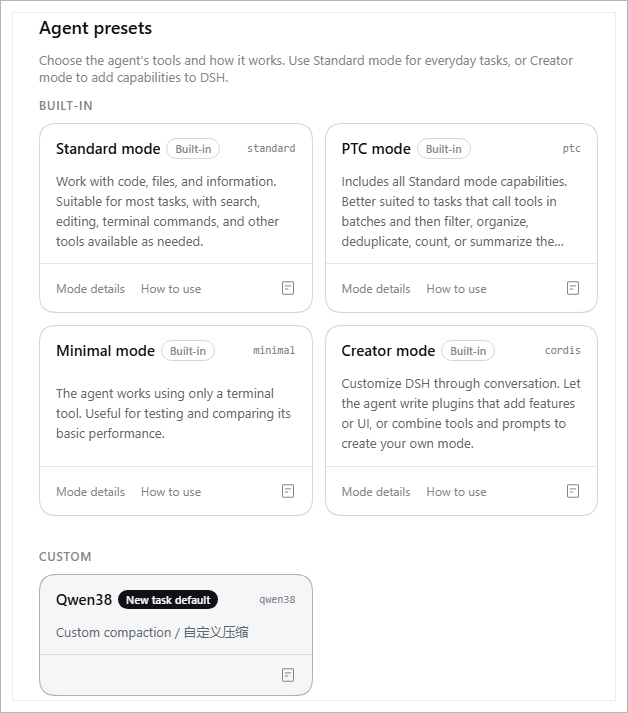
Restart dsh web: the plugin's bundle patch declares the qwen38 agent preset (full roster with the qol compaction backend) and points the profile default at it when no default is configured - nothing is generated on disk at boot. New sessions use it automatically; existing sessions keep the preset they were created with.
You can also pin a specific release: add a tag to the spec (#v0.3.1 or any past release). See Releases for what each tag pins and how to upgrade from it. Pinning a tag is the recommended setup - main is the bleeding edge (unreleased fixes and experiments land there first); move off a tag only when you actually want the newest changes.
DSH compatibility
| DSH host | Plugin | Status |
|---|---|---|
| 0.2.0-rc.2 | #v0.3.1 |
tested (production) |
| 0.1.7-alpha.1 - 0.2.0-rc.1 | #v0.3.1 |
should work - same seam batch, not exercised |
| 0.1.6-alpha.2 and older | #v0.2.0 |
supported line |
main targets the rc.2 seam batch; stay on #v0.2.0 with older hosts.
Upgrading from v0.2.0 (host first, then plugin):
# 1) update the DSH host to 0.2.0-rc.2 or newer (normal host update).
# 2) re-pin the plugin (profile dir; Windows: %USERPROFILE%\.dsh\profiles\web):
cd ~/.dsh/profiles/web
npm pkg set 'dependencies.dsh-qwen38-local-qol=github:Yunado/dsh-qwen38-local-qol#v0.3.1'
pnpm install
rm -rf ~/.dsh/.agent-presets/qwen38    # optional: old boot-generated preset (superseded, inert)
# 3) restart dsh web. Sessions already on qwen38 keep working (same id, new
#    declaration). For new sessions: if a different preset is your default,
#    pick Qwen38 on the Agent presets page. Then open Settings -> Qwen3.8
#    Local and fill the line config once (the old settings.yaml section is
#    not read by the new storage).
What it supports
- Per-request thinking budgets. The llama.cpp line sends the selected per-effort budget on every request (
reasoning_effort+reasoning_budget_tokens, overrides the server's--reasoning-budget); the NInfer engine reads its single thinking budget from the server startup flag (--default-thinking-budget); the settings tab shows that as a note on the NInfer line (no input), whiledefaultThinkingBudgetstays valid as a headless/env config field; the TabbyAPI line accepts both natively; the oMLX line (Apple Silicon MLX) accepts native top-levelthinking_budgetandchat_template_kwargs.enable_thinking, so per-effort budgets ride every request. - A compaction backend. The summarizer's prefill is trimmed (recent reasoning only, images downgraded to text placeholders, tool results capped), and compaction calls run thinking-off at the line's full output cap, so checkpoints stop getting truncated at the token cap. The trigger point is a live slider in the settings tab (default 80% of the window).
- Vision in tool results. Image blocks nested in tool results (for example
read_imageoutput) ride the wire instead of being dropped: a resolved image travels inside a multimodal tool message (a content array with animage_urlentry); an unreadable one degrades to the same text placeholder as the user side, so the model sees that an image was there but its pixels were not. - A settings tab that configures all lines, live.
The settings tab
DSH settings → Qwen3.8 Local:
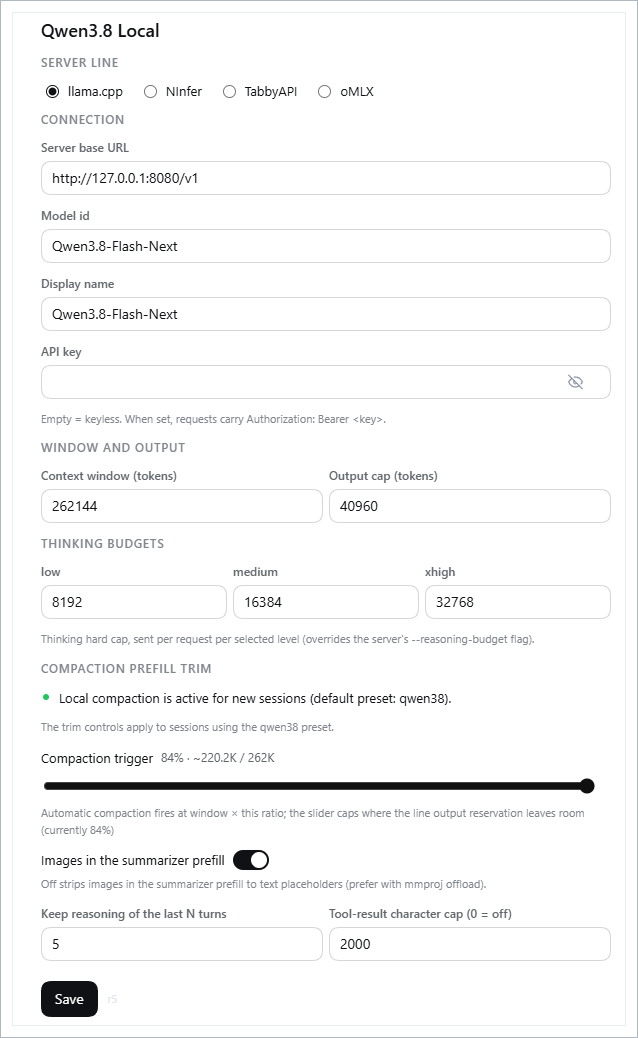
Per-line memory (connection, window numbers, budgets, trim knobs). The status dot is green when qwen38 is the default preset, amber when a different preset is the default, gray when the preset is missing. Changes apply live and persist to the profile's plugin config (Cordis patch; hot volatile commits, no restart).
What can be tuned
The settings tab is the primary entry; headless profiles and patch/env accept the same fields (an id-scoped patch replaces the whole config; env covers what the patch does not set):
| Area | Fields (env vars) | Defaults |
|---|---|---|
| Server | baseURL, model, displayName, apiKey (DSH_QWEN38_BASE_URL / _MODEL / _DISPLAY_NAME / _API_KEY) |
http://localhost:8080/v1 (llama) / 8082 (ninfer) / 8083 (tabbyapi) / 8000 (omlx), model alias, same as model, none |
| Dialect | dialect (DSH_QWEN38_DIALECT) |
llamacpp (options: ninfer, tabbyapi, omlx) |
| Window | contextWindow, maxTokens (DSH_QWEN38_CONTEXT_WINDOW / _MAX_TOKENS) |
131072, 16384 (starter defaults every local server can host; raise them to your server's real context, and keep the tab at or below what the server was started with) |
| Thinking | thinkingBudgets (llamacpp + tabbyapi + omlx, per effort), defaultThinkingBudget (the declared server thinking ceiling; the tab shows it on the ninfer line only — enter the server's --default-thinking-budget value there, the plugin cannot read the startup flag), defaultEffort (DSH_QWEN38_DEFAULT_EFFORT) |
{ low: 2048, medium: 4096, xhigh: 8192 }, 8192, medium |
| Prefill trim | DSH_QWEN38_SUMMARIZE_IMAGES, DSH_QWEN38_SUMMARIZE_KEEP_TURNS, DSH_QWEN38_SUMMARIZE_TOOL_CHARS (env only) |
strip, 5, 2000 |
| Compaction trigger | compactThresholdPct (the tab slider) |
80 (fires at exactly that percent of the window; the slider syncs the output cap to keep the point reachable) |
Settings & Fields Explained
1. Server Connection & Dialect
- Dialect (
dialect): The backend engine running your local model:llamacpp: Standardllama.cppserver (llama-server). Sets thinking budget dynamically per request.omlx: Apple Silicon MLX inference server. Sends per-request thinking budget via nativethinking_budget.tabbyapi: ExLlamaV3 backend. Fast path for EXL3 quants, accepts per-request budgets natively.ninfer: High-performance TensorRT-LLM engine. Thinking budget is configured at server startup.
- Base URL (
baseURL): The address where your local server is listening (must include/v1). Default ports:8080for llama.cpp,8000for oMLX,8082for NInfer,8083for TabbyAPI. - Model (
model): The model identifier or alias recognized by your server (e.g.Qwen3.8-27B-MLX-8bitorqwen3.8-27b). - Display Name (
displayName): Optional label shown in the Harness UI model picker (e.g. "Qwen 3.8 Local"). If blank, the model ID is shown. - API Key (
apiKey): Optional bearer token if your server requires authentication. Leave blank for unauthenticated local servers.
2. Context Window & Token Limits
- Context Window (
contextWindow): Total token capacity the model can handle (prompt + response). Harness uses this to know when a session is filling up and automatically triggers compaction to prevent overflow. - Max Output Tokens (
maxTokens): Maximum number of tokens the model can generate in a single response.
3. Thinking & Reasoning Budgets
- Thinking Budgets (
thinkingBudgets): Token limit for the model's internal reasoning (<think>...</think>) before generating an answer:- Low: Quick reasoning for simpler questions (default: 4,096 tokens).
- Medium: Balanced reasoning for general coding and tasks (default: 8,192 tokens).
- Extra High: Deep step-by-step thinking for complex bugs or architecture (default: 16,384 tokens).
- Default Effort (
defaultEffort): The default thinking level used (off,low,medium, orxhigh). Selectingoffskips thinking entirely for faster, direct answers. - Default Thinking Budget (
defaultThinkingBudget): Fallback token budget for engines that set thinking capacity globally at startup rather than per request (such as NInfer).
4. History Compaction & Trimming
When conversations approach the context window limit, Harness compresses older history into summaries:
- Compaction trigger point (
compactThresholdPct): where automatic compaction fires, at exactly this percent of the context window (slider default 80). The tab slider (50..90 band) is hot, landing on the next session step without a restart. The slider also syncs the output cap in both directions to the largest value that keeps the point reachable under the wall guard (a quarter of the cap): dragging the slider rewrites the cap so every percent is an exact trigger point (the token point shows beside the label). If a point would need the cap below what your thinking budgets require, the cap parks at that floor, a red checker names the cap the point needs, and saving stays refused until you lower a thinking budget by hand. Every thinking budget (low/medium/xhigh and the default) must stay strictly below the output cap; the tab refuses the save otherwise. Current usage lives in the chat page's top meter. - Summarize Images (
summarize.images):strip(recommended): Replaces older images with brief text placeholders to save significant context space.keep: Preserves past images in memory.
- Keep Recent Reasoning (
summarize.keepTurns): How many recent assistant turns retain their full thought logs (<think>). Older turns have their thoughts trimmed because previous reasoning is rarely needed once an action has succeeded. - Cap Tool Output (
summarize.toolChars): Maximum character length kept for bulky command outputs or file reads in compacted history (default: 2,000 characters). Prevents giant terminal logs from flooding the context window.
5. Per-Line Memory
The settings tab keeps independent settings for each dialect (llamacpp, omlx, ninfer, tabbyapi). Switching between server buttons automatically restores each server's specific port, model alias, and context size without re-entering them.
Limitations
- Vision token pricing on TabbyAPI / oMLX is not pinned: token meters report image capacity as unknown on these lines until the backend image-processor formulas are calibrated (the request itself works; only the pre-flight capacity projection is affected).
- Multimodal tool messages are a newer wire form: tool messages carrying resolved images are sent as a content array with
image_urlentries; each line's server must accept that form. A rejecting line answers with an HTTP error whose body the adapter surfaces verbatim (never a silent drop). - Vision budget rejections self-heal: an NInfer 400
media_budget_exceeded("vision raw patches exceed processor budget") classifies asCONTEXT_WINDOW_EXCEEDED, so the harness's overflow recovery compacts history below the normal threshold and retries the step; only repeated budget failures (e.g. one image alone over the per-image cap) surface as an error. - The preset seam is a web-surface feature: headless profiles do not mount
agent-presetsrows; the provider route (thinking budgets) works on both surfaces. - Summarizer internals depend on the engine version: the wire rules (thinking off, full output cap) hold for every engine version; engine internals are outside the plugin's control.
Update
dsh plugin --profile web update dsh-qwen38-local-qol
github: dependencies resolve to an exact commit. If the profile lockfile still pins the commit first installed, edit the spec (a newer #tag, or drop the fragment to track main) and re-run pnpm install in the profile directory. Updates never touch the declared preset or the settings section.
Uninstall
dsh plugin --profile web remove dsh-qwen38-local-qol- Restart
dsh web- the qwen38 preset declaration and its default ride the plugin's bundle patch, so both disappear with it.
Session history, transcripts, model lines and engines are not state the plugin owns.
Develop
pnpm install
pnpm test
pnpm run build:client   # rebuild lib/client.js after touching src/client*
Host half = plain ESM JavaScript with JSDoc; the browser half is built by scripts/build-client.mjs and shipped as the committed lib/client.js. Design details: DESIGN.md.
License
中文
给本地跑 Qwen3.8 的人用的 DeepSeek Harness(DSH)QoL 插件,零核心补丁、零 pi-ai 补丁文件。
- 模型支持:Qwen3.8-27B · Qwen3.8-Flash-Next
- 推理引擎:llama.cpp
llama-server· NInfer · TabbyAPI(ExLlamaV3)· oMLX(Apple Silicon MLX) - 注:llama.cpp 线即标准 OpenAI 兼容
/v1API,任何说这套协议的服务器预期都能走这条线(Strata、Unsloth Desktop、LM Studio)。
安装
dsh plugin --profile web add github:Yunado/dsh-qwen38-local-qol#v0.3.1
推荐钉 release tag(最新 tag 见 Releases);去掉 #tag 即跟随前沿线 main。
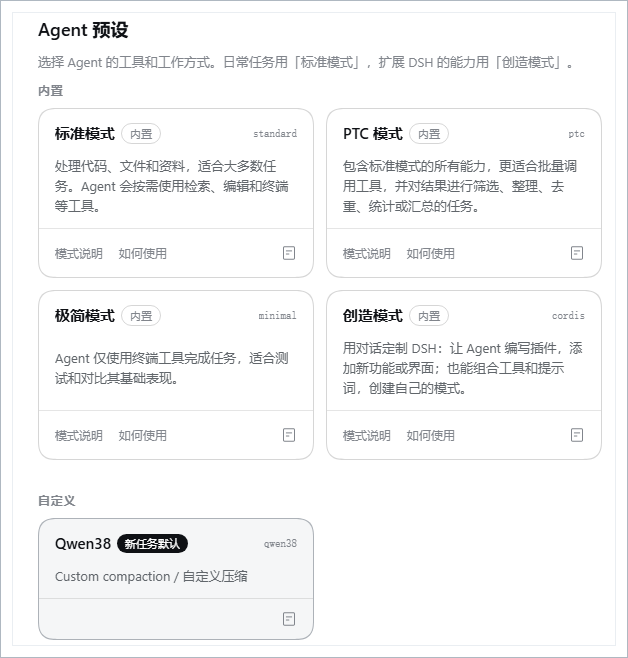
重启 dsh web:插件的 bundle patch 声明了 qwen38 agent preset(完整 roster + qol 压缩后端),未配置默认时把 profile 默认指向它 —— boot 期间不写盘生成任何东西。新会话自动使用;已有会话保留创建时的 preset。
也可以钉住某个具体 release:在 spec 里加 tag(#v0.3.1 或任意历史 tag)。每个 tag 钉住什么、之后怎么升,见 Releases。推荐钉 tag —— main 是前沿线(未发布的修复和实验先进 main),确有需求再离开 tag。
DSH 兼容性
| DSH 宿主 | 插件版本 | 状态 |
|---|---|---|
| 0.2.0-rc.2 | #v0.3.1 |
实测通过(生产) |
| 0.1.7-alpha.1 - 0.2.0-rc.1 | #v0.3.1 |
应可用 - 同一批缝,未实测 |
| 0.1.6-alpha.2 及更早 | #v0.2.0 |
支持线 |
main 已面向 rc.2 缝批次;老宿主请钉 #v0.2.0。
从 v0.2.0 升级(先升宿主,再升插件):
# 1) 先把 DSH 宿主升到 0.2.0-rc.2 或更新(正常宿主更新)。
# 2) 重钉插件(profile 目录;Windows:%USERPROFILE%\.dsh\profiles\web):
cd ~/.dsh/profiles/web
npm pkg set 'dependencies.dsh-qwen38-local-qol=github:Yunado/dsh-qwen38-local-qol#v0.3.1'
pnpm install
rm -rf ~/.dsh/.agent-presets/qwen38    # 可选:旧 boot 生成的 preset(已被取代,惰性)
# 3) 重启 dsh web。已在用 qwen38 的会话无缝继续(同 id、新声明接管)。
#    新会话:若你的默认是别的 preset,去 Agent 预设页把 Qwen38 设为默认。
#    然后打开 设置 -> Qwen3.8 本地,把线的配置填一遍(新的 profile 配置
#    存储不读旧的 settings.yaml 节)。
功能特性
- 逐请求 thinking 预算。 llama.cpp 线每请求发送所选 effort 的预算(
reasoning_effort+reasoning_budget_tokens,覆盖服务端--reasoning-budget);NInfer 引擎的 thinking 预算由服务端启动参数(--default-thinking-budget)决定;设置 tab 在 NInfer 线只显示说明(无输入),defaultThinkingBudget字段保留为 headless/env 配置项;TabbyAPI 线两者都原生接受;oMLX 线(Apple Silicon MLX)原生接受顶层thinking_budget与chat_template_kwargs.enable_thinking,逐请求按档发送。 - 压缩(compaction)后端。 摘要 prefill 先裁剪(只留近 N 轮 reasoning、图片降为文本占位符、工具结果按字数帽截断),且压缩调用强制 thinking off + 该线完整输出帽,checkpoint 不再被 token 帽截断。触发点是设置页的实时滑杆(默认窗口的 80%)。
- 工具结果里的图片不再丢弃。 嵌套在 tool-result 内的 image block(如
read_image的结果)现在会上线:attachment 能解出 data URL 时,图以多模态 tool 消息(content 数组 +image_url条目)发送;读不出来时用与用户侧相同的文本占位符,模型知道"这里有张图但看不见像素"。 - 设置 tab:图形化配置四条服务线,即时生效。
设置 tab
DSH 设置 → Qwen3.8 本地:
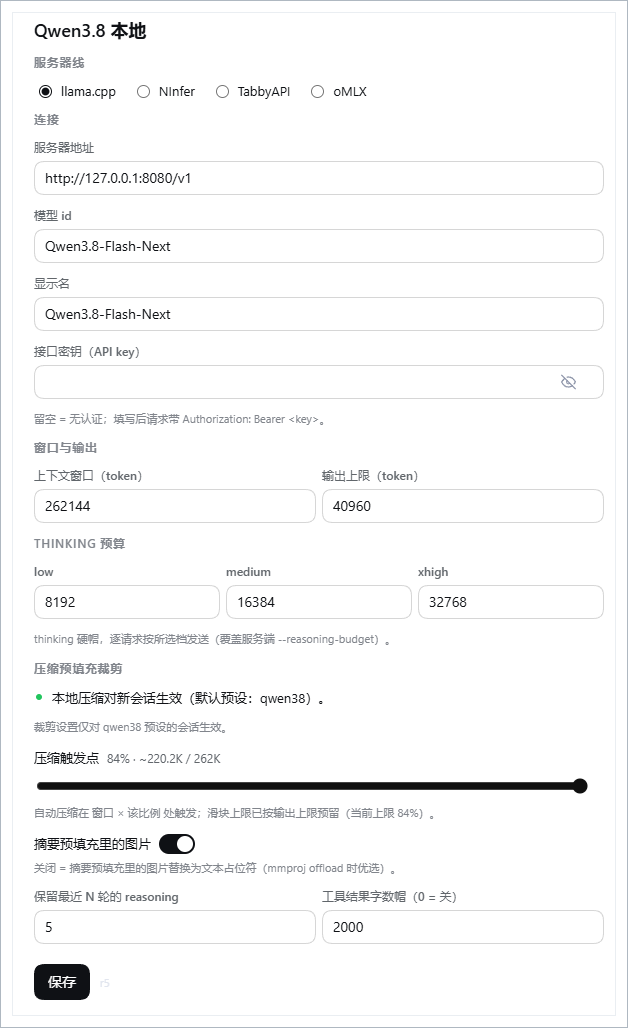
按线记忆(连接、窗口数字、预算、裁剪旋钮)。状态圆点:绿 = qwen38 是默认 preset,黄 = 默认是别的 preset,灰 = preset 缺失。改动即时生效并持久化到 profile 的插件配置(Cordis patch,volatile 热提交,无需重启)。
可调项
设置 tab 是主入口;headless profile 或补丁/环境接受同样字段(按 id 定向的补丁替换整个 config,环境回退只覆盖补丁没写的字段):
| 区域 | 字段(环境变量) | 默认 |
|---|---|---|
| 服务器 | baseURL、model、displayName、apiKey(DSH_QWEN38_BASE_URL / _MODEL / _DISPLAY_NAME / _API_KEY) |
http://localhost:8080/v1(llama)/ 8082(ninfer)/ 8083(tabbyapi)/ 8000(omlx)、模型别名、同 model、无 |
| 方言 | dialect(DSH_QWEN38_DIALECT) |
llamacpp(可选:ninfer、tabbyapi、omlx) |
| 窗口 | contextWindow、maxTokens(DSH_QWEN38_CONTEXT_WINDOW / _MAX_TOKENS) |
131072、16384(新装起步值,任何本地服务都扛得住;请按服务的真实上下文调大,且设置页不得超过服务启动时设定的上限) |
| Thinking | thinkingBudgets(llamacpp + tabbyapi + omlx,按 effort)、defaultThinkingBudget(申报的服务端 thinking 上限;设置页仅在 ninfer 线显示这一格——把服务启动参数 --default-thinking-budget 的值填在这里,插件读不到启动参数)、defaultEffort(DSH_QWEN38_DEFAULT_EFFORT) |
{ low: 2048, medium: 4096, xhigh: 8192 }、8192、medium |
| Prefill 裁剪 | DSH_QWEN38_SUMMARIZE_IMAGES、DSH_QWEN38_SUMMARIZE_KEEP_TURNS、DSH_QWEN38_SUMMARIZE_TOOL_CHARS(仅环境变量) |
strip、5、2000 |
| 压缩触发 | compactThresholdPct(tab 滑杆) |
80(触发点 = 该百分比 × 窗口;滑杆双向联动输出上限,保证该点精确落地) |
设置项与字段说明
1. 服务器连接与方言
- 方言(
dialect):运行模型的本地推理后端类型:llamacpp:标准llama.cpp服务(llama-server),每请求通过reasoning_budget_tokens动态控制思考预算。omlx:Apple Silicon 专用的 MLX 推理服务,每请求通过顶层thinking_budget控制思考预算。tabbyapi:ExLlamaV3 推理服务,EXL3 量化的快线,原生支持每请求思考预算。ninfer:高性能 TensorRT-LLM 引擎,思考预算在服务端启动参数中指定。
- 服务地址(
baseURL):本地后端服务的 HTTP 地址(需包含/v1)。默认端口:llama.cpp 为8080、oMLX 为8000、NInfer 为8082、TabbyAPI 为8083。 - 模型标识(
model):服务端配置的模型名称或别名(如Qwen3.8-27B-MLX-8bit或qwen3.8-27b)。 - 显示名称(
displayName):在 Harness UI 界面模型下拉菜单中显示的友好名称(如 “Qwen 3.8 本地”)。留空时直接显示模型标识。 - API 密钥(
apiKey):若本地服务开启了鉴权,在此填入 API Key。若无需鉴权可留空。
2. 上下文与输出窗口
- 上下文窗口(
contextWindow):模型能容纳的最大总 token 容量(输入 + 输出)。Harness 据此判断会话何时接近上限并自动触发压缩(compaction),防止超窗。 - 最大输出 Token(
maxTokens):单轮回复中模型允许生成的最大 token 数量。
3. Thinking 思考预算
- 思考预算档位(
thinkingBudgets):模型在给出最终答案前在<think>标签内能思考的最大 token 数量:- Low(低):轻度思考,适合简单明确的任务(默认 4,096 tokens)。
- Medium(中):平衡思考,适合日常编码与问答(默认 8,192 tokens)。
- Extra High(超高):深度多步推理,适合复杂架构与疑难调试(默认 16,384 tokens)。
- 默认档位(
defaultEffort):默认启用的思考强度(off、low、medium、xhigh)。选off则完全关闭 thinking 模式,回复更快速直接。 - 默认思考预算(
defaultThinkingBudget):针对不支持逐请求切换档位的引擎(如 NInfer)使用的回退预算值。
4. 历史压缩与裁剪(Compaction)
当会话过长接近上下文上限时,Harness 会将较早的历史压缩成摘要:
- 压缩触发点(
compactThresholdPct):自动压缩恰在窗口的该百分比处触发(滑杆默认 80)。设置页滑杆(50–90 区间)改完即生效、无需重启,落在下一个会话步骤;滑杆同时双向联动输出上限——拖动即重写该帽到"保证该点可落地的最大值"(墙护=帽的 1/4),于是每一格都是精确的真实触发点(标签旁显示对应的 token 点)。若某点所需的帽会低于 thinking 预算所需的容量,帽停在该底线、红字 checker 点出该点需要的帽值,保存被拦,直到手动调低某档预算。每档 thinking 预算(低/中/超高)与默认预算必须严格小于输出上限,否则设置页拒绝保存。当前用量看聊天页顶部的上下文计量。 - 图片处理(
summarize.images):strip(推荐):在旧轮次中移除大图并替换为简短占位文本,大幅节省上下文空间。keep:在历史中保留原图。
- 保留近期思考(
summarize.keepTurns):压缩时保留最近多少轮助手的完整<think>思考过程(默认 5 轮)。更早轮次的思考过程会被裁掉(通常只需最终操作结果,无需保留早期心路历程)。 - 工具输出截断(
summarize.toolChars):历史中单次工具输出(如大段终端日志或文件读取)保留的最大字符数(默认 2000 字),防止巨量日志挤占宝贵的上下文。
5. 按线独立记忆
设置 tab 为每种方言(llamacpp、omlx、ninfer、tabbyapi)保留独立的配置记忆。切换方言单选框会自动恢复该服务线的地址、模型名与窗口大小,无需反复重新填写。
已知限制
- TabbyAPI / oMLX 线的视觉 token 数未钉:这些线上 token meter 报图片容量未知(请求本身正常,只影响预检容量投影)。
- preset 接缝是 web 面功能:headless profile 不挂
agent-presets行;provider 路由(thinking 预算)两面都工作。 - 摘要器内部行为依赖引擎版本:wire 层规则(thinking off、完整输出帽)对所有引擎版本生效;引擎内部行为不在本插件控制之内。
更新
dsh plugin --profile web update dsh-qwen38-local-qol
github: 依赖按精确 commit 解析。若 profile 锁文件仍钉在首次安装时的 commit,改 spec(更新的 #tag,或去掉 fragment 跟随 main)后在 profile 目录重跑 pnpm install。更新不触碰声明的 preset 与设置节。
卸载
dsh plugin --profile web remove dsh-qwen38-local-qol- 重启
dsh web—— qwen38 preset 声明与默认都挂在插件的 bundle patch 上,随插件一起消失。
会话历史、transcript、模型线、引擎都不是插件持有的状态。
开发
pnpm install
pnpm test
pnpm run build:client   # 改完 src/client* 后重建 lib/client.js
宿主半边 = 带 JSDoc 的裸 ESM JavaScript;浏览器半边由 scripts/build-client.mjs 构建并以已提交的 lib/client.js 出货。设计细节:DESIGN.md。
许可
Comments
Comments live in GitHub Discussions. Sign in with GitHub to post or react.