
Install
Inside DeepSeek Harness, with dsh-market
dsh plugin --profile web add dshmarket
Or from the command line
dsh plugin --profile web add freecodego
Installing runs third-party code with your own permissions — it can read your files, use your credentials and reach the network. Review the source first, and pin a commit (github:owner/repo#sha) when you can.
Screenshots
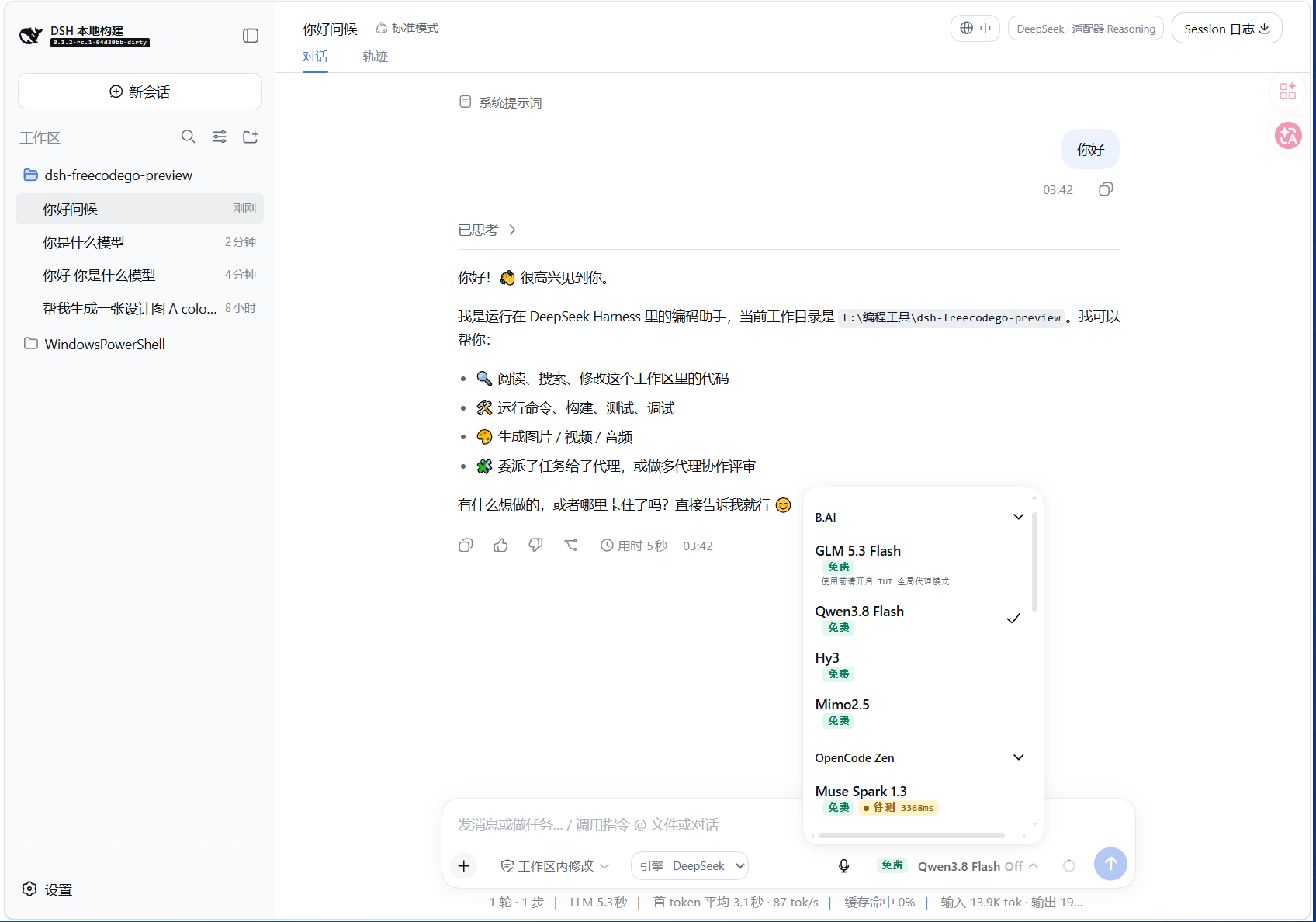
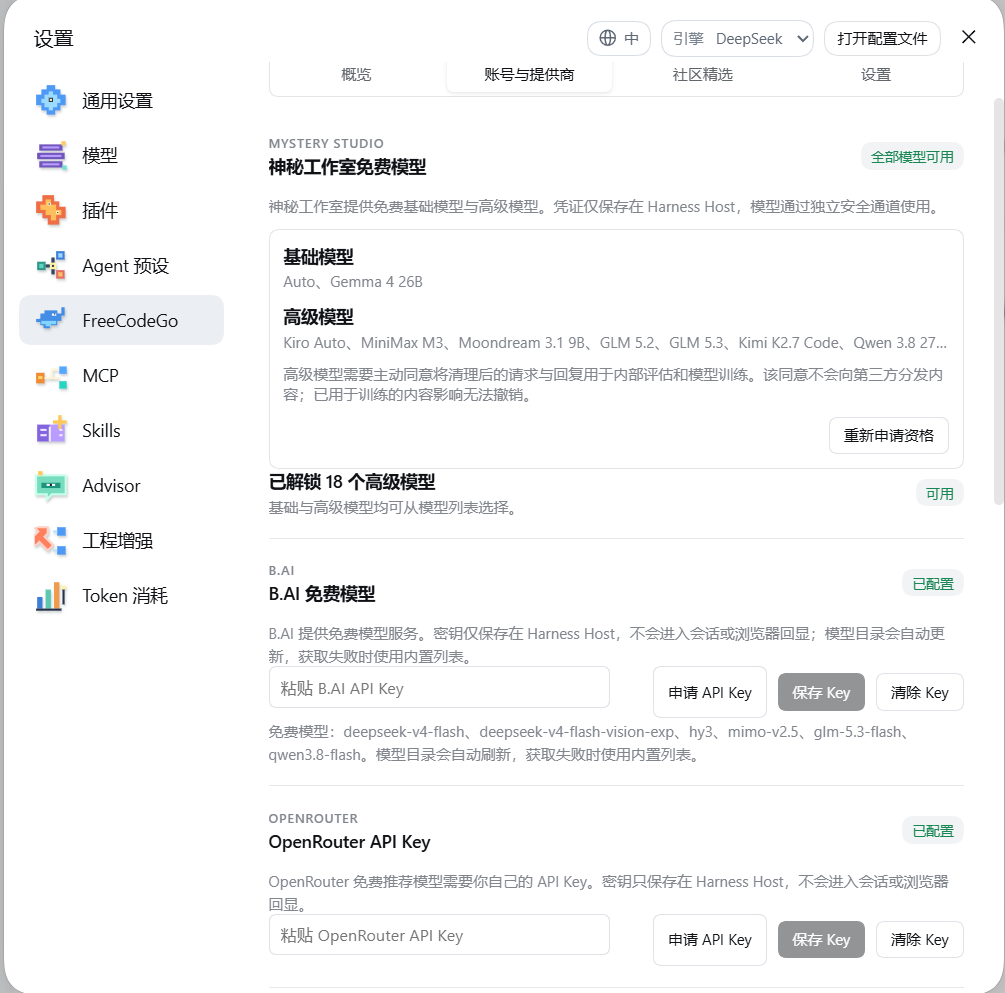
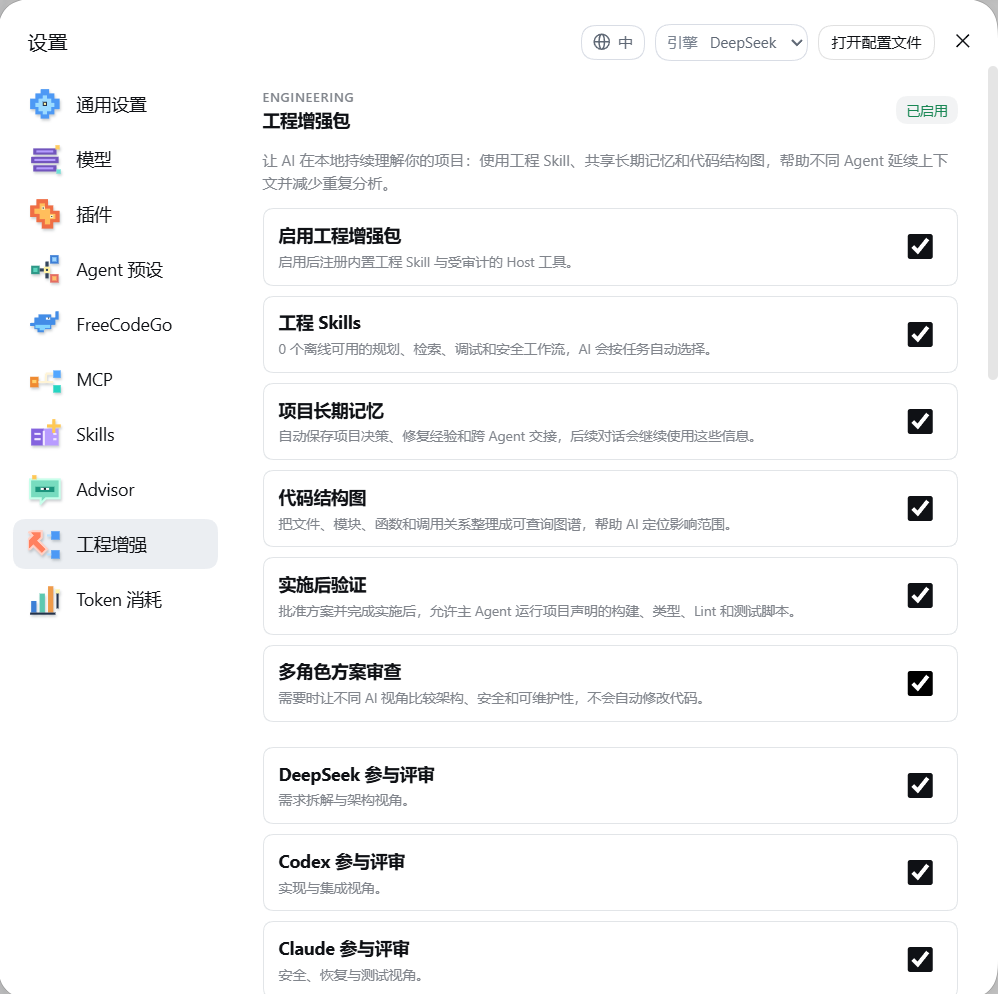
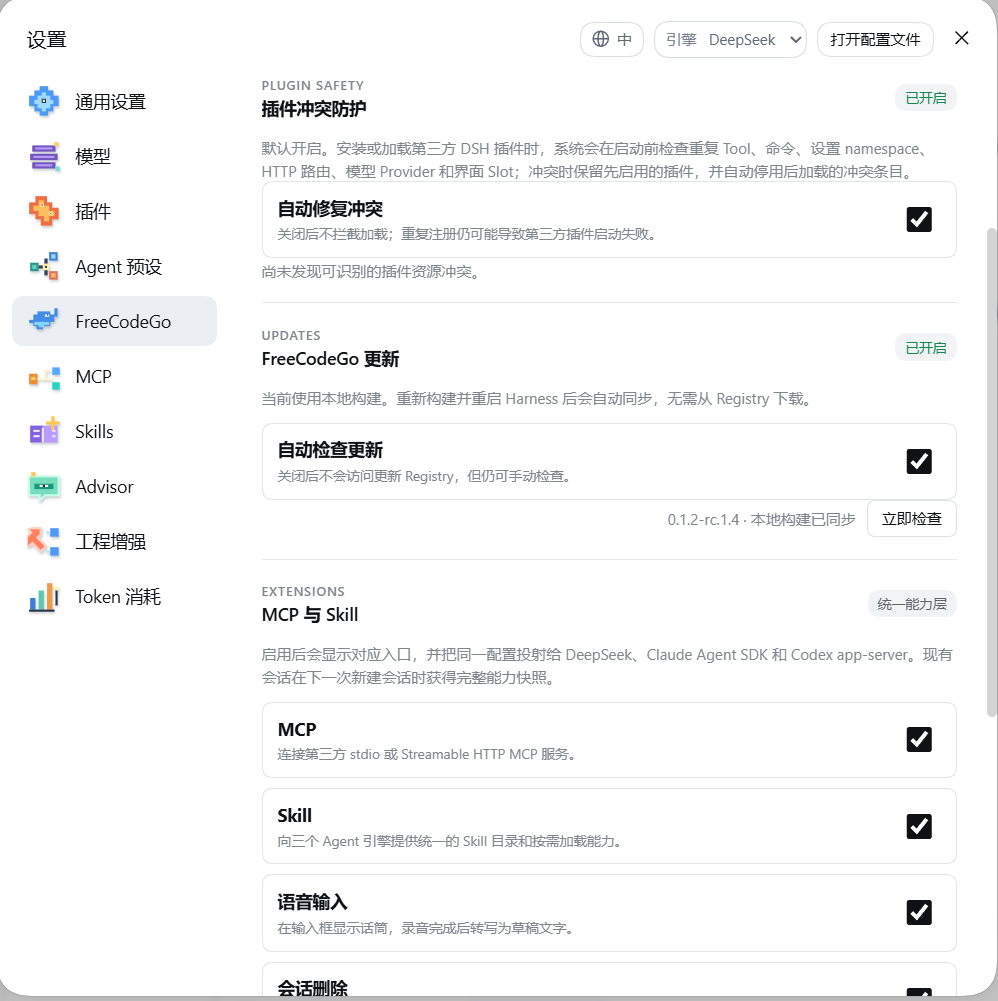
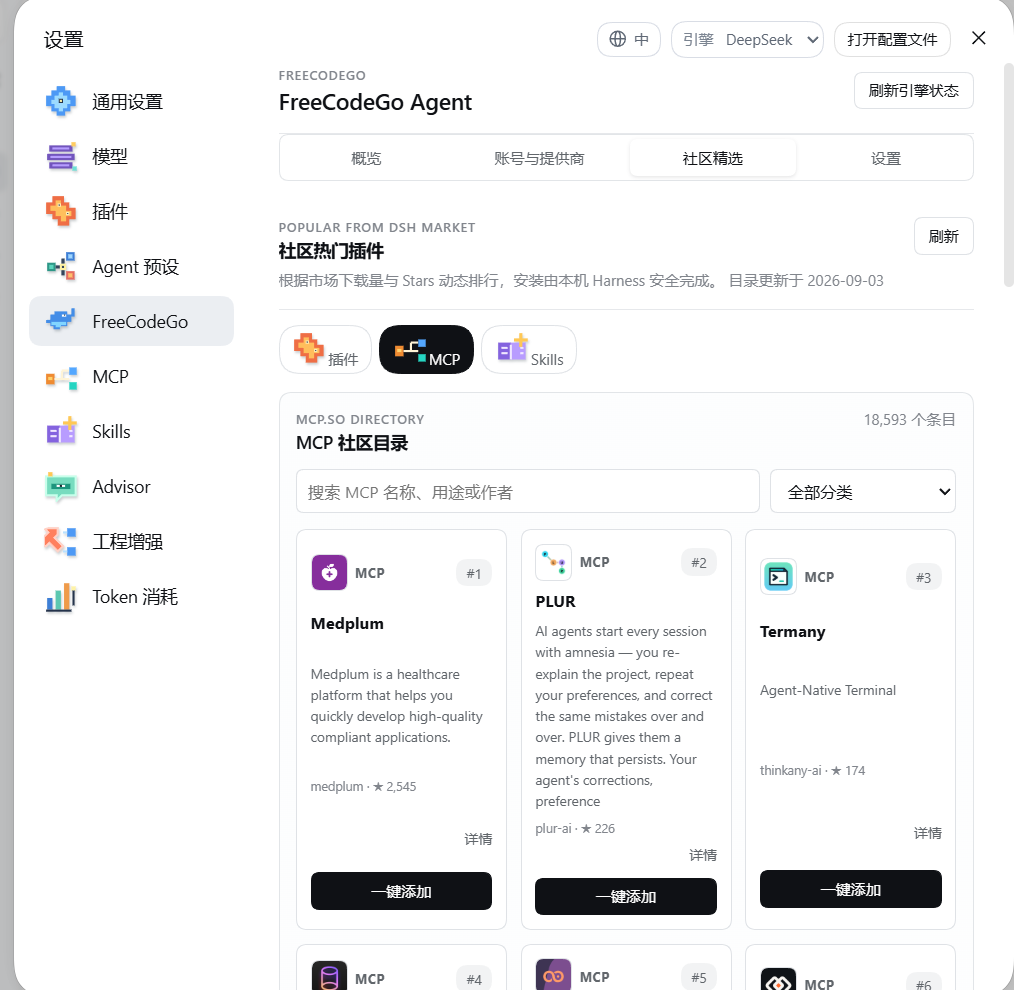
README
description: "The installable single-package FreeCodeGo composition for DeepSeek Harness: install channel, release tagging, and the bundled Agent Teams composition." kind: "package-bundle"
FreeCodeGo Harness Bundle
English | 中文
Summary
Installable single-package FreeCodeGo composition for DeepSeek Harness freecodego@0.2.0-rc.2.1, targeting Harness baseline 0.2.0-rc.2. The npm artifact contains the compiled Host plugin, browser client, session-event prerequisite, native worker entrypoints, and the bundled Harness Agent Teams composition. A release publishes on npm's next dist-tag, and its plugin version intentionally matches the Harness version it targets exactly; for a reproducible install, name the version (freecodego@0.2.0-rc.2.1) instead of the channel. Official Codex and Claude runtime binaries remain optional platform downloads — the package does not embed every platform's native binary.
Table of Contents
- Install
- Free Models
- Private Key Gateway Free Models
- Code Review
- Project Memory
- Agent Teams
- Image and Video Generation
- Model Experience
- Known Limitations and Deferred Work
- Dev Note
Install
Install the release for the Harness baseline you run; each release carries one tarball, named after the baseline it mounts on:
dsh plugin --profile web add --save-exact \
  https://github.com/XiangSu-ce/dsh-plugin-freecodego/releases/download/freecodego-v0.2.0-rc.2.1/freecodego-0.2.0-rc.2.tgz
freecodego-0.2.0-rc.2.tgz is the bundle for Harness 0.2.0-rc.2: substitute the version you run, which the settings page shows beside the installed plugin version. The asset name is the naming contract in packages/freecodego/AGENTS.md.
The dsh command is provided by the Harness CLI, not this bundle. In a normal terminal install it first with npm install --global @deepseek-ai/dsh (and ensure pnpm is available). Desktop launches the same command through its private shims and passes the active DSH_HOME, so Web and Desktop use one Profile data directory when they select the same Harness home.
Maintainers release from a tag. pnpm run release:freecodego <version> bumps the bundle and creates the freecodego-v<version> tag, and the workflow is dispatched from that tag:
pnpm run release:freecodego <version>
gh workflow run release-freecodego.yml --ref freecodego-v<version>
The workflow verifies the family, builds, packs, and creates the GitHub release for that tag. It refuses to publish unless the packed file already carries the asset name an update check looks for, and it re-reads the published release the way the plugin does before the run is allowed to pass. The family publishes only from a freecodego-v* tag that names the version the workspace carries, so a dispatch from a branch fails before the build rather than after it.
Free Models
Every free row below comes from the provider's own directory, read when you open the picker, so this is what those directories returned on 2026-10-01 (sorted, where the picker keeps directory order) — and the picker is the count that is true when you look.
| Provider | Free models | Directory |
|---|---|---|
| Private Key Gateway | the free routes in the picker, read live | no sign-up and no API key |
| OpenCode | big-pickle, deepseek-v4-flash-free, jev-1.13-free, ling-3.0-flash-fin-free, longcat-2.5-preview-free, mimo-v2.5-free, mimo-v2.6-flash-free, muse-spark-1.2, muse-spark-1.2-contributor-free, muse-spark-1.3, muse-spark-1.3-contributor-free, nemotron-3-ultra-free, nemotron-3.5-lightning-free, space-bunny-free |
14 of 84 rows; public, no sign-in |
| Kilo | cohere/north-mini-code:free, dots-studio/dots-3-note-preview:free, inclusionai/ling-3.0-flash-sante:free, kilo-auto/free, liquid/lfm-2.5-2.6b:free, nvidia/nemotron-3-nano-omni-30b-a3b-reasoning:free, nvidia/nemotron-3-super-120b-a12b:free, nvidia/nemotron-3-ultra-550b-a55b:free, nvidia/nemotron-3.5-content-safety:free, nvidia/nemotron-3.5-lightning:free, openrouter/free, poolside/laguna-s-2.1:free, poolside/laguna-xs-2.1:free, qwen/qwen3.8-27b:free, stealth/space-bunny-alpha, stepfun/step-3.7-flash:free, thinkingmachines/inkling-small:free |
17 of 397 rows; public, 200 requests/hour per egress IP |
| Logfare | chat deepseek-v4.1-flash, gemma-4-26b, ling-3.0-flash-vl, logfare/auto, qwen-3.8-27b, space-bunny-alpha; images flux-1-schnell, flux-2-dev, flux-2-klein-4b, flux-2-klein-9b, flux-2-pro, gpt-image-2, sdxl-lightning; audio whisper-large-v3-turbo; other routes aura-2-en, lucid-origin, nano-banana-2, nova-3, phoenix-1.0 |
19 rows; 11 need a training-data opt-in, the other 8 do not |
| Qoder | Qwen 3.8 Flash (route qmodel_38flash) |
the free flash route, plus daily check-in campaigns |
| NVIDIA | google/gemma-4-31b-it, moonshotai/kimi-k3, z-ai/glm-5.3, z-ai/glm-5.3-flash — the roster also names deepseek-ai/deepseek-v4-flash-0731 and deepseek-ai/deepseek-v4-pro-0813, which are gone from NVIDIA's live catalogue of 81 rows |
an API key is required to call them; cross-checked 2026-10-01 |
| SenseNova | deepseek-v4-flash, deepseek-v4-pro, glm-5.2, kimi-k3, sensenova-6.8-flash-lite |
roster ships in the bundle; an API key is required |
| TRAE | the rows its directory lists | free credits reset daily, per account |
| Cline | the rows the directory marks ×0 · 官方免费模型, deepseek-v4.1-flash among them |
an account pool |
| WorkBuddy International | the rows a credit package marks x0, deepseek-v4.1-flash among them while its promotion window is open |
device login, several accounts |
| Agnes | chat and image/video rows | a control-plane account |
| VyceAI | no free roster | the daily check-in credit pays its metered rows |
| Groq | whisper-large-v3-turbo |
transcription, not a chat route |
These lists follow their directories: a route upstream retires leaves the table on the next read, which is why it is generated by scripts/generate-free-model-tables.ts rather than remembered.
TRAE, Cline, WorkBuddy International, Agnes publish no stable roster, so their rows are counted when they arrive rather than listed here.
11 Logfare rows sit behind a training-data opt-in, which the picker labels rather than hides.
deepseek-v4.1-flash is also free here through two of the account pools above: Cline keeps it in its free half, and WorkBuddy International covers it for as long as its promotion runs.
Private Key Gateway Free Models
The private-key gateway gives the user free models with no sign-up and no API key to apply for: its identity is a secp256k1 private key whose EVM address is the peer id and the wallet at once. The Accounts-and-providers page carries one card for it. Downloading fetches the pinned runtime into the Harness home, and the Host then generates an identity into the credential vault — nothing is written to ~/.antseed, the key is generated once and never rotated, and it reaches the browser only through an explicit export click. A session-scoped gateway switch starts the runtime and serves its catalog at http://127.0.0.1:8390/v1, so free text models join the picker under antseed only while the switch is open, and its free image models become selectable as the image model under Overview — generated through the runtime's own /v1/images/generations on the same endpoint — only while it is open. The switch is deliberately not persisted — a restart asks again — and only free routes are wired up: the runtime is started with a zero price ceiling, which its own router enforces by dropping every offer priced above it, so there is no deposit and no payment channel in the integration and a wallet funded later still cannot be charged through it. Because upstream's default trust floor is a hard gate on routing while its model listing ignores it, the runtime also pins its own routing preferences — a zero trust floor, free offers preferred — in a config file under its own root, so nothing the card lists is refused once a request is made; and a port another process already holds is refused rather than reused, since a buyer this plugin did not start is a buyer it cannot hand its identity to. Free means the model is currently offered at no charge, so the roster is a snapshot rather than a platform grant, and the card's refresh re-reads it without moving the switch.
Code Review
The bundle mounts a four-tool change reviewer. engineering_code_review reviews the workspace (staged, unstaged, and untracked changes), a ref range measured from its merge base, or one commit against its first parent, and renders the report as text, json, or sarif; engineering_review_rules returns what would be reviewed and under which rule with no model call at all; engineering_review_status and engineering_review_report show what is running and re-render the last result for another reader. Rules resolve in four layers — a rule file passed for the run, the project's own (.opencodereview/rule.json, .dsh/review.json, or .freecodego/review.json), the user's ~/.opencodereview/rule.json, then the baseline shipped with the plugin — and the first matching layer wins, so a project override replaces the shipped rule rather than merging into it. Coverage is accounted per file: a run cannot finish while a changed file is still unreviewed, and every skip records why it was skipped.
The reviewer spends model calls, so it is opt-in. reviewMode is off, record (findings become durable session events, so a review is answerable later without re-running it), or gate (findings at or above reviewThreshold are injected back into the turn once reviewCooldownTurns has passed, so the Agent has to answer them before it can finish). reviewDeep gives each changed file its own read-only child agent, and reviewEscalation re-checks high-severity findings with an independent adjudicator that is asked to refute them. Reviews run on the plugin's second-model route (advisorProvider / advisorModel), so a fresh install reviews without extra configuration; the settings page's Second-model route panel edits that route, and every feature that shares it — the reviewer here, the memory recall selector, the memory-consolidation planner, and the action reviewer — moves with it.
Project Memory
Durable per-project memory ships with the bundle: recall is reviewed-only, injected recall is fenced and budgeted, and credential screening refuses a labelled credential or redacts a shape-only match on the write path. Consolidation is a staged rollout rather than a switch — memoryRollout is off, record_only, shadow (which runs the whole pass, including the model call, and commits nothing, so an operator can read what the model would have written), or active — and a pass takes a fenced lease plus a frozen snapshot, so a crashed pass is recoverable while a live one is reported instead of retried. MEMORY.md is a bounded index of absolute pointers, and forgetting requires the caller to hand over the bytes it means to remove together with their hash, because "forget what you know about X" must not become a relevance decision that deletes records with no undo.
Agent Teams
The bundle enables Harness Agent Teams with same-engine child sessions. A DeepSeek parent creates DeepSeek teammates, a Codex parent creates Codex teammates, and a Claude parent creates Claude teammates; the child route is inherited from the parent session rather than selected from the process default. Team roster, mailbox, task-board, and teammate Session records remain owned by Harness. The Web Chat renders the live delegated-Agent progress tree inside the parent conversation, including each task label, current tool, status, and tool-use count.
Image and Video Generation
The bundle registers image and video generation tools for DeepSeek, Codex, and Claude, and they read the model each category is configured to use at execution time rather than a pinned one. mediaGenerationEnabled (on by default) is the switch: with it off, freecodego_generate_image, freecodego_generate_video, and the legacy agnes_generate_image / agnes_generate_video names are unregistered — they leave the model's tool list instead of failing at call time — while freecodego_generate_audio and freecodego_transcribe_audio stay, since one writes a file into the active workspace and the other reads one out of it.
The route is chosen from the provider, never from a keyword in a model id. Image generation speaks the OpenAI Images contract (/images/generations, and /images/edits when source images are attached), Seedream's image: [...] fusion body, Gemini's :generateContent, Imagen's :predict, and DashScope's multimodal-generation. Video generation speaks nine: Kling's text2video / image2video / multi-image2video, Ark's /contents/generations/tasks, DashScope's asynchronous video-synthesis, MiniMax Hailuo's /v2/video_generation, Vidu's four ent/v2 routes, Gemini's Veo :predictLongRunning, xAI's /videos/generations (with edits and extensions when a source video is given), OpenAI's /videos, and the gateway's portable shape for everything unrecognized.
The model roster is live, not pinned: candidates are collected per request from the Harness model directory, the managed catalog, Logfare, and Agnes, and a route's category is inferred from its id and can be overridden by hand in the settings page's model categories. Every call carries a per-route circuit breaker, and only a route's own problem falls through to the next one — a wrong credential or a refused prompt fails outright rather than paying for another attempt. The package README in harness-plugin carries the full table, including which providers accept a last frame and which durations each route can render.
Model Experience
Indirectly, through the packages the bundle mounts; each inserted row's package owns its own model-facing behavior.
KV Cache effect
The bundle adds no request text of its own, so the cached prefix is whatever the composed rows produce.
Known Limitations and Deferred Work
- The artifact is assembled, not authored —
prepackrebuilds the Host plugin, browser client, native worker entrypoints, and the Agent Teams composition; nothing in the tarball is edited by hand. - The version matches the Harness baseline exactly — a hotfix keeps the tag precise while the release asset keeps the baseline in its name.
- Official runtime binaries stay optional platform downloads — the package does not embed every platform's native binary.
- Install is pinned by version — a reproducible install names the baseline rather than a channel.
Dev Note
No invariant companion is published because the bundle is static composition metadata with no runtime registry relationship of its own.
The plugin version tracking the Harness version exactly is deliberate: a bundle assembled against one baseline composes the rows of that baseline, so an independent version number would only invite installing a pair that no build ever tested.
Runtime invariant: the bundle declares its composition as data (dsh.bundle.patch); it owns no runtime state.
Comments
Comments live in GitHub Discussions. Sign in with GitHub to post or react.