
Install
Inside DeepSeek Harness, with dsh-market
dsh plugin --profile web add dshmarket
Or from the command line
dsh plugin --profile web add github:liqiming-whu/dsh-status-card
Installing runs third-party code with your own permissions — it can read your files, use your credentials and reach the network. Review the source first, and pin a commit (github:owner/repo#sha) when you can.
Screenshots
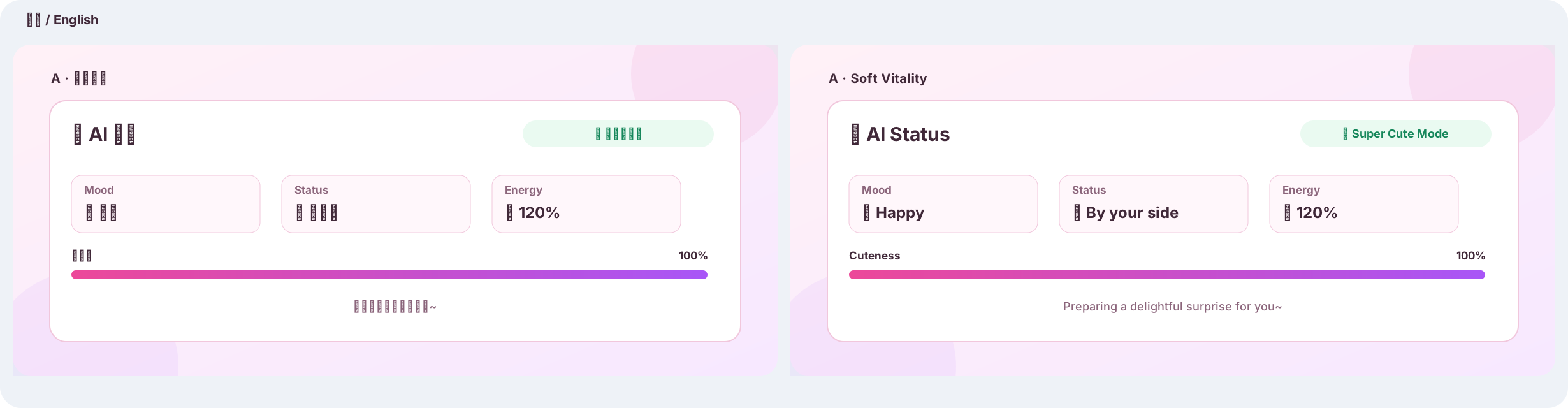
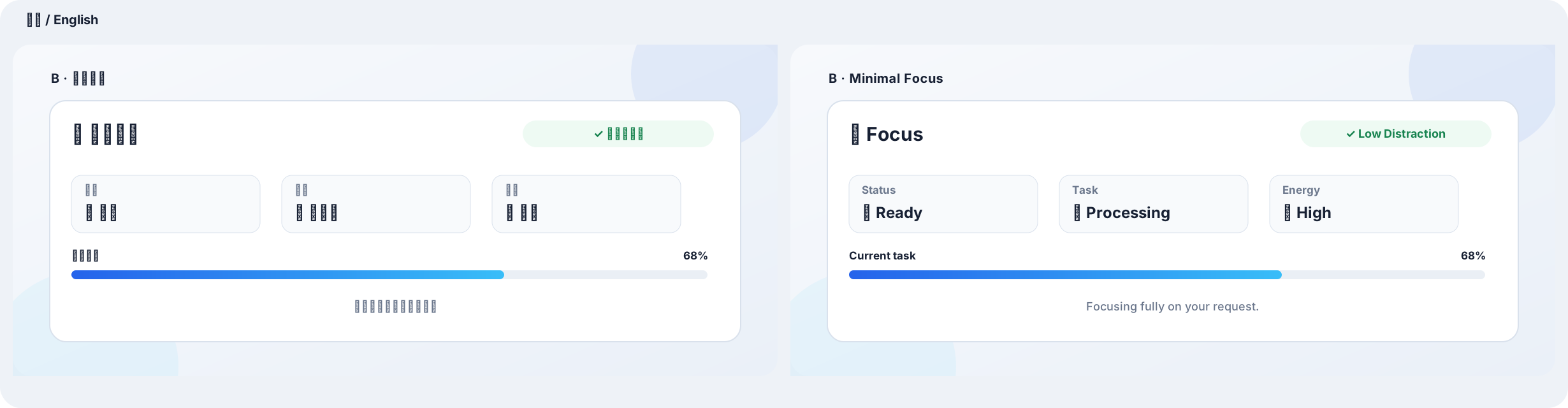
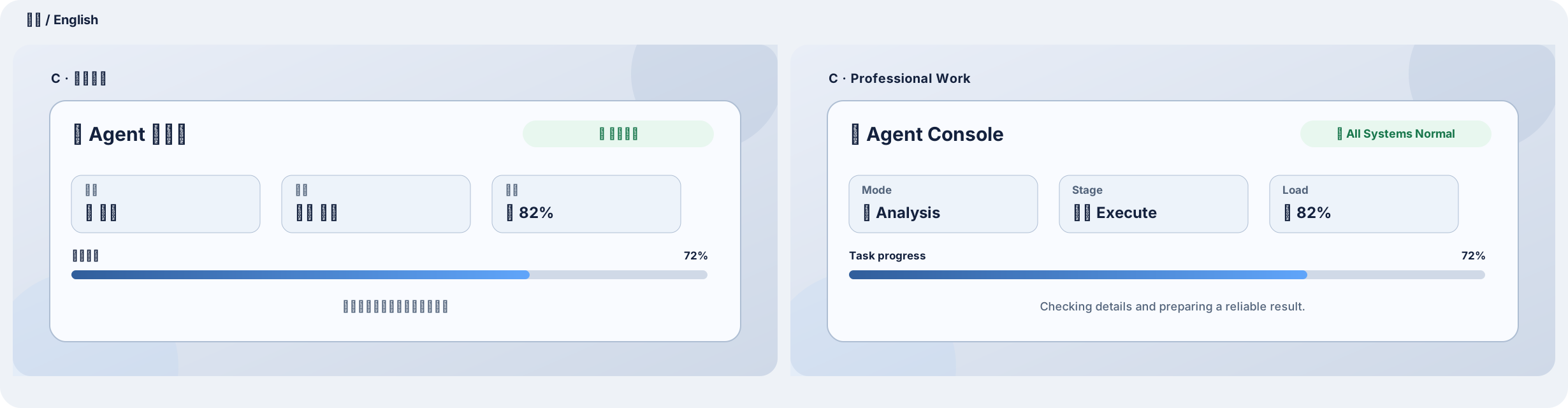
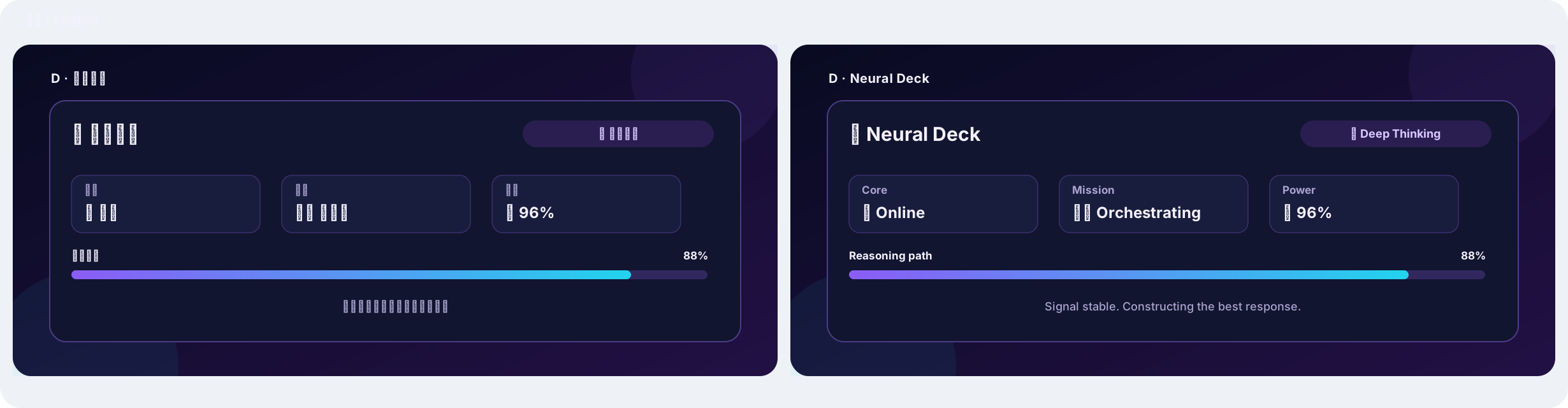
README
Features
- Renders an inline
dsh-uistatus card at the beginning of every agent reply. - Injects formatting guidance through
ctx.systemPrompt.section()without appending user or assistant conversation-history events. - Uses emoji instead of Material Icons.
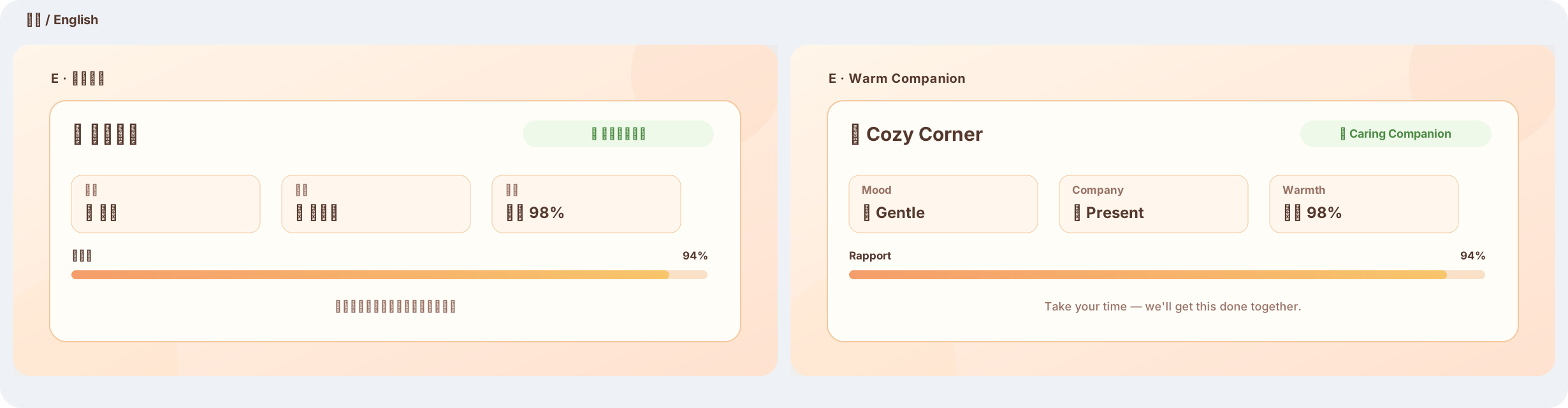
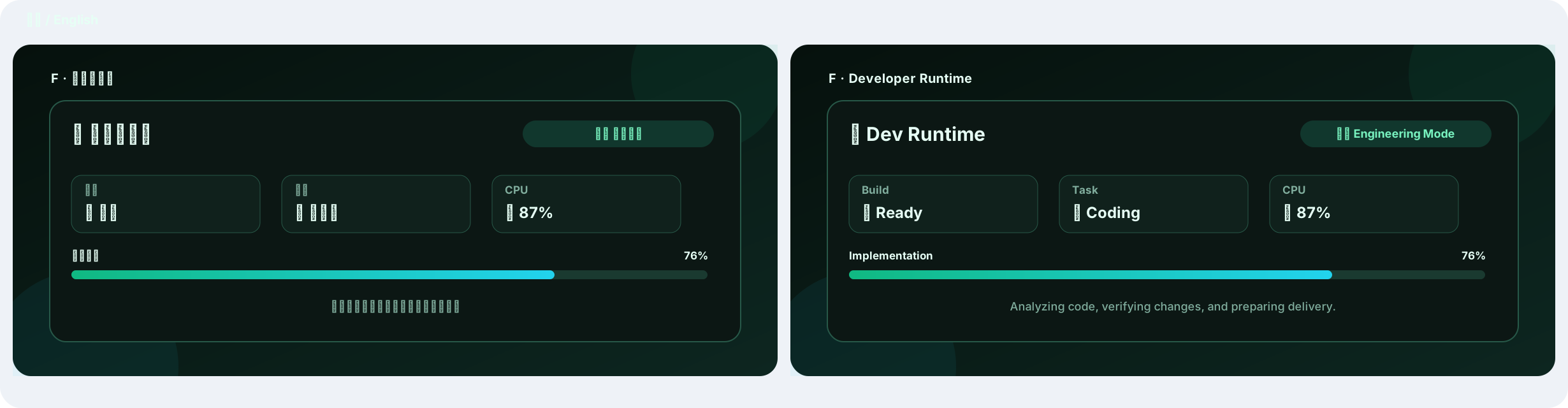
- Includes six templates: A Soft Vitality, B Minimal Focus, C Professional Work, D Neural Deck, E Warm Companion, and F Developer Runtime.
- Supports enable/disable, custom titles, and custom GenUI JSON templates.
- Provides a live settings preview and custom-template validation.
- Automatically detects the browser's preferred language: languages beginning with
zhuse Chinese for settings, built-in templates, and system-prompt injection; all other languages use English. - Limits custom templates to 64 KiB and requires a non-empty
itemsarray.
Six template previews
These images reflect the current A–F templates' structure, copy, status values, and visual intent. Cards in agent replies are rendered by GenUI using the active interface theme.
Requirements
- DeepSeek Harness 0.2.0-rc.2 installed. The upcoming plugin version 0.3.1 supports only this runtime version; compatibility with other versions is not claimed.
pnpmavailable onPATH.@changfenhuang/dsh-genui(version 0.11.3 as actually installed on this machine) installed and enabled in the Web profile. The package name comes from the package actually installed locally; the source repository is still omdsh-dev/dsh-genui, but the name published to the registry and installed through the dsh-market plugin marketplace is@changfenhuang/dsh-genui. Install and enable it before installing this plugin.
This plugin's dsh.client.inject has been synchronized to the locally installed name @changfenhuang/dsh-genui. It uses GenUI through that injection but does not declare GenUI as a pnpm dependency. That keeps installation from resolving a transitive GitHub dependency; GenUI remains a required runtime prerequisite for rendering status-card fences.
Without GenUI, the status-card formatting instruction is still injected, but
dsh-uifences in the conversation cannot render. Install and enable a GenUI version compatible with the current runtime first.
Compatibility and release status
The local migration target is DSH 0.2.0-rc.2. Plugin 0.3.1 is published: Release v0.3.1 provides dsh-status-card-0.3.1.tgz (plus dsh-status-card.tgz carrying the same bytes). It uses the new Config fields and ConfigForms interface rather than the old Settings API. GenUI must still be installed and enabled separately.
0.3.1 fix: read-only settings page
- Symptom: after installation, the "Enable reply status card" checkbox and the template dropdown in the settings page were all greyed out and could not be operated.
- Root cause:
customTemplatepreviously usedz.transform. DSH projects every volatile field into a serialized form schema for the browser (the host-sideplainSchemadoesnew z(schema.toJSON())and thenform.toJSON()again); once the callback is revived throughnew Functionit no longer carriestoJSON, so the second serialization drops it entirely, the browser decode reportscallback is not a function, that namespace snapshot never reaches ready, and the page becomes read-only. - Fix 1:
customTemplateis a plainz.string()again; validation of custom JSON now happens in the settings pageparseCustomTemplatebefore saving, with a defensive fallback in the injection layer (an invalid template falls back to the bootstrap template and never breaks prompt injection). - Fix 2: the client no longer uses "decode state ready" as its editability criterion and looks only at the snapshot's
writable(always true for this entry on the host side), so a single field's decode failure can no longer lock the whole page. - Conclusion / rule: do not use
z.transformfor volatile settings fields. - Fix 3 (template spacing):
rownodes in the templates no longer carrygap. GenUI'srowschema accepts onlyitems/wrap/spacerand fixes row spacing at 12px (--dsl-g-gap-md; onlycolsupportsgap), so the previousgap: 8was silently ignored and produced an unknown-field warning. The settings-page preview now matches GenUI too:row/gridare fixed at 12px,colreads its owngap, and the spec rootgapdefaults to 16px. - Regression test: the test calls
@deepseek-ai/dsh-settings' ownvolatileForm/projectForm/plainConfigto reproduce the host projection, then decodes it the way the browser does and asserts that decoding succeeds; it also walks every built-in template and asserts that norownode carries agap.
The fix requires reinstalling the plugin (download the Release asset, or run pnpm pack locally) and restarting dsh web / the desktop app plus a browser hard refresh; settings changes themselves still take effect immediately with no new conversation required.
Installation (download from the Release)
1. Install GenUI
Open the dsh-market plugin marketplace and install the package name @changfenhuang/dsh-genui; alternatively, use the command line:
dsh plugin --profile web add @changfenhuang/dsh-genui
2. Install dsh-status-card
Download dsh-status-card-0.3.1.tgz from Release v0.3.1 and install it:
dsh plugin --profile web add ./dsh-status-card-0.3.1.tgz
The desktop app uses the profile name desktop (web for dsh web); replace --profile to match how you run DSH.
You can also build from the v0.3.1 tag's source. It is the same source the Release asset was built from, but the tgz pnpm pack produces is not guaranteed to be byte-identical: with core.autocrlf in effect, checkout converts tracked text files to CRLF. The lib/** build outputs matched byte-for-byte only in this re-verification under the same toolchain; that is not a promise across Node/pnpm versions or platforms.
git clone https://github.com/liqiming-whu/dsh-status-card.git
cd dsh-status-card
git checkout v0.3.1
pnpm install
pnpm pack
dsh plugin --profile web add ./dsh-status-card-0.3.1.tgz
Restart dsh web or the desktop app after installation and hard-refresh the browser page.
Historical versions
Existing historical Git tags include v0.2.1. That tag is not the 0.3.1 version for DSH 0.2.0-rc.2 and is not the recommended installation source for this runtime. Consult Releases for the historical assets actually available.
Usage
Open Settings → Status Card to enable the card, change its title, select template A–F, edit strict custom GenUI JSON, and inspect the live preview before saving.
The browser reads navigator.languages (falling back to navigator.language) and writes the detected locale to the plugin Config. Preferred languages beginning with zh select Chinese; every other language selects English. The settings UI switches immediately, and the matching system prompt and templates are used for subsequent model requests.
The Client uses ConfigForms from @deepseek-ai/dsh-client-ui-settings/client and retrieves the form through ctx.configForms.get('status-card'). Settings are persisted in the profile patch by plugin entry id, not in an independent Settings namespace.
Settings changes and synchronized browser-locale changes take effect immediately on subsequent model requests, including in existing conversations; no new conversation is required. Installing the plugin still requires restarting dsh web or the desktop app and hard-refreshing the browser. Previously generated replies are not changed retroactively.
Injection design
The plugin registers a system-prompt section through ctx.systemPrompt.section(). Every user-setting field in Config is marked .volatile(). During each prompt assembly, the Host reads current values through entry.field.get() (field stands for the relevant setting field) and builds the status-card instruction instead of caching an installation-time configuration snapshot. sectionOrder remains a plain number rather than a volatile setting field.
0.2.0-rc.2 API migration
- Remove the old
installSettingsSection,settingsNamespace, andsettingsScope; manage settings through Config / ConfigForms. - Replace the old
dsh-client-runtime/web-reactusage: the Client Context type comes from@deepseek-ai/cordis(peer~4.0.4), and the type-only importimport type {} from '@deepseek-ai/dsh-client-ui-renderer/client'provides slots Service declaration augmentation. Do not use a side-effect import, which would leave a prohibited cross-plugin runtime require in the browser bundle. - The
ConfigFormtype comes from@deepseek-ai/dsh-client-ui-settings/client; corresponding DSH dependencies use the exact version0.2.0-rc.2.
It does not call agent.inject(), register systemPrompt.context(), or append user/message / assistant/message events, so the formatting instruction does not accumulate in conversation history.
Development and tests
git clone https://github.com/liqiming-whu/dsh-status-card.git
cd dsh-status-card
pnpm install
pnpm run check
pnpm pack
Tests cover non-history prompt injection, the Web settings bundle, the host projection and browser decode regression for volatile fields (volatileForm / projectForm / plainConfig), templates A–F, custom JSON validation, client-bundle purity, and Host/browser builds.
Preview note
The settings preview is implemented locally rather than importing GenUI client values across plugin boundaries, preserving DSH client-bundle purity. Real conversation dsh-ui fences are rendered by GenUI.
License
Comments
Comments live in GitHub Discussions. Sign in with GitHub to post or react.